Showing posts with label sustainable living. Show all posts

Saturday, 21 May 2016

Fixing My Own Food Systems

It's only May, but it's feeling like a tough year on the allotment already. We made a great start, and took advantage of the mild winter by getting everything cleared and the soil prepared in good time, so that it was all ready for planting and sowing come March. But March and April were so cold and windy and forbidding – and so busy for us in other ways – that we somehow still got behind with things. Now, we're just about back on track – at least we would be, but the slugs are eating everything in sight, and the warm spell we had in early May means the weeds are the healthiest thing on the plot once again. And I seem to be having trouble germinating any squashes, which is unheard of and really frustrating.

In the garden, however, I can really keep an eye on things, and the fact I'm going to be hosting one of Transition St Albans' Open Food Gardens later in the summer has provided extra motivation to make it great this year. In the garden I can do a quick two minutes' weeding here and there as soon as I see the need, and I can go out at night and pick the slugs off things. The garden brings me pleasure every day; every time I look out the window.


Yet there's one thing that's really bothering me in the garden. My March-sown spinach plants are bolting and I haven't picked a single leaf yet. My gorgeous stand of rare perennial kales has been virtually untouched all spring. My radishes are going woody. I'm somehow far more efficient in the garden than I am in the kitchen, and gorgeous organic homegrown produce actually goes to waste. Can you believe it? I'm ashamed to admit it. And it's strange because I used to have a great, great passion for cooking, and love to spend hours in the kitchen cooking up complex dishes with virtually any ingredients.

Since I quit my nice safe (frustrating, oppressive) full-time job five years ago, I feel like everything about me has changed. I see the world differently now I've learned different things about it. Some old hobbies and passions have been replaced with new ones – others are just... gone. I've struggled to fill my time, and then I've overfilled it. I don't think I have time, anymore, for a passion for cooking.

I had a bit of a revelation watching Rick Stein's Long Weekend in Bologna on TV last night. It painted a picture of a culture which still makes real, handmade food the absolute centre of their lives; where everyone spoke of the wonderful local produce, and all those involved in making food were real craftspeople. TV is always selective in what it depicts, of course, and I do wonder how true a picture it was of the place, but clearly it was different from the food culture that I know. Towards the end of the program, Rick asked food blogger Enrica Lazzarini what she thought was so 'particular' about the cuisine of Bologna. "The love of cooking and the love of food is in our DNA," she said. "We grow up looking at our granny and mother cook from the very beginning of the day, all day long". And I thought yes, that's what it takes. Growing and harvesting and preserving and cooking and feeding and clearing up and storing and composting... It's an endless cycle. It's not the first time I've thought this, but it was certainly a timely reminder. You've got to be dedicated. You've got to give time. "It's your identity," she finished. "Without food, who are you? No-one."

You probably already know that I believe fixing our food systems could fix or improve a great many of the world's problems, and that food is and must be a central focus of our lives. Yes, our identity. 

So is it a worthwhile compromise that for man to occupy himself with more advanced things he must sacrifice his health and the world's by forgetting where his food comes from? Do any of the 'more advanced things' really matter anyway? Advancement is eating the world. Industrialism consumes itself. Automation removes the need for people. Innovation consumes the innovation of the generation earlier. 'Advanced' modern factory farms are poisoning us and 'advanced' modern crops need more chemical application than ever. What is the great goal? Wealth, of course, but for what? Convenience? Luxury? The freedom to sit back and get fat and sick? The freedom to enjoy leisure activities in diminishing open spaces and polluted air? The freedom to produce art about how dreadful everything is?

I'm not about to quit everything and become a full-time home-farmer and housewife – I couldn't possibly – but in the quest to fix my own food systems I need to make time for cooking again and try to get that passion back.

There are people that think I should be doing something 'better' with my time and energy; something more 'intelligent' or 'noble' or 'advanced' or even 'useful'. To me there's nothing more noble, useful or intelligent than feeding those around me real food that is produced in harmony with the natural world; I'm already growing food for us and for the community but I just need to get that spark back in the kitchen. And 'advanced' can go screw itself.

Saturday, 21 March 2015

More Geeky Soil Stuff: My Soil Analysis Results!

As I've mentioned before, I resolved to get a proper lab analysis done of my soil this year, to identify any deficiencies and attempt to bring it to - or close to - the ideal mineral balance described in Steve Solomon's book The Intelligent Gardener: Growing Nutrient-Dense Food.

I took not just one but four soil samples. The allotment is perhaps the most important, but I also wanted to test the raised bed soil which gave poor growth last year and the soil of my garden veg bed, which did very well last year but which I suspected of a boron deficiency due to some hollow courgettes. Finally, I thought I might as well send off a sample of FoodSmiles soil as well, mostly out of curiosity.


To take a sample, you're supposed to cut regular-sized-and-shaped slices of soil, six inches deep and an inch or so across each way, from several points on the plot, to get a mix representative of the whole area. Professional soil-testers have a tube-shaped device they use to get a perfect even core of soil each time. I was just working with a spade and trowel... but I think I did good enough for a first-timer! For each sample, I put all the soil 'slices' in a bucket or bowl and let them air-dry near a radiator for a few days, then broke up any big lumps, picked out stones and twigs, mixed it all up really well and bagged up two cups of the soil for sending off.

Sending it off was a faff as well! I could only find one lab in the UK that would do the soil test described in Solomon's book - what's called a Mehlich 3 extraction along with pH, organic matter, total cation exchange capacity and base saturation - and it cost three times more than what it costs in Solomon's recommended lab in the US... So I sent my samples off to the US! I felt a bit guilty about the air miles, but I couldn't have afforded to do it any other way. Samples had to be labelled and double bagged, sealed very securely in a strong envelope with all the seams taped up, and an import permit and special label attached to the outside of the package to declare what was inside and show that I was allowed to send foreign soil to this address!


It must have made it through, because two weeks later, my results came by email, and you can see the full report here if you like. But most of the numbers are fairly meaningless until you take a deeper look; everything swings on the TCEC, which indicates the amount of nutrition a soil can hold, so XX lbs per acre of a nutrient might be way too much for a soil with a low TCEC, but not nearly enough for a soil with a high TCEC. Solomon provides worksheets to help crunch the numbers and figure out exactly what your soil has and what it needs.

A Note on Organics...

The soil amendment 'prescriptions' mentioned here, involving measured amounts of all sorts of mineral compounds, might seem to go against the grain for someone who is concerned with gardening organically and sustainably, and have certainly given me cause to think a bit about 'organic' versus 'chemical' fertilisers. But there are plenty of mineral soil amendments approved for organic use where a need is identified, and just because it's not organic compost or manure, doesn't mean a substance is necessarily harmful in any way. Adding pure mineral supplements carefully chosen according to measured needs is a very far cry from routinely applying synthetic, high-nitrate, petroleum-based mixes (many of which contain heavy metals) at maximum application rates, as is much too often done in modern agriculture; these kinds of chemical fertilisers feed the plants but diminish soil fertility. In his book Solomon spends quite a lot of time discussing the sustainability and impacts of different amendments, and before buying I will check out each one and decide individually whether I want to use it - but even though Solomon's method isn't 100% 'organic' all the time, these amendments are all designed to help the soil and its microlife, which is of key importance in this soil health business!

Allotment

The allotment soil has a pH of 7.1 - just above neutral which is what most veg-growers will aim for, with a range of 6.0-7.5 commonly recommended. 6.5 might be nearer to ideal, but since different veggies like slightly different conditions it's certainly good enough.

It contains 7.6% organic matter, which will supply more than enough of nitrogen through the growing season as it is digested by soil organisms. 7% is plenty - 4% is about the minimum it needs and 10% is more than a soil can efficiently use. More good news! I'm actually surprised it's this high, since I've never been good at adding organic stuff to the soil. I compost allotment waste and return it to the soil as and when it's ready, but only once in eight years have I bought in manure and compost to spread, and I know some gardeners do it religiously every year.

The TCEC is 13.1, which indicates a good level of nutrient-holding clay and humus in our soil. TCECs in very rich clay soils might be as high as 40 or more, but for the purposes of the analysis it only matters whether our TCEC is below or above 10, and above is a good result.

The main purpose of this exercise is to make sure the major cations - calcium, magnesium, potassium and sodium - are in balance, and a good supply of sulphur, phosphorus and trace nutrients are available. 68% of the TCEC should be calcium, 12% should be magnesium, 3 or 4% percent potassium and 1 or 2% sodium. The allotment soil has an excess of calcium and potassium and a deficiency of magnesium and sodium - a balance of 81%, 10%, 4.5% and 0.3%, so I'll take some action to adjust this balance. It also has very significant sulphur deficiency. Phosphorus is very slightly low but not enough to worry about.

Trace minerals measured are boron, iron, manganese, copper and zinc. In the allotment soil, iron, copper and zinc are plentiful (with more than twice the iron needed and more than four times the zinc!) but boron and manganese are very low, so I'll aim to add more of these.

The prescription to amend this soil is to add, per 100 square feet, 225g manganese sulphate, 120g sea salt, 110g agricultural sulphur, 60g magnesium oxide and 20g borax.

Garden soil

It was extremely difficult to get an accurately representative sample of the garden veg bed as it comprises two very different layers: a few inches of old bagged compost and used growbags on top, and a hard clay just underneath at a depth that varies across the bed... So my confidence in the accuracy of these results is lacking slightly, but I was interested to see them anyway.

The pH is 6.8 - very slightly acid and pretty perfect for growing vegetables. The organic matter was very high - 38% - but perhaps not surprising given the thick layer of old compost. The TCEC is high too at 17.9, probably thanks to the heavy clay.

The cation balance is heavily weighted to calcium and magnesium, with potassium slightly low and sodium very low. Funny how we're told salt is terrible for soil - actually a small amount is very important, but it looks like most of our soils don't even have that much. Sulphur and phosphorus are both significantly low, as are boron, manganese, copper and zinc. The boron deficiency I suspected is shown, but actually it's only very slightly lower than any of the other soils I had tested.

The prescription for this soil is 760g monoammonium phosphate, 414g sea salt, 212g manganese sulphate, 110g sulphur, 40g zinc sulphate, 28g copper sulphate and 20g borax per 100 square feet. I think I might take a cautious approach to making the amendments, considering I'm not confident in the consistency of my soil sample, and just aim to fix the worst of it this time round.

Raised Beds

Now this one was interesting. As I described at length a few posts ago, this soil, bought in to fill my new raised beds about this time last year, gave extremely poor growth last season. I suspected an overabundance of potassium and perhaps a low pH, and added calcium and nitrogen to try to counter those things and help plant growth but it didn't really help.

In fact, this is a calcareous soil with an overabundance of free lime and a high pH which makes trace nutrients unavailable to plants. If I pour vinegar onto the soil, it actually fizzes! This means the test I ordered isn't accurate, as a Mehlich 3 extraction can't test accurately where high lime is present - I should have done the vinegar test first and ordered a different soil test... Doh!

The soil shows a pH of 7.7 but this is likely to be artificially low. There does indeed appear to be a high level of potassium, but the level of lime and high pH is clearly the bigger problem and, save ordering a new soil test and a whole load more mucking about, I think the easiest way forward is to address that first by applying sulphur, which is turned into sulphuric acid by soil bacteria and neutralises the surplus calcium carbonate, turning it into highly soluble gypsum which will then easily leach from the soil. This takes time; a year or more. So in the meantime it will be important to only grow what is happy in these beds; so far garlic, brassicas, lettuces, carrots and beets; and to feed plants with a foliar spray to ensure they get the trace elements they need.

I have real trouble understanding how a soil mix that was obviously so high in manure and woody waste can be so very high in lime, but I guess it looks like my lime application last year may have only made things worse - doh again!

FoodSmiles

The FoodSmiles soil has a pH of 7.3 - right at the high end of a good range - a TCEC of 15.2, and 7.6% organic matter. Its cation balance is not too far from the target, with small excesses of calcium, magnesium and potassium but a deficiency of sodium. Phosphorus and sulphur are both very low. Like the allotment, it has very high levels of iron and zinc, but it is low in boron, copper and manganese.

Amending this soil with mineral applications would be a whole different ball game, since it is Soil Association certified land and we'd have to show a clear need for every amendment and have it approved in advance - and we've got more than enough to do at the moment anyway! But it hasn't had a lot of organic matter added in recent years and I expect applying manure would bring a beneficial pH change. IF I was going to tackle anything else, the priority would be to amend the sulphur and phosphorus levels, but at the moment the soil is growing crops very well indeed.

Some Thoughts

As I write this, I'm wondering about those high levels of iron and zinc... Solomon warns that tiny flakes of rust or galvanizing from the tool used to take the samples can inflate these levels. I didn't have a steel tool I could do it with but I did clean my trowel thoroughly and make sure nothing looked like it was going to come off it... If I do this again in future I'll be sure to be prepared and use stainless steel instead just in case!

All the soils tested require, according to this method, a significant application of sea salt, which feels a bit wrong but I'm doing my best to trust the method and go with it!

I have high hopes that if I correct the sulphur level on the allotment, I might be able to grow onions and garlic there again; sulphur protects against fungus so perhaps the lack of it allows the white rot to thrive.

My next task, then, is to read up on and source the various minerals needed to amend the allotment soil and garden bed, and sulphur for the raised beds. It's quite a bit of work, all in all, but it's absolutely fascinating and I'm really looking forward to seeing the results!

Saturday, 14 February 2015

Seed Sowing!

At last! The day is here! I've been itching to get starting with this season's seeds since, ooooh, about the second of January, but there's really not much point starting that early and seedlings grown when days are short can end up leggy and weak. Instead, I've taken on board a tip from veg-growing guru Charles Dowding, who advises waiting until there are ten hours of daylight each day before sowing seeds. This happens in mid February, and I've certainly noticed the evenings lengthening these last two weeks so hopefully it will make all the difference.

I like a good clear rule like this - it means no umming and aahing about whether or not it's the right time, no 'well I'll do a few now and a few later and see if there's any difference', no worrying.


Setting myself a clear day to get started - and making it a bit later than perhaps I'd like - has also meant I was far more organised than usual beforehand. I'd cleaned and tested the electric propagator in advance. I'd sorted out all my pots, and I've got a big bag of surplus ready to give away. I'd even written out my plant labels - I usually put the seeds in first then find myself writing labels with grubby fingers while trying to remember which pot's which - not clever!

I've also written up a sowing and planting plan for the whole year, which I'll use to keep records of the dates I actually sow as well. I can see at-a-glance what needs to be sown and where each month, so there'll be no forgetting things or puzzling over when to sow things for winter. I'm sure it'll get tweaked a bit along the way, but you can see it here if you like.

I sow all my seeds in peat-free compost - usually New Horizon organic peat-free. Peat-free seems to have a bad rap in the press - they'll tell you it's not suitable for seed-sowing, or that you have to sieve it and add vermiculite and water more, as if it's somehow more complex or more dangerous - but I've never, ever had any trouble with it; it's really very good stuff. And digging up peat is destructive, unsustainable, and totally unnecessary.


So here they all are. Tucked up in the electric propagator are three sweet peppers (Marconi Rossa, Lipstick and Kaibi Round), three chillies (Ancho Grande, Jalapeno and Big Jim Numex), and one aubergine (Bonica F1). They all need a bit of extra warmth to germinate well, so the electric propagator is really helpful, and I hope to be able to pot them up just in time to sow my tomatoes in the same propagator sometime around mid-March. On the windowsill are cape gooseberries, two pots of leeks (Autumn Giant Porvite and Lyon 2 Prizetaker) and some celeriac (Monarch). I've sown these things first as they are all slow-growing crops that need an early start in order to crop in good time, or to reach a good size.


Hooray! Getting these seeds started is a really good feeling and makes the spring feel that much closer. There's nothing else quite like the promise of big beautiful plants and tasty harvests just from putting a seed in the soil.

Monday, 9 February 2015

The Food Shortage is a Lie

It's easy to be confused by the current opposing issues of world hunger and food waste. We seem to hear them everywhere now: Hundreds of millions of people are going hungry! We need to grow more food for our fast-growing population! 30-50% of food produced is not eaten! Huh?!

But this article - How the Great Food War Will Be Won - clears things up thoroughly, and I'd like to urge everyone to read it.

The fact is, we produce an overabundance of food; the stats show it and the World Bank Institute admits we produce enough, globally, for 14 billion people. This isn't exactly new news; I've argued before that we could already produce more than enough food for the global population. But yet industrial agriculture and its supporters - from the UK's National Farmers Union to CropLife International to, of course, Syngenta, Bayer and Monsanto - want us to believe we do not - perhaps cannot - produce enough. The article points out;
The strategic centrepiece of Monsanto’s PR, and also that of just about every major commercial participant in the industrialised food system, is to focus on the promotion of one single overarching idea. The big idea that industrial producers in the food system want you to believe is that only they can produce enough for the future population.
It's a lie. An industry lie, to promote industrial agriculture over small-scale agroecological growing. An industry lie to make money, at great cost to the earth.
...in every single case where industrial agriculture is implemented it leaves landscapes progressively emptier of life. Eventually, the soil turns either into mud that washes into the rivers or into dust that blows away on the wind. Industrial agriculture has no long term future; it is ecological suicide. 
The article goes on to describe how the ecological food movement needs a new strategy; one that involves dismantling this lie and changing perception. Do give it a read:
How the Great Food War Will Be Won

Friday, 6 February 2015

An Exception

I've always tried to avoid growing F1 hybrids - well, mostly. If I'm sent free seeds with an order or magazine it seems rather churlish to reject them, and a few others have slipped through the net over the years for one reason or another. It's not that there's anything 'wrong' with hybrids, but you have to support the things that you want to thrive. It's a bit like buying British or local. I want to see biodiversity and food security thriving, and hybrids undermine these by drastically reducing demand for traditional open-pollinated varieties, and because they're not genetically stable and can't reproduce to create another generation the same. I also like to think I can save the seeds of all my crops, although my seed-saving operation has a long way to go yet... And F1 seeds can be pretty expensive too!

But this year I'm making one deliberate exception, and it's this:


Aubergines are a luxury vegetable for us - something that we could easily do without, but something I'd love to eat more. I rarely buy them, simply because I'm buying less and less veg anyway - my priority is to eat what I grow and I'm far too busy eating all the courgettes and French beans and tomatoes and peppers and leafy greens coming out of the garden when they're in season. So the only way I'm gonna get to eat them is if I grow them myself!

But aubergines, lets face it, are just not really suited to the British climate - they need lots and lots of warmth and sunshine - yet I know many gardeners have moderate success with them, especially under cover. Not me; I've managed to grow just two small aubergines in five or six years of trying, and one of them went bad on the plant. There are only really two open-pollinated varieties of aubergines widely available (not counting fancy-coloured ones or mini ones, which I'm less interested in for now) and I've tried them both, without success. So when I read a recommendation for this variety, Bonica F1, on Nicky Kyle's great blog I thought well, why not have one last bash? Better to grow an F1 hybrid than not to grow them at all! Hybridisation brings the best traits together from other varieties to create new varieties that are (generally) more productive or earlier, more consistent and more reliable - the easier (though pricier) choice for any gardener, and in theory they will crop more readily where traditional varieties have failed. The plastic greenhouse we're putting on the allotment this year means we'll be able to provide them with a bit more protection than at home, too, so I'm crossing my fingers and looking forward to a bountiful aubergine harvest for once!

Thursday, 1 January 2015

Starting Afresh

I'm not usually one to make new year resolutions, but here's one for 2015: to get back to posting regularly on this blog - even if it's just a quick update, a picture or two, or what-I-did-on-the-plot-today for the record. And as everything out there freezes over and readies itself to start afresh, I plan to start afresh too, assuming you know nothing about my plot, and not worrying about repeating myself. Last year's posts were mostly theory and rants anyway - it's been a long time since I actually wrote about the day-to-day stuff of growing my own.

So this is me. I'm Naomi, and my wonderful husband is Eddie. We've had our allotment in St Albans since 2007, and it's had its ups and downs and we've learned an awful lot along the way. We very nearly gave it up once - what a lot has changed since then! We also grow veg in our garden, which is really my parents' garden. I passionately believe that we must all grow more food at home and in our communities, for the good of our health and the planet. (To this end I also help run a Community Supported Agriculture initiative where I live.) We grow sustainably, which for us means organically, often guided by permaculture principles, and supporting wildlife, soil health and biodiversity. We don't dig unless it's absolutely necessary. We don't grow F1 hybrids, which harm diversity and self-reliance. I love the great outdoors, I love food and I love to cook. I plan big and I dream big. I tweet a lot. I long for a smallholding of our own someday, with chickens and pigs and beehives and perhaps a little market garden business. I don't have a regular job at the moment; I have three casual ones and a few that don't pay - and I like to think of growing food a lot like growing money anyway, though it's a real shame you can't buy a house with it...

So happy new year and here's to a great growing - and blogging - season in 2015! Thanks for reading, and I hope you'll drop by again along the way.


Friday, 27 June 2014

Score One for Permaculture

When you think of organic growing, there are a lot of things that might come to mind. You might think of nasty organic pesticides such as pyrethrum or diatomaceous earth; you might think of arduous slug-patrols and endless couchgrass; you might think of sterile white insect-proof mesh covering up beautiful rows of crops. But the best method for growing organically, in my opinion (though slug patrols and insect-proof mesh certainly have their places!), is to work in harmony with nature as much as possible - the permaculture way; sustainable and low-maintenance - and we've seen a great example of this on our plot over the last month.

One important factor when it comes to growing in harmony with nature is simply to give plants the right conditions to promote great health, and that means sowing at the optimum time so that plants don't have to struggle. As much as I like the idea of sowing broad beans in autumn so I can pick them super-early the next season, experience has shown this never turns out well on my plot and the plants get absolutely ravaged by pests come April. Broad beans sown from March onwards, however, seem to grow up stronger and have almost no pest problems.

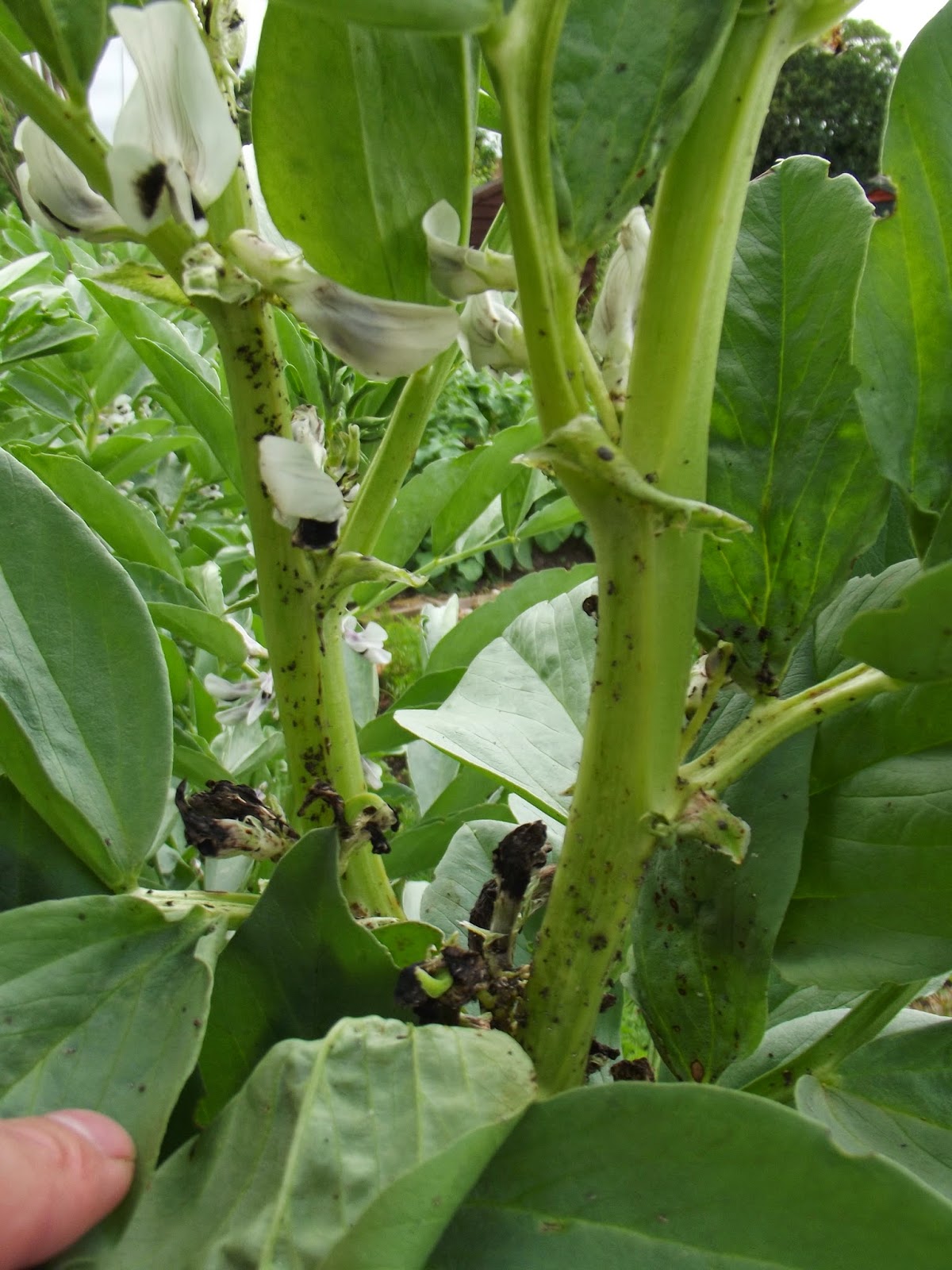
Nevertheless, sometimes the unexpected happens, and a few weeks ago we noticed the stems of just a couple of our broad bean plants were absolutely covered in blackfly. I groaned, but then I looked closer...


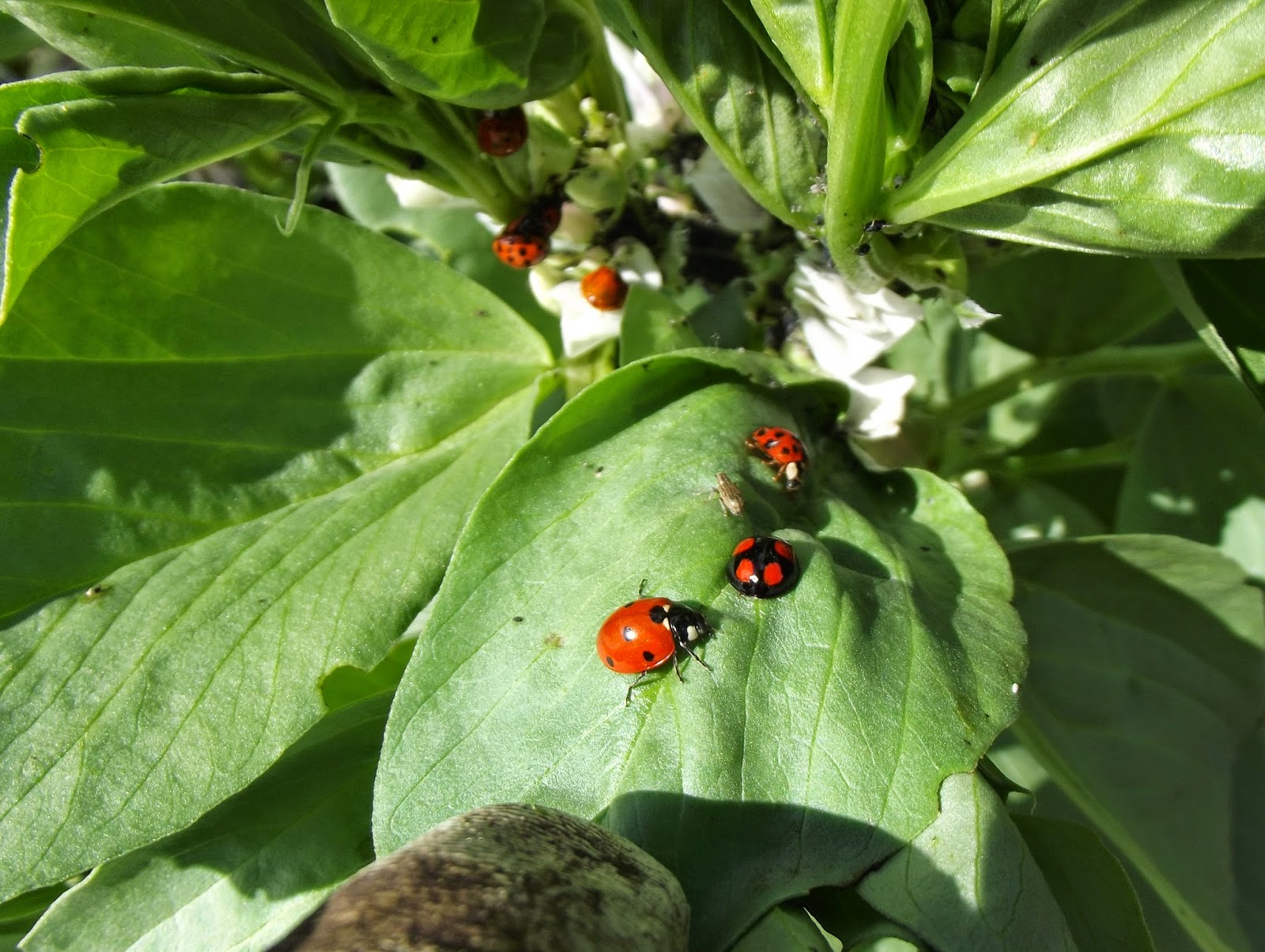
There were ladybirds everywhere - at least 15 on the most affected plant - and many of them were busy mating or laying eggs. Knowing that adult ladybirds eat up to 1000 aphids per day, I didn't see much point rushing to squish all the offending aphids or pinch off the tops of the plants! I just left them to it...


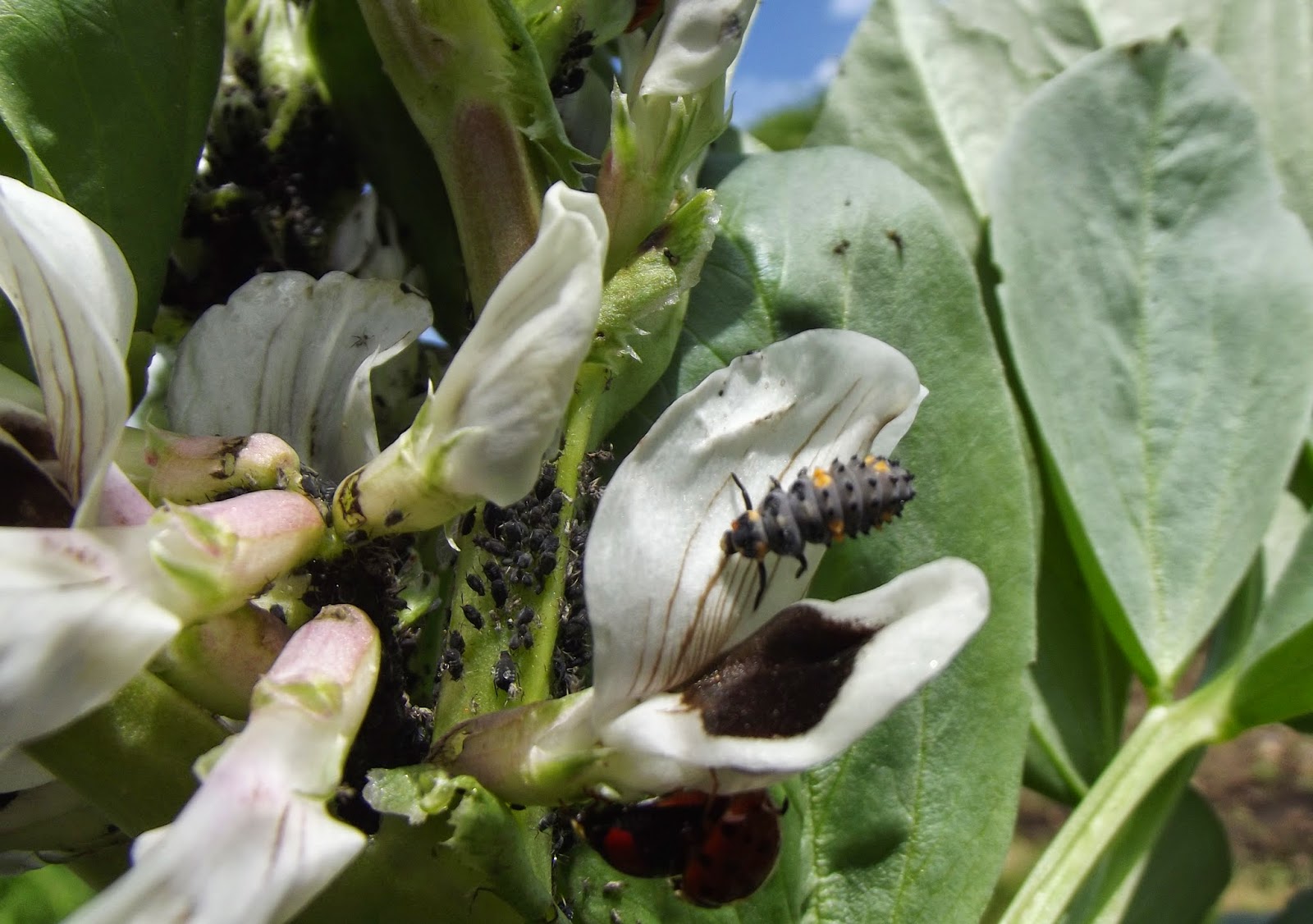
A week or two later there were plenty of ladybirds still around, and lots of their larvae too...


And a week or two after that - no more blackfly! Just a few corpses remain on the stems, ants picking over them rather sadly, and the bean pods are well on their way. That's 100% pest control, with no spraying, squishing or other interference from us. Hurrah!

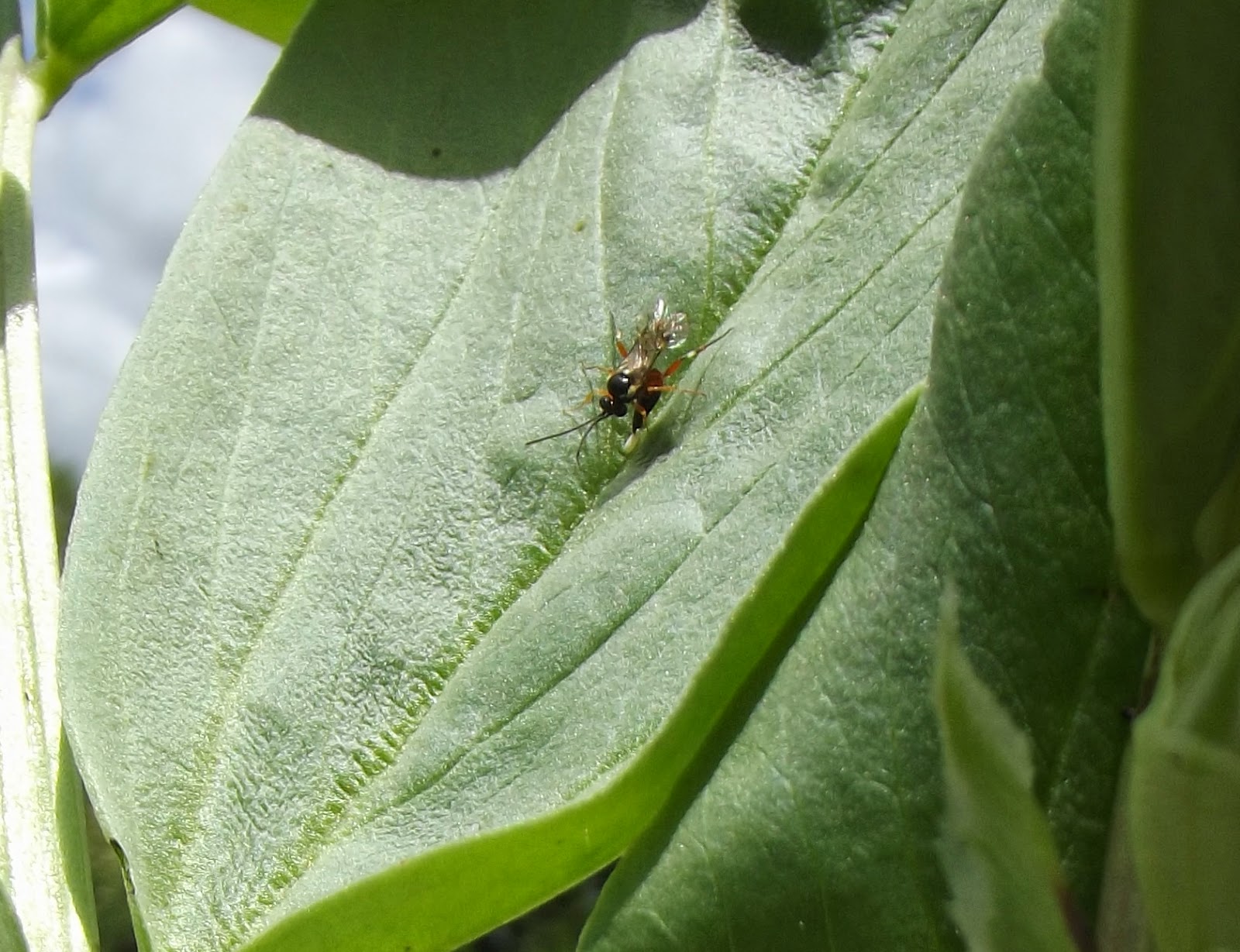
These broad beans are close to where we'd grown some phacelia as a green manure over winter - the phacelia was flowering by this point and covered with busy bees - and since ladybirds tend to like feathery-foliaged plants I presume this is what brought so many to the area. When I finally pulled the phacelia up I certainly found plenty more ladybirds sheltering there! A pesticide-free plot, no-dig beds, and plenty of sheltered places for insects to overwinter are helping make our plot even more hospitable to predatory insects such as these, and there are plenty of other plants we can grow to encourage them too; cosmos, dill, parsley, fennel, angelica, caraway, coriander and yarrow are all good choices which should be left to flower for best effect (slugs ate all my dill - boooo!) as well as flowering herbs such as mint, lemon balm and thyme. They're trickier to photograph, but there are definitely more little parasitic wasps on the plot this year too.

I love it when a plan comes together. Score one for permaculture!

Parasitic wasp laying an egg

Wednesday, 28 May 2014

FoodSmiles

Well, I haven't really been blogging as much as I intended this spring, but there's a very good reason. I've been unexpectedly busy with an exciting new community food project...

I joined the steering group for FoodSmiles back in September when it formed - the outcome of a public meeting run by Transition members as part of the St Albans Food and Drink Festival. The idea was to start a CSA - Community Supported Agriculture - project in St Albans. CSAs across the world take many forms, from meat-shares and food co-ops or 'hubs' to community-run farms, but our aim was to rent a smallish piece of spare land from a local farmer or grower, grow our own produce there, and share it among our members, with the aims of reducing food miles and making food-growing and locally-grown food more accessible to the community.

In April we secured a piece of land at the organic-certified Hammonds End Farm, just outside St Albans. It's small, but it's a lovely spot, with polytunnels already onsite, and we couldn't ask for a more supportive landlord!


Starting late in the spring has meant it's a bit of a race-against-time to get all our seeds in the ground, which is hard clay and very stony (the farmer generously ploughed and harrowed it for us before we arrived, but it still needs lengthy prep before sowing!) and a bad flea beetle problem has meant resowing the first of our brassicas. The polytunnels had some big holes and needed repairs before use (one still does), and the organic certification of the farm, while a really positive thing, means we have to be very careful to use only organic seeds and plants, soil amendments and treatments, and keep strict records of everything we do onsite. So as 'site co-ordinator', I have been quite busy...


But we've got some dedicated and enthusiastic members, we've had some great support from local garden centre Aylett Nurseries, who donated organic compost and equipment to get us started, and it's all go on the site! Our potatoes, carrots, lettuces, parsnips, swedes and broad beans are all growing well, we're raising courgettes and squashes ready to plant out soon, and we're about to fill the polytunnels with cucumbers (from seed), peppers, chillies and tomatoes (from Rocket Gardens).


As you'll know if you read this blog often, bringing food production back home and back to communities is something I'm really passionate about, so I'm enormously honoured and proud to be so heavily involved in a project like this, and very grateful to those with the vision to kickstart it! We can only support 25 to 30 members this year, but we hope to grow and grow, possibly producing eggs, meat, and who-knows-what-else in the future, and truly bringing a new source of local food to St Albans. Its hard work at the moment but the plot's already a wonderful place and I know in a few months it will be bursting with lovely fresh veg for us all - and it's great to see lots of new friendships between like-minded people blossoming too!


FoodSmiles is on facebook and twitter if you want to know more or follow our latest updates. We still have a few membership places available so if you're local and you'd like to join us, get in touch!

Friday, 4 April 2014

Grow Your Own Nutrition!

Okay, this post is going to be long, and I'm sorry about that, but I promise it will be absolutely worth it! During the winter I had the pleasure of reading two fascinating and wonderful books about soil nutrition and its impact on our health, and I've got to tell you why my approach to growing food will never be the same again.


The first book, which I just happened upon while idly browsing for free Kindle books one day, was Beyond Organic: Growing for Maximum Nutrition by Dr Jana Bogs. It kicks off with an analysis showing how vastly different the levels of vitamins and minerals could be in vegetables grown in different soils across the US: "not by just 10 or 20 percent, or even a two-fold difference..." but "...as great as 1,938ppm (parts per million) iron in some tomatoes as opposed to only 1ppm in other tomatoes of the same variety. This is nearly a 2000-fold difference!" Not rocket science, is it, to work out that more nutritious soils would grow more nutritious veggies? But I'd always assumed that a carrot was a carrot was a carrot, and any variations would be so small as to be irrelevant.

It's funny the way we often just go on doing things the way we were taught, without really thinking about them. For years I've believed it when I was told that all my soil needed was as much compost as I could make, plus a bit of horse manure or fish, blood and bone for a boost, and some lime every few years to keep the pH level where it should be. 

Nutrition levels in our food have dropped off by around 75% in the last hundred years or so. Concerns about depleted soils and nutrition deficiency leading to poor health in Americans were first brought to the US Senate way back in 1936. Between 1948 and 1991, Australia's 'Commonwealth Scientific and Industrial Research Organization' recorded an 80% drop in vitamin C in apples, an 82% drop in magnesium in broccoli, a 75% drop in iron in potatoes and an 89% drop in calcium in potatoes, and a similar American study showed that roughly half the vitamins in vegetables had significantly decreased between 1950 and 1999. An analysis on canned peaches over a hundred years old found that they contained more vitamins, even after a hundred years in a can, than today's canned peaches do! We'd need to eat a huge amount of today's fruit and veg to get the same nutrients we would have got from our 'five-a-day' a hundred or a thousand years ago. Is it any wonder we're all fat and sick??

Dr Bogs explains some of the complex interplay between nutrients in plants: minerals taken up by their roots activate enzymes which create the proteins, fats and vitamins we need. Though plants need only around 20 nutrients to survive (some say up to 42), if given a fuller range of nutrients they are capable of generating all the 50+ (some say up to 90) nutrients that we humans need. In other words, a vegetable might have everything it needs to reach maturity looking and tasting good, but that doesn't mean it has reached its full potential by producing all the nutrition it can, and should, contain: plants pass on a certain amount of nutrition from the soil (iron, copper, magnesium, calcium) but they're also little factories producing fatty acids, proteins and vitamins, as long as they have the building blocks to do so. You might have plied your plot with N:P:K fertilisers, but have you ever wondered whether your veggies get enough zinc, cobalt, boron, molybdenum or selenium? I hadn't!


The second book, The Intelligent Gardener: Growing Nutrient Dense Food by Steve Solomon, was even more eye-opening and exciting, not to mention more practical, offering a full hands-on approach to finding out what your soil needs and making it the best it can be, and I have to thank Douglas of @SweetPeaSalads for recommending it to me! This book busts some myths about the usual organic approach to feeding the soil, and offers a really good and easy-to-understand lesson in soil science. Solomon speaks from a broad range of experience from gardening on a variety of soils in several different parts of the world, and tells of healthier, tastier plants, a complete halt to fungal disease, and dramatic improvements in his own health when the soil on which he grows his food is properly nutritionally balanced. He also keeps a free online library - The Soil and Health Library - full of books, papers and studies on holistic agriculture, the connections between soil and health, and more, and he draws heavily on the works in this library to explain his theory and method.

He particularly highlights a study published in 1939 by one Weston Price called Nutrition and Physical Degeneration. Price visited remote communities around the world; tribes and isolated villages that as yet had no access to the mass-produced "foods of civilization", but survived on what they hunted, foraged or grew on a small scale locally with old methods. Despite his subjects having a wide variety of colours and shapes, of diets and of lifestyles, across the board their health was far, far better and when analysed, their foods were found to contain a huge amount more nutrition; for example, the primitive people's diets contained at least ten times more vitamins A and D than the American diet even back in the 1930s! Steve Solomon believes that the ideal human diet "has more to do with the soil food comes from than which foods are chosen"; some of these people ate no animal products while others ate virtually no vegetables, and others subsisted on just fish and oats supplemented with a few leafy greens. You can read Solomon's in-depth review of Price's book here, and I highly recommend it.

It would be impossible to share everything of importance in The Intelligent Gardener here - it's a fabulous and fascinating book - but here are my main take-aways:

Leaching is the factor with the biggest impact on nutrient density. Leaching is what happens when soil becomes saturated with rain, which dissolves a lot of the soil minerals and eventually drains downward carrying those minerals with it so that they end up in the subsoil or offsite altogether. Leaching is worse in climates where evaporation is also low - warmer weather slows leaching - and in climates where there is a lot of heavy rain in a short period of time. It's also a great deal worse where soil is left bare. Some nutrients leach out of soil more easily than others: calcium goes fast, while potassium tends to get left behind. This leads to imbalances.

Loss of soil microlife and organic matter is another major factor that harms nutrient density, since micro-organisms help to release the nutrients from the soil for use by plants, and high-quality humus holds a lot of nutrition in the soil and helps prevent leaching! This isn't generally a big problem for us organic food-gardeners, but industrial farming methods have devastated agricultural soils.

Compost isn't enough! Composting waste from the plot to feed the plot cannot provide all the nutrition the plot needs - unless the plot is already perfectly balanced. In fact, feeding a plot exclusively with compost from the plot will only magnify existing imbalances! There's a sustainability discussion to be had here: feeding your plot with compost alone is a permaculture ideal; a natural recycling process where we make the most of our waste to fulfil another need without importing costly additional materials from elsewhere. But Solomon explains that a soil can virtually sustain itself nutritionally - once it's properly healthy and balanced and cared for.

Remineralisation is the answer, Solomon says. Soils that have not been cared for properly have lost their ability to stay balanced, and their mineral content has been devastated. Solomon's own experiences and research (and Jana Bogs' studies) show that remineralised soil allows crops to reach their full genetic potential, enjoy proper health with much less chance of pest attack and disease, and provide the maximum nutrition for us.

Total Cation Exchange Capacity (TCEC) is a measurement (calculated in a lab) of how much minerals a soil can hold. Clay and humus particles in the soil have a tiny electrical charge that makes positively charged mineral particles in the soil attach to them - a bit like static cling. These positively charged particles are called cations, and include calcium, magnesium, potassium, sodium and others. The clay and humus particles have a set number of 'exchange points' where cations can stick, so a soil with lots of clay and humus has a high TCEC and a lot of these exchange points, and a light sandy soil with very little organic matter has a low TCEC and few exchange points. Some cations cling harder than others: calcium will always take first priority, magnesium second and the others will follow suit if there's space left. Solomon likens the TCEC to the number of shelves in a pantry. Calcium will fill up the shelves first and the others fill up the gaps in order. If the shelves are empty, they just fill up with air - hydrogen actually, from the soil water. As well as from the TCEC, plants can also get nutrition from the soil solution: mineral particles in the soil (or in slow-release fertilisers) breaking down slowly in tiny amounts and dissolving in the soil water. But that soon runs out and needs recharging. The soil solution is like plates on the table. When the plates are empty they can be refilled from the pantry (the TCEC). The bigger the pantry, the longer the meal goes on. Thus while a plant relying on nutrients in the soil solution would require very regular feeding to keep up with its needs, the TCEC buffers plants against nutritional ups and downs: with big reserves, their plates are never empty!

Balance, balance, balance. It's not about having a certain weight or volume of each nutrient in your soil, nor about throwing all the nutrients you can at it; too much of a good thing can lead to overdosing and cause even more problems. Instead, it's all about balance and the interplay between the nutrients.

Not all compost is made equal. As we all know, organic matter is vital for healthy soil. It improves texture, structure, and moisture retention. Most crucially, it feeds soil life, and it holds anions (negatively-charged mineral particles such as phosphorus, sulphur, nitrogen and boron) in the soil. But Solomon warns against adding too much organic matter and recommends only a 1/4" to 1/2" inch layer per year! Too much compost, he says, can overload the soil and its nutrients can end up just going to waste. He also warns that you never know what you're getting when you buy in compost (or organic waste to compost yourself); it may contain contaminants, or you could be importing unbalanced material that adds to your soil's imbalances without you knowing it. Most crucially, he teaches that much of our home-made compost (and shop-bought compost) is only partially decomposed organic matter, but our goal should be truly mature humus...

Humus and clay, clay and humus. These are the two most important components of soil, and they must both be present in abundance to hold a lot of nutrition. Humus is organic matter that has broken down to a point of stability and will change no further. It stays in the soil, instead of breaking down and disappearing. And while clay holds cations in the soil, humus holds both cations and anions. But great humus needs clay to form properly, so it will only form in your compost heap if you add enough clay to the heap as well. Solomon recommends adding around 5% by volume soil, of which 40% should be clay, to your compost heap. If your soil doesn't contain much clay, he recommends finding some, creating a clay slurry with water in a bucket, and sprinkling it generously between layers! Humus might also form in the ground when you add your partially-decomposed compost to a clayey soil - but when added to a light, low-clay soil, little humus will form, if any, and the organic matter will rot away to nothing, and so light sandy soils have great difficulty building up a useful level of organic matter.


Calcium is arguably the most important mineral in a garden soil, not because plants need a lot of it, but because it is critical for good soil structure: not enough calcium but too much of the other cations (especially magnesium) leads to a closed and airless soil structure in which microlife cannot thrive and other nutrients remain unavailable. Calcium is also the mineral most often lacking, as it's so easily leached away. A soil's TCEC should be around 68% full of calcium.

Magnesium takes second priority after calcium, when it comes to sticking to these exchange points in the soil, so it's the magnesium/calcium balance which will most often cause a problem. Magnesium is present in dolomite lime, often used by organic gardeners, so care must be taken to avoid an excessive build-up. Magnesium should fill around 12% of the soil's TCEC.

Potassium always rolls to the front of the pantry shelves, so if there's an abundance of it, plants use it first instead of reaching to the back for the other cations. When plants have lots of potassium they make lots of sugars and starches, but fewer proteins and vitamins and other more important nutrients. An excess of potassium, therefore, can boost yields, but those yields will be lower in nutrition than they should be, and higher in calories. Potassium can accumulate in soils because it doesn't leach away as much as other cations, and because imported composts made with hay, straw and woody wastes are often very high in it (potassium accumulates in the structural parts of plants; the trunks, barks and stems). I guess endlessly throwing N:P:K fertiliser at a plot might well add to this imbalance too, and presumably potassium is a particularly beneficial yield-booster for commercial growers whose primary concern is the size of the crop. Solomon recommends a soil balance that leaves potassium "just a little bit scarce" - just a few percent of the TCEC - for crops with the highest nutrition.

Sodium. We all know salt isn't good for most plants, but a small amount of sodium in soil is crucial and some crops need it. However, Solomon warns that growers using tapwater to irrigate their crops should be aware of the sodium level in their irrigation water. Annually, twelve inches of water containing 50ppm sodium would bring 200lbs per acre of sodium! There's something I'd never considered before! My local mains water contains an average 17ppm sodium, according to an analysis on my water company's website, but I have no idea how many inches of it I put on my soil... There should be around 1-2% sodium in the TCEC.

Phosphorus is a controversial soil amendment, since it is mined from the ground and we are steadily running out - but even a slight deficiency slows plant growth. Many agricultural soils are severely depleted of phosphorus and heavily dependent on phosphate fertilisers, but a healthy balanced soil can hold on to phosphorus for decades, because phosphorus is held in the soil by humus. If it fails to connect with humus, it soon connects with other minerals and becomes insoluble iron phosphate or calcium phosphate instead, and remains unavailable to plants long-term. Solomon suggests there should be around the same amount of phosphorus as potassium in soil, but that it should be added gradually over a number of years to ensure as little as possible goes to waste. Bonemeal provides a sustainable source, but comes with additional sodium and calcium too.

Nitrogen is crucial for healthy green growth: it's vital for production of the plant protein chlorophyll, which plants absolutely depend on for photosynthesis and energy. Dark leafy greens grown on fully mineralised soil can contain up to 20% protein - as much as beef steak! Nitrogen is released when soil organisms feed on organic matter - annually, every 1% of organic matter existing in a soil will provide 15-25lbs of nitrogen per acre, and to produce a good crop, 100lbs/acre is needed. So a healthy soil with 4-7% organic matter should have plenty of nitrogen available (although if it is hitherto dependent on nitrogen fertilisers, it might need weaning off them first). Solomon also advocates digging in leguminous green manures to provide nitrogen naturally, and points out that a healthy stand of field beans can provide the full 100lbs/acre needed.

Sulphur is a really interesting nutrient which helps plants to form amino acids (proteins) and enzymes, and boosts flavour. While we see sulphur as a fungicide and dust it on our plants as a defence, Solomon suggests that fungal disease is actually a symptom of sulphur deficiency, and describes how the onion root-rot on his plot completely disappeared when he rebalanced his soil. This is great news for me, as I've had to give up growing onions on my allotment thanks to my white rot problem! Sulphur is another anion, held in the soil by humus, and when it dissolves into the soil solution it bonds with cations to become a water soluble sulphate (iron sulphate, calcium sulphate, zinc sulphate etc.) Thus too much sulphur can leach cations from the soil - or it can be used, with care, to deliberately deal with a cation excess.


Micro-nutrients and trace nutrients are vital for maximum plant health and maximum nutrition too, and Solomon reveals the amounts needed for good balance and recommends amendments such as seaweed or Azomite for adding trace elements. Surprisingly, he's not such a fan of rock dust, and his analysis of it makes interesting reading.

pH. Wow, now this is important! pH is NOT the be-all-and-end-all of soil health, but a side-effect of the chemical and microbiological activity in the soil. It's not really as meaningful as we tend to think, and it fluctuates in a much more complex way than most of us know! pH stands for 'potential hydrogen' and is defined as the density of hydrogen atoms in water (or in a solution of a substance, such as soil). All the exchange points in the soil must always be filled up, so if there is no calcium, magnesium or other useful minerals around, hydrogen atoms from the water in the soil will stick instead, and the soil will contain a lot of hydrogen and have a low pH (an acidic soil). A soil rich in cations such as calcium and magnesium, on the other hand, has very little hydrogen and a high pH (an alkaline soil). So the pH of your soil can indicate how nutrient-rich it is - certainly an acid soil is lacking in cations. BUT a soil high in cations (alkaline) may have completely the wrong balance of cations and still benefit from liming, and in fact, the liming might not raise the pH further (since the new calcium ions knock off and replace the excess magnesium, potassium or sodium ions) but allow it to fall because correcting the balance allows the microlife to thrive again and kicks off the normal cycles of nitrate release and so on!

Soil testing is the only way to really know what's going on in a soil, and this is the method Solomon recommends to get the maximum potential out of any food-growing plot. The book explains how to take a soil sample and where to send it, and provides worksheets for readers to interpret the results and work out a perfect prescription of amendments for their soil. He also acknowledges that a soil test and a bunch of calculations won't be for everyone and might be severely over the top in a very small plot - so he offers a generic one-size-fits-all solution too, which he promises will greatly improve virtually all garden soils and increase its benefits year by year. He calls this his Complete Organic Fertiliser, or COF.

The Intelligent Gardener is a garden-changing book - maybe even a life-changing book - and I thoroughly recommend it to all home-growers. It's the kind of book that, once you've read and understood it, you just have to put into action. Steve Solomon believes that "many of our current social problems would also vanish by themselves, if only the mass average health of people were uplifted", and I'm inclined to agree, having seen the enormous variation possible in the nutrient content of our foods, and considering how far the impact of an unhealthy soil can reach into every part of our diets. If I'm going to grow my own food, then I want to do it properly and really get the best out of it. And if brilliant health is within my grasp (and my family's), just by changing what I feed my soil... well, no-one's getting in my way!

I intend to have my soil analysed and to remineralise it with The Intelligent Gardener's guidance, but not this year, with so much else going on. This year I'm trying Steve Solomon's Complete Organic Fertiliser (more on this in a future post), both on the allotment and on my beds at home, and I have high hopes for some excellent results.

I hope you're itching to go out and read this book for yourself right away! (I don't get anything for that, by the way.) But if money's tight or you're not convinced yet, there are three great interviews with Steve Solomon available free on the Ruminant Podcast website, here, here and here - do have a listen. And watch this space for more on Complete Organic Fertiliser...

Monday, 31 March 2014

Got Mycorrhizae?

Fungi are amazing organisms. They're everywhere, but their lives go on unseen, in secret, for the most part. They're crucial for decomposition and recycling of waste. They grow like plants but are made of chitin like insects and other invertebrates and, just like humans, they produce vitamin D when exposed to sunlight - in fact, some consider fungi to be more closely related to animals than to plants. They can absorb toxic waste and chemical pollutants, using them as food and rendering them harmless. They can MAKE IT RAIN! Their rootlike mycelium - the main body of the organism - can spread underground for miles (the largest fungus on earth is believed to be a honey fungus which covers nearly nine square kilometres in Oregon's Blue Mountains!) while the mushrooms and toadstools we see on the surface are just their flowers and fruits! And it's fungi that form the vast underground network which scientists believe allows plants to communicate, warning each other of pest attack and other troubles.

These mycorrhizal fungi - fungi which connect to the roots of plants and form a symbiotic relationship with them - have other benefits for their hosts too; a vast mycelium acts as a secondary root system for a plant, bringing nutrients and water from far deeper and further away, effectively increasing its root system by up to 700 times! Plants with roots colonised by mycorrhizal fungi establish faster, grow better thanks to the additional nutrients, have more resistance to pests and disease, and suffer less in drought. It's estimated that 90% of land plants have associations with these fungi. Just one gram of woodland soil can contain over a million microscopic fungi, and in one square inch of decomposing organic matter, such as a decaying tree trunk, there can be 70 miles of mycelium. The stuff is everywhere!

Well, not everywhere. Guess where you won't find mycorrhizal fungi...

You won't find it in the kind of sterile shop-bought compost you raise young plants in. And you won't find it on highly-cultivated, regularly disturbed allotment soil. Nope.

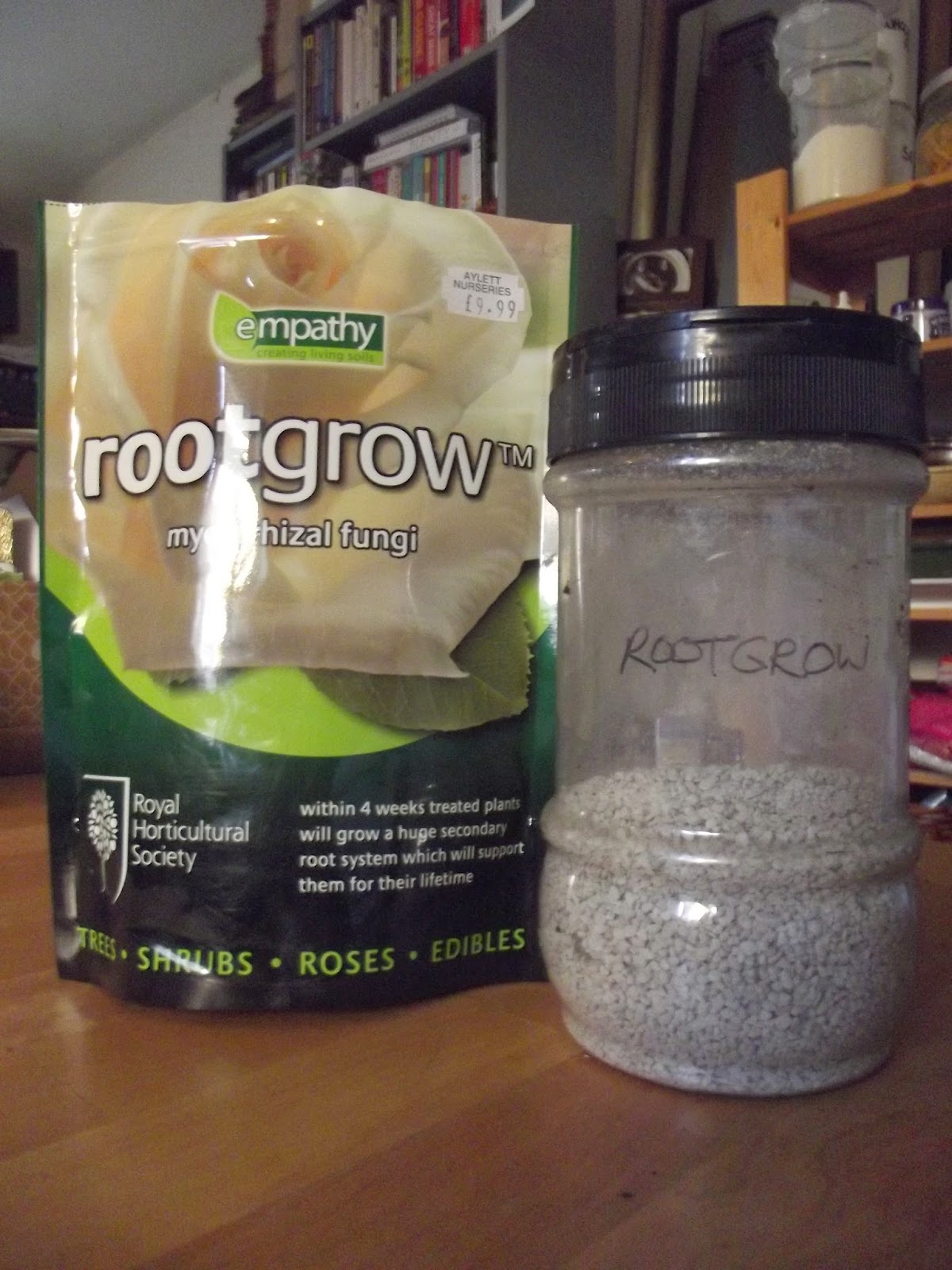
So I think it's pretty cool that you can now buy it in a packet. :-)


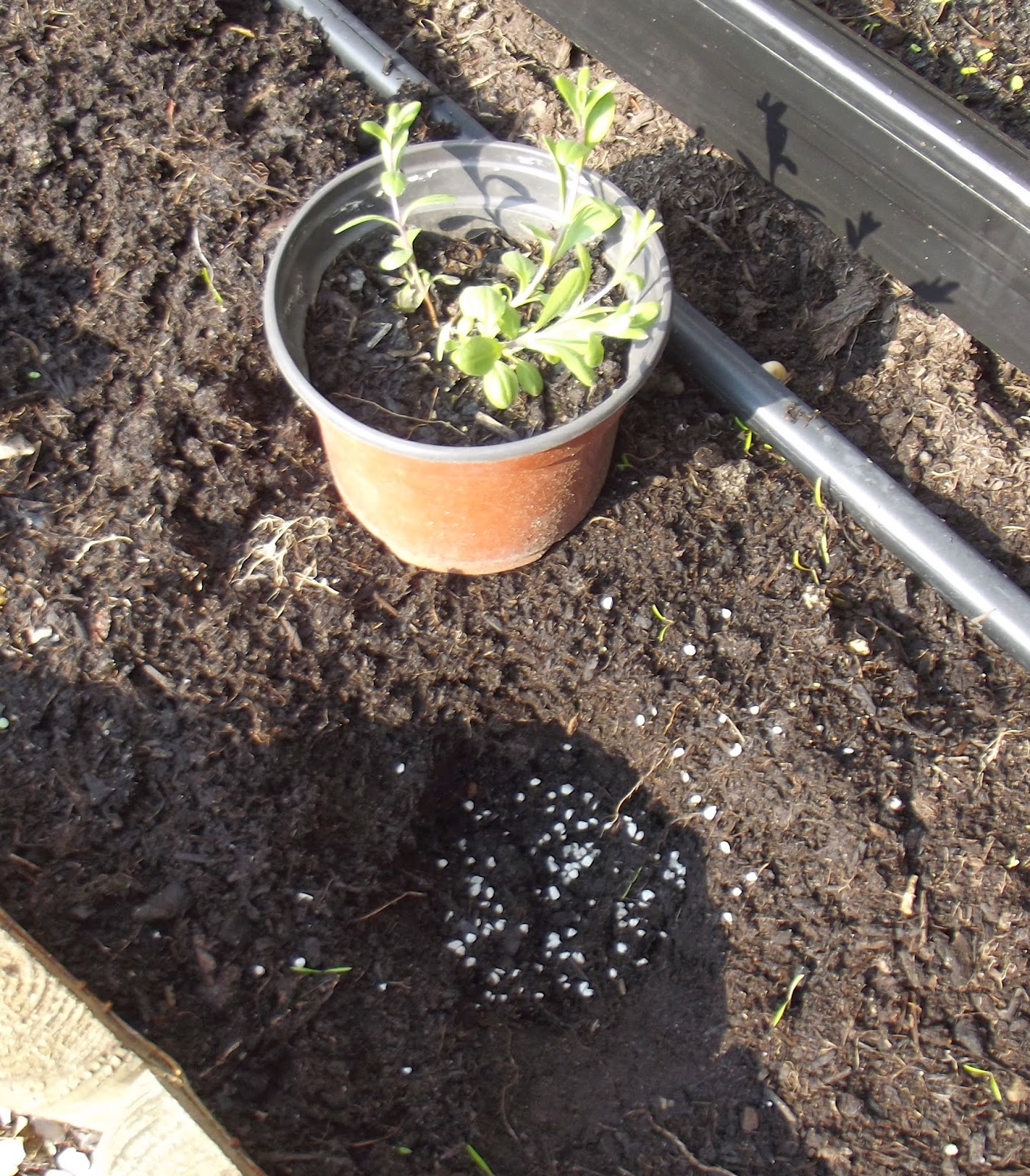
The fungi spores, native to the UK and grown here, are dried and bound in clay. To use them you just sprinkle them in the planting hole when transplanting, or add them to a drill under a sprinkling of soil before sowing seeds. I have put mine into an old herb jar with a shaker top for easy application!

Needless to say, I will be using this this year, especially under my new perennials, and have already added it when planting my strawberries and asparagus, and sowing my broad beans. Of course, switching to no-dig growing and using ground-covers will mean that fungi can survive much better in our soil from now on, and should colonise the area nicely, so personally I can't see myself using it year on year, but it certainly looks like it has great benefits for growers whatever their methods (look here for some photos comparing plants with and without mycorrhizae) and the RHS particularly recommends it when planting out trees, roses and shrubs, to ensure less transplant shock and help plants establish faster.


Mycorrhizal fungi apparently don't help brassicas, since brassica roots release a natural anti-fungal defence which stops them thriving, nor acid-loving plants such as cranberries, blueberries, heathers, azaleas and rhododendrons. Some other plants however, like grapes and roses, depend heavily on the mycorrhizae and can really struggle without them, and a few species of orchid cannot live without them at all.

It's crazy to think that our traditional method of digging the soil over before growing crops actually breaks this beneficial natural relationship that does so much good in the wild, and stops us benefiting right where we need it most. It's another one-up for no-dig gardening, and I can't wait to see the results!

Tuesday, 11 March 2014

You Vote Three Times Every Day

For some reason I've always been under the impression that organic food - and organic farming - was the environmentally friendly choice. Organic farmers avoid pesticides or herbicides or fungicides, and they only use environmentally friendly fertilisers, right? They use methods like polyculture, soil-building, companion planting and encouraging beneficial predators, and when they have a problem they deal with pests manually or use strictly-controlled organic pesticides if they really, really have to, right?

Wrong! I got quite a shock when I saw this video:


(For the purposes of this post, I'm talking only about the first 1m40s of the video - the rest is another issue, which I've commented on before, here, and about which I'll have plenty more to say in the next few weeks...)

It seems some organic farmers don't give two hoots about environmentally-friendly methods, and use organic-certified pesticides, fungicides and herbicides liberally - in fact, at much higher rates and much more often than conventional fertilisers. Apparently I should have known this back in 2010, when a study showed that use of organic pesticides could actually be more damaging to the environment and its wildlife than synthetic pesticides. In fact, some organic-certified (i.e. derived-from-nature) pesticides are much more toxic than their synthetic counterparts: organic-certified rotenone, derived from the roots of tropical bean plants and effective against caterpillars and beetles, is six times more toxic than carbaryl, a synthetic product used for the same pests. Nicotine sulfate, extracted from tobacco, is six times more toxic than its synthetic counterpart, diazinon. 

Now, some say this study is irrelevant:
"...the implications of the study are minimal because organic farming is not about replacing synthetic pesticides with organic pesticides, say organic farmers, retailers and regulators.
The culture and approach of organic farming is what distinguishes it from conventional farming, organic farmer David Cohlmeyer said. He runs Cookstown Greens, which supplies organic produce to restaurants and hotels in Ontario. Organic pesticides are "irrelevant" to his business, he said.

"When you're doing it right, you don't have pest problems," Mr. Cohlmeyer said. "We don't use any pesticides because we don't need to."

Organic farmers are only supposed to use natural pesticides as a last resort. Instead, crop rotation, planting habitats for beneficial predators and good soil are an organic farmer's first priority, said Simon Jacques, Ontario representative for organic certification program Ecocert."
Good news! I wasn't completely delusional about the good of organic farming then. But the attitudes of the two farmers in the video demonstrate very clearly that an organic farmer is not necessarily a farmer who cares for the environment or supports wildlife on his land. For the two farmers in the video, organic farming IS about replacing synthetic pesticides with organic ones. I don't know why I hadn't seen it coming, to be honest: profit trumps the greater good every time, doesn't it? If you're going to grow big monocultures, you're going to need more pesticides, whether organic or synthetic. And - as well as rendering the 'organic' label fairly meaningless - this revelation highlights again what I think is really wrong with our food supply chain: industrialisation.

It's the sheer scale of industrial farms that causes the trouble. Monocultures push out nature. Small farms and big gardens are far better suited to chemical-free growing, good soil care, manual pest-control and rich biodiversity. On a huge industrial farm, a relatively small number of workers have to deal with a vast area of land in the way that makes the most profit. Doesn't our food supply deserve a little more attention-to-detail than that? They plant monocultures because they're simpler to care for and make the most money. They use chemicals because they're the easiest way to deal with a problem, not the best way. They don't feed or protect the soil any more than they must to get their crop. Wildlife? Wildlife doesn't make a profit.

Food is the foundation of our survival and wellbeing. It's the cornerstone of economy; the number one most important commodity in every country. It's the linchpin of society; civilisations have risen and fallen according to their ability to produce it. You can't build a shelter, use a computer, drive a car or win a war without it. It's our first and foremost concern when it comes to looking after our families and our health - food is personal. As human beings, it is and must be our primary industry, and because it's SO important - because we must throw so much time and energy and resources and land into it - HOW we do it is crucial too.

So why are we so dreadfully out of touch with our food supply? Why have we pushed food production out of our communities? Why have we given up responsibility for it, preferring to pay money for other people, often in other countries, to sort it out for us? How much time and energy and resources and land do we as individuals and families and communities give to it?

Our modern food and farming system has transformed some 700,000,000 hectares of woodlands, forests and meadows into vast, featureless swathes of cereal crops, replacing natural ecosystems, displacing wildlife and sometimes destroying whole species. It depletes soils worldwide up to ten times faster than nature can restore them. It's an enormous source of pollution - the biggest source in many countries - and could even be depleting the ozone layer, scientists say. It's the world's biggest source of animal cruelty. And the worst thing of all? It's not even working! 12% of the world still goes hungry, and a good deal more than that struggle to get the food they need.

And I'm sick to death of claims that GMOs are the answer - the only way to feed the world. Recent news of a GM potato that resists blight failed to mention the naturally-bred potatoes already developed by the Sarvari Research Trust. These 'Sarpo' potatoes are resistant to all strains of blight and have been around for six years - if you grow your own you may well already be familiar with them. The trust is currently busy trying to crowdfund £50,000 to expand their business and make their blight-free potatoes available to farmers and growers across the globe (you can help them reach their target here). Meanwhile, £3,200,000 of public money has been spent trying to genetically-engineer potatoes to do exactly the same thing that Sarpo spuds can already do - and it has taken three years to achieve resistance against just one strain of the disease! Whatever the GM industry is about, it is NOT about feeding the world. Imagine the benefits to the food supply by now if Sarpo had been given that £3.2 million, three years ago!

I've said it before and I'll say it again: divide the worlds 21,800,000 square miles of agricultural land by its 7 billion people and we get nearly two acres each! That's more than enough to feed the world by anyone's logic; we're just managing the land - and its produce - insanely badly. Once upon a time, everyone was involved in their own food production. Today, we get our food from shelves, in buildings, without a second thought, and for that reason we've forgotten that because it's SO important, food production is perhaps THE biggest influence on how our world is run.

Every time you eat, you vote for how you want the world to be. You vote for or against biodiversity. You vote for or against animal cruelty. You vote for or against wildlife, and deforestation, and pollution, and slavery, and CO2 emissions, and chemical food additives. You vote for or against the corporations that seek to own the food supply. You vote for or against your own local economy, and your personal food security in times of trouble. Change never happens overnight, but every pound you spend, every consumer choice you make, every meal you eat is an opportunity to influence the system.

We need to take back responsibility for our food supplies; we need to bring food production back to our communities. We need to get involved. Please, get involved. Support your local farmers and producers and, crucially, talk to them about how the food was produced. Join a CSA, a community garden project or a similar group in your area - or start one! If you don't already, grow some food for yourself! Take the One Pot Pledge. Start some herbs and salad greens in containers - they're easy and some of the most heavily-sprayed conventional crops. Put your name down for an allotment. Do anything to take the power back and have some say about how you want our food system to run. Do it now!


Wednesday, 1 May 2013

URGENT: Save Our Seeds

On May 6th, the EU will vote on new legislation governing plant varieties, proposed by the Directorate-General for Health and Consumers in response to hard lobbying by the globalised agricultural seed industry - Monsanto and its buddies. This legislation will mean that no seed (or other plant reproductive material) can be sold, swapped or given for free to anyone anywhere in the EU unless it is registered on the EU Plant List as an 'approved' variety.


If the legislation passes, it will kill off innumerable heirloom, heritage and amateur varieties. It won't (I believe) impact the varieties already licensed for commercial use, but it will impact the huge number of 'amateur' varieties, all those that breed plants on a small scale at home, all those that forage seed and propagate wild plants, and all the rare seeds being preserved and brought back to cultivation by small businesses. It will mean high costs for seed merchants to put their varieties through rigorous tests to get them on the list - and since the tests are designed around high-output industrial varieties, many are unlikely to be approved anyway. Once a variety is approved, the seller will have to pay an annual fee to keep it that way. Heirloom varieties and other less-popular varieties will undoubtedly be lost. Small seed merchants preserving and supplying rare varieties will undoubtedly not be able to continue. Biodiversity will fall dramatically. Consumer choice will be reduced. Food security will be damaged. With every variety that dies out, the pool of genetic material for breeding future varieties will be diminished. That unique heirloom bean your grandfather gave you will be outlawed - it will be illegal to pass it on to anyone else. There'll be no seeking out local varieties when you move to a new area. There'll be none of the seed-saving and -swapping and -sharing that we growers enjoy so much - unless they're on the EU Plant List. And all this so that agricultural giants can make more money and take yet more control of our food supply.

This legislation flies in the face of nature, which propagates, adapts and evolves freely, constantly creating sub-species and sub-sub-species. It's an attempt by corporations to claim ownership of the plant world, and it's an assault on our right as earth-dwellers to enjoy and interact with the earth's natural world.

I personally grow many unusual and heritage varieties which are at risk; seeds I've saved myself and seeds I've bought from Real Seeds and others - many listed as 'amateur' varieties 'not for commercial exploitation', which Real Seeds must get round by charging 1p per year to join their 'club'. Many of these are my favourite varieties. I have a Caucasian vining spinach plant which I've only ever seen shared informally and sold by one-woman company Backyard Larder. I suspect most of these varieties would quickly become endangered if the legislation passes, and next year I'd have to grow a dramatically different selection.


I'd like to think there's no way this insane law would pass when put to the vote, but Monsanto seems to have ways to get anything it wants. I have had no replies so far to my letters to MEPs and it's simply too important an issue to just wait and see without expressing my opposition.

Whether or not you grow food yourself, this legislation has implications for your food security, the natural world all around you, and thus the future of the planet. PLEASE inform yourselves about this issue and TAKE ACTION.

Here are some links to help you:


Please share this post. We must not let this happen.
Related Posts Plugin for WordPress, Blogger...