Last year I set myself two new challenges: to start a cut flower patch, and to grow some cauliflowers.
I'm pleased to report that my late summer cauliflowers were pretty successful, although varying in size. These 'Autumn Giant' caulis from Real Seeds were sown in April and planted out in May, and by mid-August we were enjoying them. The slugs enjoyed them quite a lot as well... But I'm calling it a success and we'll hope to grow even more of them this year. I've sown them earlier this spring, to give them more time to get nice and big...
The spring cauliflowers still on the plot now (variety 'Aalsmeer') are not doing quite so well; they haven't really gotten big enough, a few have disappeared completely, and I'm not very hopeful they'll provide us much worth eating. But still, I think I'll put that down to 'probably planted out a bit late' and give them another try; anything that crops in early spring is worth striving for as it can be a lean time in the veg garden.
The cut flowers were a roaring success, brightened up the plot no end and brought more beneficial insects to our plot than ever before, and they'll certainly be a permanent feature from now on! We brought home flowers once or twice a week, most weeks from May through to October - and we won a first at the allotment show with them too!
Here are eight things I learned about growing cutting flowers:
1) Deadheading (and harvesting the flowers too for that matter) takes aaaages.
2) We didn't provide proper support for our flowers, but it turned out we didn't really need to. As it's a small patch and the flowers were grown close together, they generally supported each other. They did sprawl out across paths on the outside of the patch, but a simple bamboo-cane fence round the perimeter was enough. I'll put this in from the beginning this year.
3) I'm not very good at arranging flowers. (I'm not letting this stop me.)
4) It's hard to know where to cut the flowers sometimes; for example cornflowers are very branching - should I cut at the first branch, which doesn't leave me a very long stem? or should I cut a whole branching arm from the plant?
5) Cosmos are not actually that great in the vase, with their scrawny, twisting stems. But they're so good on the plot - attracting bees until well into the autumn - that I'll keep growing them anyway. Corncockle, with short stems and a short vase life, weren't terribly useful either, but again the bees loved them so I might grow one token plant...
5.5) Sweet peas are amazing.
6) Some others weren't so good in the vase either but I know it's because I haven't got the knack yet of conditioning them properly. Cerinthe was the worst - absolutely lovely, but always the first to wilt. Apparently you're supposed to dip the stems in boiling water, which frankly just seems wrong... But this year I'll give it a go.
7) Mixed seeds are never a good mix. My 'mixed' scabiosa were all white, my 'mixed' snapdragons were 90% pink, and my 'mixed' salvia viridis were 90% purple. Just buy the individual colours you want to grow.
8) It's SO worth it. Give up just a few square metres of your plot for some flowers and see for yourself.
Unfortunately I somehow missed out on sowing flowers last autumn for an early show this spring (except for some October-sown sweet peas), so I'm a step behind with my flowers this year, but nevertheless I've invested in a few new varieties to try and I'm looking forward to seeing them brightening up the plot again soon :-)
In addition to the annuals and biennials I plan to sow, I've got a few other flowers coming up...
Our local nursery, Aylett Nurseries, is a bit of a dahlia specialist and has a dahlia show every September. I went along for the first time last year and, though I find some dahlias a bit too much, was wowed by the bright colours and the huge variety...
So I've invested in a single 'Finchcocks' dahlia tuber (pictured above, bottom right), just to see how I go with it... Actually it's not my first dahlia; I have a compact, dark-leaved 'Mystic Illusion' in a pot. As you probably know by now, I'm really not one for fiddling about with plants with complex needs, so there was no digging up tubers when winter came; I just bunged the pot in the summer house and hoped for the best...
Anyway, today I potted up my new tuber in some compost in the summer house to start sprouting. I doubt this one will get any coddling either; I may just mulch it in winter and see how it does by itself.
I bought a verbena bonariensis 'Lollipop' plant last summer just because the butterflies and bees seem to love it so much, and I adore that deep purple glow - but this could be a good cutting flower too, and it's now planted out by the side of our pond on the allotment. I heard they self-seed easily, so I crumbled some of the seed heads over a tray of compost last autumn, stuck it at the back of the greenhouse, and whaddaya know...
I can't possibly use all of these seedlings, but I pricked some out and potted them up today so that now I can enjoy them in the garden as well as at the allotment - and so can the bees :-)
Showing posts with label companion plants. Show all posts
Friday, 11 March 2016
Wednesday, 1 April 2015
Busy, busy!
Winter and early spring are great times for gardeners to do all sorts of non-growing jobs, like developing new areas and working on paths or buildings. I had a long list of these this year, and a long session on the allotment on Monday finally allowed us to finish up all but one of them. Just in time I'd say - 'early spring' is most definitely over now we've hit April!
We finally finished digging over what was previously our strawberry bed, which will be our flower patch this year and hopefully bring looooads more beneficial insects to the plot, as well as giving us flowers to cut and give away. I planted out the corncockle, calendula and clary sage I raised at home over winter, and I'll sow lots more here in a couple of weeks...
We've also planted up the herb patch round the pond and fruit trees. The focus here isn't on culinary herbs, as they're much more useful grown at home where you can grab them easily as you need them, but on flowering perennial herbs for insects and some herbs which I'd like to try drying for tea - lemon balm, camomile and peppermint. I've also popped a few perennial and self-sowing flowers in; some poached egg plant and primroses, an oriental poppy and an echinops. Maybe I should call it my 'companion plants patch' instead of my herb patch.
There's still a bit of work to do to get rid of the last of the grass in that corner by the pond... But it's so good to have this area looking nice again after it got swamped with grass and then we mulched it with manky cardboard over winter!
When we moved our compost bins last summer, there was a lot of good compost in the bottom that we just couldn't use at the time, so it's been heaped up in the place where the compost bins were ever since - we even grew our beans late last summer on the temporary raised bed it created...
...but now we've levelled the ground and moved the pile to this year's potato bed, where it will help build the soil. Our greenhouse will go in this spot this year. I hope the people on the next plot sort out their compost pile soon - it's a bit of a battle to stop it falling onto our plot, and there are brambles growing in it which keep finding their way into this bed.
While we were on the plot I also took the opportunity to sow some more seeds: I scattered some dill and parsley seeds in some carefully-chosen corners, and sowed beetroots, turnips and parsnips in rows in our roots bed, a foot apart, and covered with sieved compost.
Do you like my new plant labels? They look a bit industrial, but I was desperate to find something that would last for years, instead of perishing in the sun or rotting in the rain or just getting kicked about and lost in the dirt, and I hope these are the answer. They're from Amazon - I tried to find another supplier but couldn't - by a company called GardenMate. The permanent marker is supposed to last all season, and I'll be able to clean it off with a solvent cleaner to reuse them. That's the theory, anyway...
I'm happy that we have some broad beans on the plot at last, after a bit of a battle against mice eating the seeds! These were actually sown at home in a big seed tray at the beginning of March, and planted out this week. There are a few more sown direct here too, and covered with the same mesh to try to keep the rodents off this time. I have half a feeling I'm going to go down there and find little holes chewed right through the netting one of these days!
At home, I've sown lots more seeds, including celery, basil, dill, perpetual spinach, pea shoots and some more flowers; sunflowers, achillea and cerinthe. After a manic March, I think I've just about caught up with myself. The only things remaining are to clear and dig over the old asparagus bed, which is small and shouldn't take too long, and plant out my poor sweet peas which are getting desperate for some space and some support! Poor things!
I'm glad it's April now and the weather must warm up a bit more soon. I feel like I've got a bit of a holiday coming up over the long Easter weekend, and I'll probably get stuck into some more sowing: courgettes, squashes, brassicas and beans are next, as well as the bulk of the flower patch, getting the greenhouse sorted - and it'll be time to plant potatoes before we know it!
We finally finished digging over what was previously our strawberry bed, which will be our flower patch this year and hopefully bring looooads more beneficial insects to the plot, as well as giving us flowers to cut and give away. I planted out the corncockle, calendula and clary sage I raised at home over winter, and I'll sow lots more here in a couple of weeks...
We've also planted up the herb patch round the pond and fruit trees. The focus here isn't on culinary herbs, as they're much more useful grown at home where you can grab them easily as you need them, but on flowering perennial herbs for insects and some herbs which I'd like to try drying for tea - lemon balm, camomile and peppermint. I've also popped a few perennial and self-sowing flowers in; some poached egg plant and primroses, an oriental poppy and an echinops. Maybe I should call it my 'companion plants patch' instead of my herb patch.
There's still a bit of work to do to get rid of the last of the grass in that corner by the pond... But it's so good to have this area looking nice again after it got swamped with grass and then we mulched it with manky cardboard over winter!
When we moved our compost bins last summer, there was a lot of good compost in the bottom that we just couldn't use at the time, so it's been heaped up in the place where the compost bins were ever since - we even grew our beans late last summer on the temporary raised bed it created...
...but now we've levelled the ground and moved the pile to this year's potato bed, where it will help build the soil. Our greenhouse will go in this spot this year. I hope the people on the next plot sort out their compost pile soon - it's a bit of a battle to stop it falling onto our plot, and there are brambles growing in it which keep finding their way into this bed.
While we were on the plot I also took the opportunity to sow some more seeds: I scattered some dill and parsley seeds in some carefully-chosen corners, and sowed beetroots, turnips and parsnips in rows in our roots bed, a foot apart, and covered with sieved compost.
Do you like my new plant labels? They look a bit industrial, but I was desperate to find something that would last for years, instead of perishing in the sun or rotting in the rain or just getting kicked about and lost in the dirt, and I hope these are the answer. They're from Amazon - I tried to find another supplier but couldn't - by a company called GardenMate. The permanent marker is supposed to last all season, and I'll be able to clean it off with a solvent cleaner to reuse them. That's the theory, anyway...
I'm happy that we have some broad beans on the plot at last, after a bit of a battle against mice eating the seeds! These were actually sown at home in a big seed tray at the beginning of March, and planted out this week. There are a few more sown direct here too, and covered with the same mesh to try to keep the rodents off this time. I have half a feeling I'm going to go down there and find little holes chewed right through the netting one of these days!
At home, I've sown lots more seeds, including celery, basil, dill, perpetual spinach, pea shoots and some more flowers; sunflowers, achillea and cerinthe. After a manic March, I think I've just about caught up with myself. The only things remaining are to clear and dig over the old asparagus bed, which is small and shouldn't take too long, and plant out my poor sweet peas which are getting desperate for some space and some support! Poor things!
I'm glad it's April now and the weather must warm up a bit more soon. I feel like I've got a bit of a holiday coming up over the long Easter weekend, and I'll probably get stuck into some more sowing: courgettes, squashes, brassicas and beans are next, as well as the bulk of the flower patch, getting the greenhouse sorted - and it'll be time to plant potatoes before we know it!
Friday, 27 June 2014
Score One for Permaculture
When you think of organic growing, there are a lot of things that might come to mind. You might think of nasty organic pesticides such as pyrethrum or diatomaceous earth; you might think of arduous slug-patrols and endless couchgrass; you might think of sterile white insect-proof mesh covering up beautiful rows of crops. But the best method for growing organically, in my opinion (though slug patrols and insect-proof mesh certainly have their places!), is to work in harmony with nature as much as possible - the permaculture way; sustainable and low-maintenance - and we've seen a great example of this on our plot over the last month.
One important factor when it comes to growing in harmony with nature is simply to give plants the right conditions to promote great health, and that means sowing at the optimum time so that plants don't have to struggle. As much as I like the idea of sowing broad beans in autumn so I can pick them super-early the next season, experience has shown this never turns out well on my plot and the plants get absolutely ravaged by pests come April. Broad beans sown from March onwards, however, seem to grow up stronger and have almost no pest problems.
Nevertheless, sometimes the unexpected happens, and a few weeks ago we noticed the stems of just a couple of our broad bean plants were absolutely covered in blackfly. I groaned, but then I looked closer...
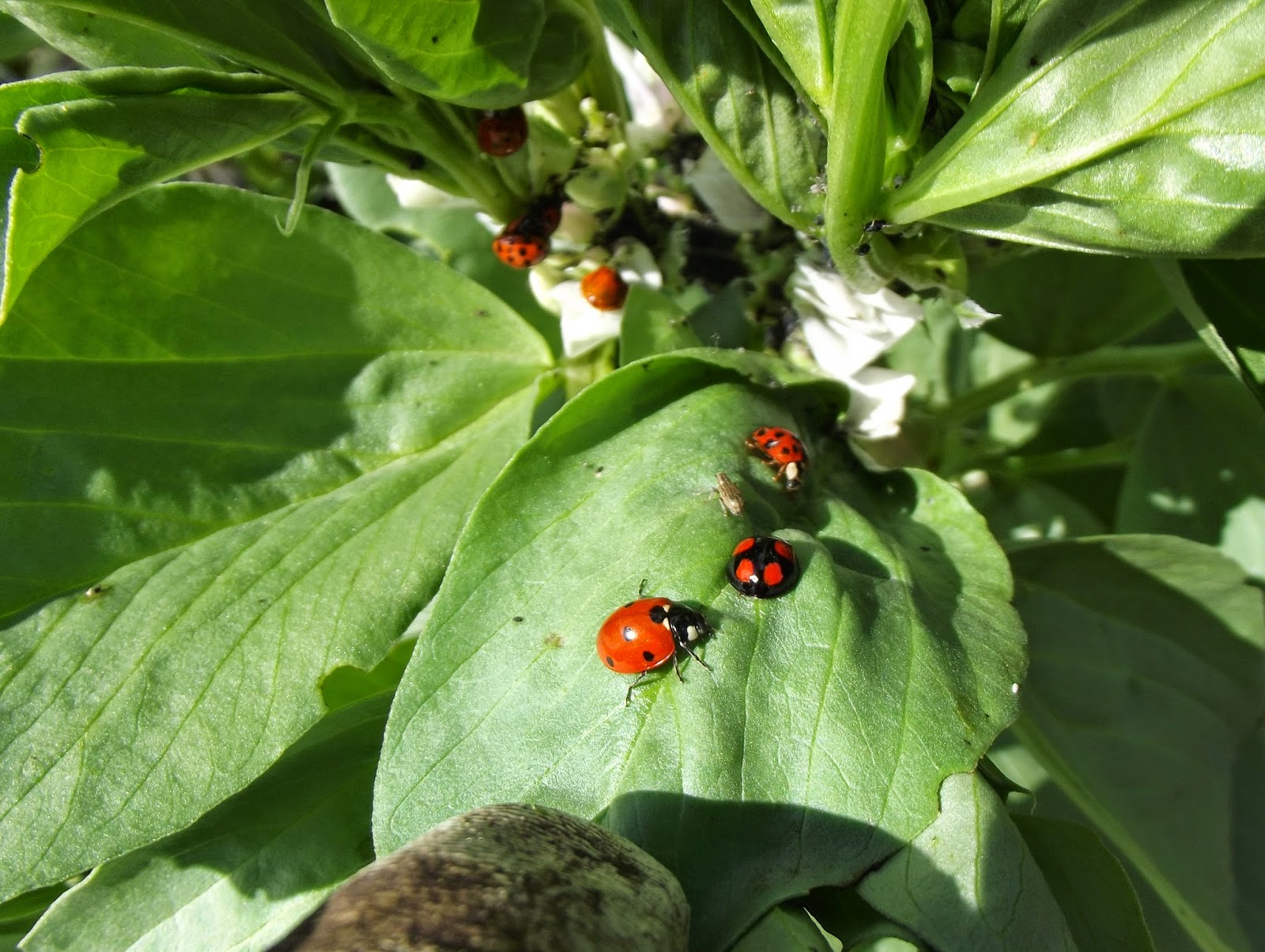
There were ladybirds everywhere - at least 15 on the most affected plant - and many of them were busy mating or laying eggs. Knowing that adult ladybirds eat up to 1000 aphids per day, I didn't see much point rushing to squish all the offending aphids or pinch off the tops of the plants! I just left them to it...
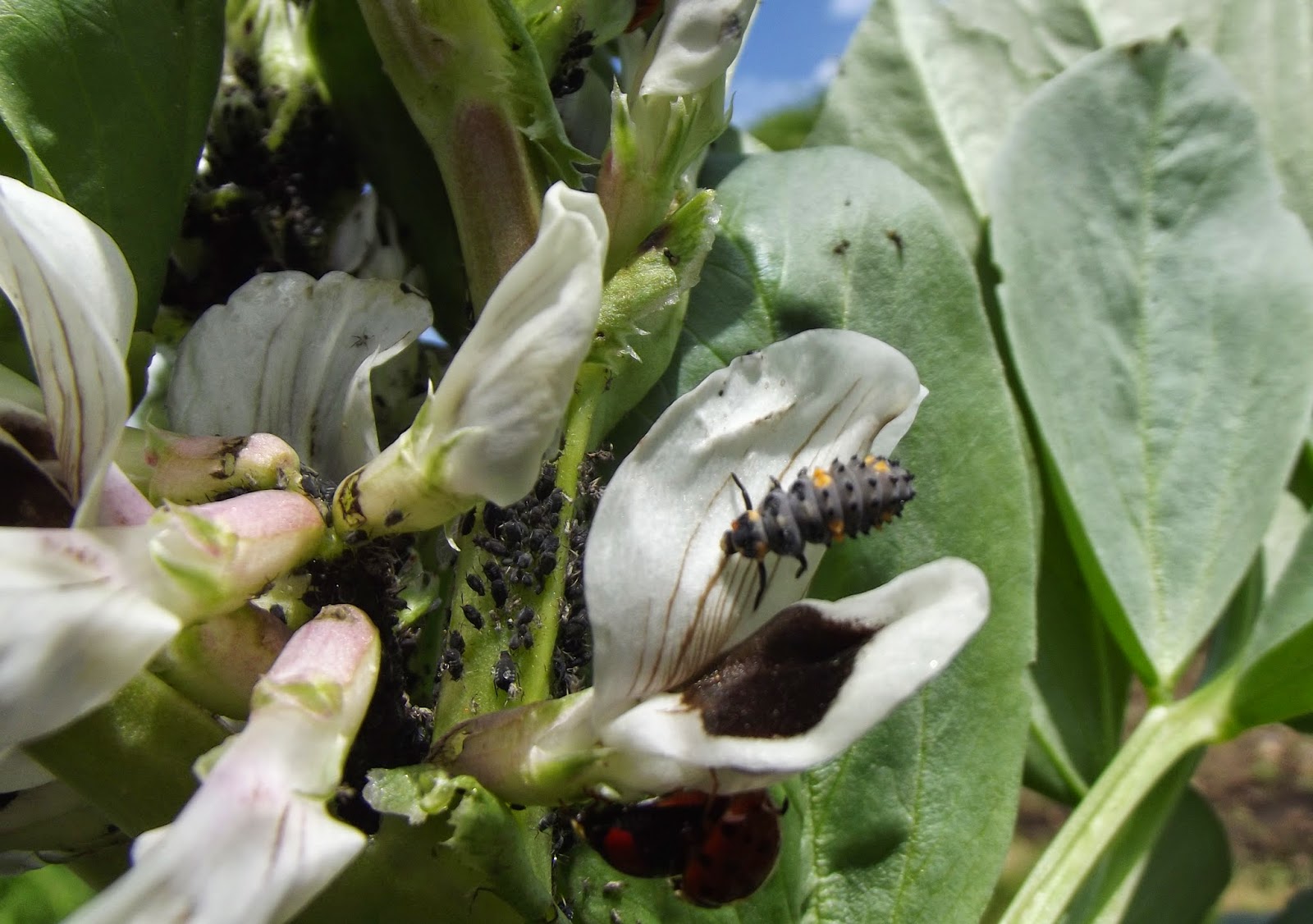
A week or two later there were plenty of ladybirds still around, and lots of their larvae too...
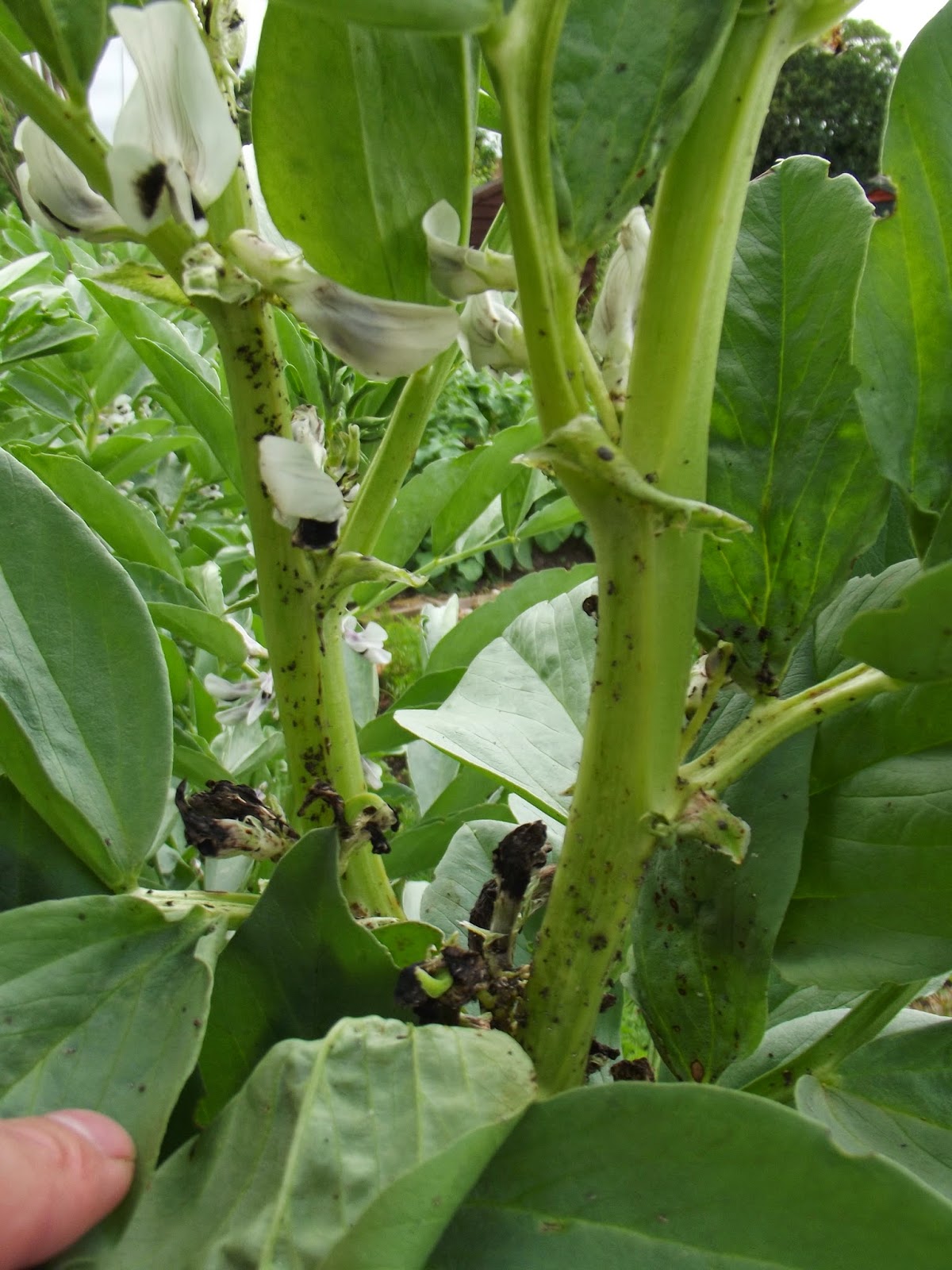
And a week or two after that - no more blackfly! Just a few corpses remain on the stems, ants picking over them rather sadly, and the bean pods are well on their way. That's 100% pest control, with no spraying, squishing or other interference from us. Hurrah!
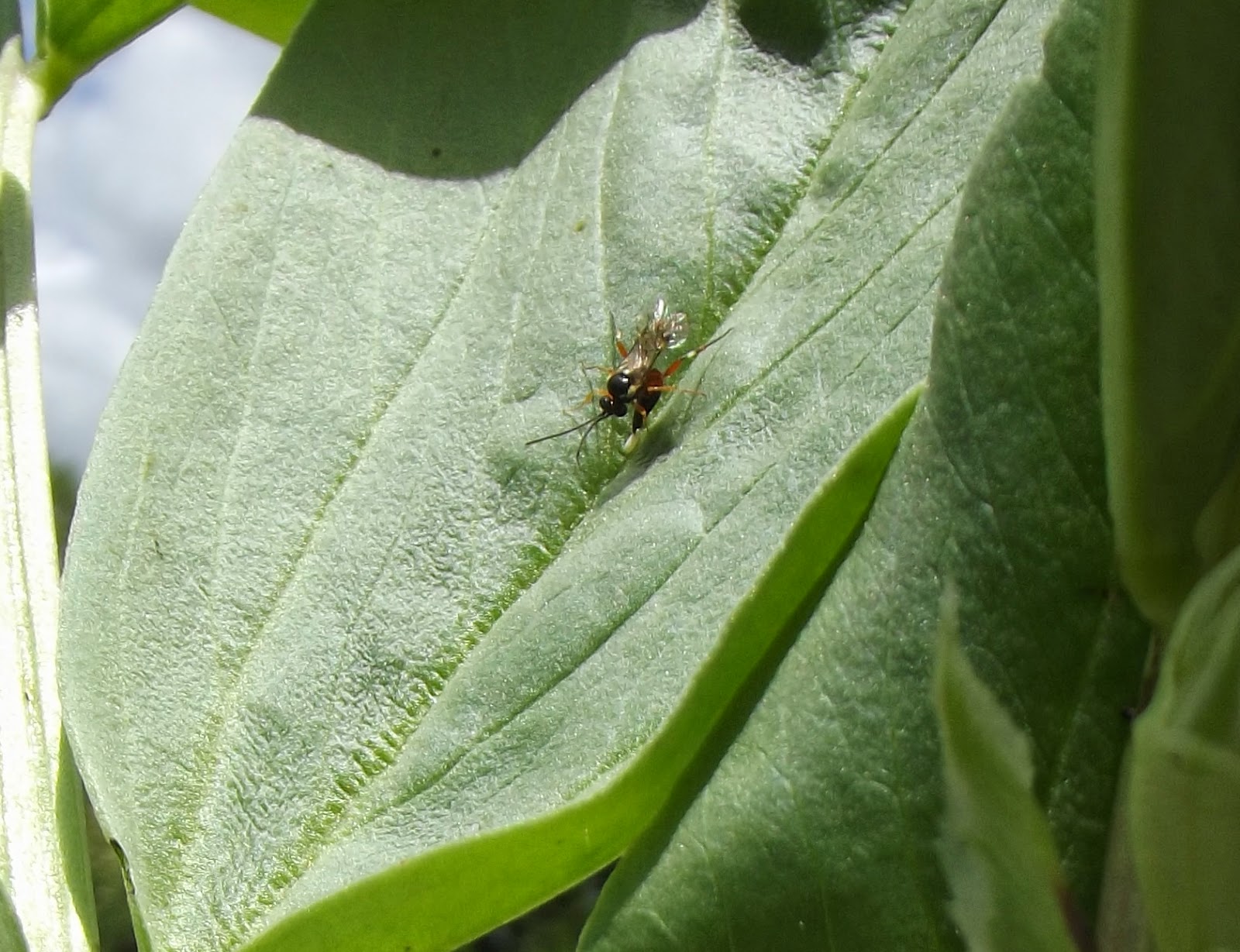
These broad beans are close to where we'd grown some phacelia as a green manure over winter - the phacelia was flowering by this point and covered with busy bees - and since ladybirds tend to like feathery-foliaged plants I presume this is what brought so many to the area. When I finally pulled the phacelia up I certainly found plenty more ladybirds sheltering there! A pesticide-free plot, no-dig beds, and plenty of sheltered places for insects to overwinter are helping make our plot even more hospitable to predatory insects such as these, and there are plenty of other plants we can grow to encourage them too; cosmos, dill, parsley, fennel, angelica, caraway, coriander and yarrow are all good choices which should be left to flower for best effect (slugs ate all my dill - boooo!) as well as flowering herbs such as mint, lemon balm and thyme. They're trickier to photograph, but there are definitely more little parasitic wasps on the plot this year too.
I love it when a plan comes together. Score one for permaculture!
One important factor when it comes to growing in harmony with nature is simply to give plants the right conditions to promote great health, and that means sowing at the optimum time so that plants don't have to struggle. As much as I like the idea of sowing broad beans in autumn so I can pick them super-early the next season, experience has shown this never turns out well on my plot and the plants get absolutely ravaged by pests come April. Broad beans sown from March onwards, however, seem to grow up stronger and have almost no pest problems.
Nevertheless, sometimes the unexpected happens, and a few weeks ago we noticed the stems of just a couple of our broad bean plants were absolutely covered in blackfly. I groaned, but then I looked closer...
There were ladybirds everywhere - at least 15 on the most affected plant - and many of them were busy mating or laying eggs. Knowing that adult ladybirds eat up to 1000 aphids per day, I didn't see much point rushing to squish all the offending aphids or pinch off the tops of the plants! I just left them to it...
A week or two later there were plenty of ladybirds still around, and lots of their larvae too...
And a week or two after that - no more blackfly! Just a few corpses remain on the stems, ants picking over them rather sadly, and the bean pods are well on their way. That's 100% pest control, with no spraying, squishing or other interference from us. Hurrah!
These broad beans are close to where we'd grown some phacelia as a green manure over winter - the phacelia was flowering by this point and covered with busy bees - and since ladybirds tend to like feathery-foliaged plants I presume this is what brought so many to the area. When I finally pulled the phacelia up I certainly found plenty more ladybirds sheltering there! A pesticide-free plot, no-dig beds, and plenty of sheltered places for insects to overwinter are helping make our plot even more hospitable to predatory insects such as these, and there are plenty of other plants we can grow to encourage them too; cosmos, dill, parsley, fennel, angelica, caraway, coriander and yarrow are all good choices which should be left to flower for best effect (slugs ate all my dill - boooo!) as well as flowering herbs such as mint, lemon balm and thyme. They're trickier to photograph, but there are definitely more little parasitic wasps on the plot this year too.
I love it when a plan comes together. Score one for permaculture!
| Parasitic wasp laying an egg |
Saturday, 29 March 2014
Allotment Week, Part Three - Green Manures and Ground Covers
I've dabbled a little with green manures before - mostly scattering phacelia seeds here and there at the last minute of the growing season and then cursing them when they finally appear the following spring right where I want to be planting stuff, and I can't bear to get rid of the lovely flowers before the bees have made the most of them... But last autumn I made my first serious attempt at using green manure properly.
The idea, in case you're not familiar, is that rather than leaving soil bare over winter (or at any time), you sow a cover crop of some sort. This crowds out weeds, keeps the fungal organisms in the soil happy, and protects the soil against leaching, erosion and so on - and when you're ready to plant crops again you dig in the vegetation to add organic matter to the soil. Now that I've seen our plot flood, I can see how important it can be to have roots in the ground, keeping the soil together and preserving its structure in case of extreme weather. The problem I typically have, though, is that I clear my beds too late to sow anything, or, as with the phacelia, poor planning means I want to plant right where a cover crop is doing its thing. I've also always been a bit wary about adding to my weed problem by experimenting with certain green manures which are reportedly not-so-easy to kill off when you're done with them! But after a lot of reading, I've identified a few green manures that I think suit my way of working:
Field beans, often grown for livestock feed and much-resembling a branching broad bean, are winter-hardy and germinate right up to November, so I can get away with sowing them really late in the season. And being in the bean family, their roots fix nitrogen in the soil.
Phacelia needs sowing by September latest, so I'm gonna have to try harder to clear some space for it late summer (maybe after the broad beans...?) but I think it's well worth persisting with for the lovely bee-friendly flowers it produces around May - if I can manage to leave it that long. It'd be ideal for whatever bed I'm going to grow squashes on, since they don't get planted out until May or June.
Mustard is a quick grower which is killed off by frost and can be left where it dies to decompose and mulch the soil. It's not quite the same as having something growing over winter, but I'm interested in giving it a try this year and seeing how it works out. Mustard is said to help keep soil pests under control too, so it might be good to grow this before potatoes.
White clover is hardy and long-lasting, and can be used as a 'living mulch' around perennial or widely-spaced plants. It keeps weeds down and has bee-attracting flowers in the summer, AND it fixes nitrogen. I'm going to start introducing this all over the place: we have already sown it over what is to be our squash bed (too late to sow phacelia here now for flowers by May) and I will start to scatter it round the edges of the perennial bed, letting it spread naturally. If it's growing where I want to plant, I'll simply pull it up to clear a space.
Buckwheat is a quick-growing summer green manure and to be honest, I'm not sure if I'm really going to fit it in anywhere, but like phacelia it has wonderful flowers, loved by insects, and it seems easy to deal with, so I wanted to give it a try and bought some seed anyway...
Back to 'allotment week', and our third big task was to clear last year's green manures and sow a new one. After our potatoes were harvested early last October we sowed field beans in their place, and they've grown pretty well through the mild winter, reaching a height of nine inches or so. But plans have changed since last autumn and I wanted to get some clover started here, so it was time for them to go.
Switching to no-dig gardening means we won't be able to dig our green manures into the soil, but instead we can cut down the growth and either use it as a mulch and let it decompose naturally on the surface, or add it to our compost heap. Leaving the roots in the soil means they'll add loads of nitrogen. Just look at the nitrogen-filled root nodules on this field bean stump I pulled up by mistake!
I cut the beans down at the soil surface, trying to get every shoot to reduce the chance of regrowth. I'm sure some of my allotment neighbours must have thought they were up-and-coming broad beans I was cutting down! The greens made a nice leafy layer on the compost heap.
I hand-weeded the whole bed after this - the beans don't keep weeds down as well as some other green manures are supposed to and there were quite a lot of young dandelions, docks and pineapple weed around. Then I raked and watered in some white clover seed over the whole bed. Hopefully it will have a good chance to get established as a living mulch before I plant the squashes out.
Mulching round plants helps to keep weeds down, reduce evaporation, and absorb excess rainfall in wet periods. A living mulch has all these benefits and more! It can attract and provide shelter for beneficial insects, it doesn't need replacing so often, and it has even been shown to decrease pest attacks in some vegetable plants. I'm really looking forward to seeing how this works out! Earlier this week I also read this interesting post by Alison of Backyard Larder, which talks about using edible plants such as wild strawberries and lambs lettuce as living mulches - something I am going to have to give some thought to now! I'm certain claytonia, one of my favourite home-grown salad leaves, would make a pretty great groundcover too, but judging by the way it gets everywhere in the garden I think it'd be a bit risky on the plot!
We did sow a spot of phacelia last year too, scattering it in odd patches where I pulled up individual squash plants. You can see what remains as a clump in the third bed in the picture at the bottom. I'd really like this to flower before I want to sow my root veg there... I don't think it's going to happen, but I'll wait and see, and if all else fails maybe I'll scatter a few seeds out of the way for the bees (and me!) to enjoy the flowers later in the summer!
So that's it for allotment week. We didn't get our potatoes in like we wanted to - no big deal as it's early yet - but we really did get a good headstart on the season, and did a lot of those little jobs that usually get pushed to the bottom of the list. If you follow this blog I'm sure you'll agree it's probably never looked this neat and tidy! Now, bring on some warmer temperatures and let's get some crops out there!
The idea, in case you're not familiar, is that rather than leaving soil bare over winter (or at any time), you sow a cover crop of some sort. This crowds out weeds, keeps the fungal organisms in the soil happy, and protects the soil against leaching, erosion and so on - and when you're ready to plant crops again you dig in the vegetation to add organic matter to the soil. Now that I've seen our plot flood, I can see how important it can be to have roots in the ground, keeping the soil together and preserving its structure in case of extreme weather. The problem I typically have, though, is that I clear my beds too late to sow anything, or, as with the phacelia, poor planning means I want to plant right where a cover crop is doing its thing. I've also always been a bit wary about adding to my weed problem by experimenting with certain green manures which are reportedly not-so-easy to kill off when you're done with them! But after a lot of reading, I've identified a few green manures that I think suit my way of working:
Field beans, often grown for livestock feed and much-resembling a branching broad bean, are winter-hardy and germinate right up to November, so I can get away with sowing them really late in the season. And being in the bean family, their roots fix nitrogen in the soil.
Phacelia needs sowing by September latest, so I'm gonna have to try harder to clear some space for it late summer (maybe after the broad beans...?) but I think it's well worth persisting with for the lovely bee-friendly flowers it produces around May - if I can manage to leave it that long. It'd be ideal for whatever bed I'm going to grow squashes on, since they don't get planted out until May or June.
Mustard is a quick grower which is killed off by frost and can be left where it dies to decompose and mulch the soil. It's not quite the same as having something growing over winter, but I'm interested in giving it a try this year and seeing how it works out. Mustard is said to help keep soil pests under control too, so it might be good to grow this before potatoes.
White clover is hardy and long-lasting, and can be used as a 'living mulch' around perennial or widely-spaced plants. It keeps weeds down and has bee-attracting flowers in the summer, AND it fixes nitrogen. I'm going to start introducing this all over the place: we have already sown it over what is to be our squash bed (too late to sow phacelia here now for flowers by May) and I will start to scatter it round the edges of the perennial bed, letting it spread naturally. If it's growing where I want to plant, I'll simply pull it up to clear a space.
Buckwheat is a quick-growing summer green manure and to be honest, I'm not sure if I'm really going to fit it in anywhere, but like phacelia it has wonderful flowers, loved by insects, and it seems easy to deal with, so I wanted to give it a try and bought some seed anyway...
Back to 'allotment week', and our third big task was to clear last year's green manures and sow a new one. After our potatoes were harvested early last October we sowed field beans in their place, and they've grown pretty well through the mild winter, reaching a height of nine inches or so. But plans have changed since last autumn and I wanted to get some clover started here, so it was time for them to go.
Switching to no-dig gardening means we won't be able to dig our green manures into the soil, but instead we can cut down the growth and either use it as a mulch and let it decompose naturally on the surface, or add it to our compost heap. Leaving the roots in the soil means they'll add loads of nitrogen. Just look at the nitrogen-filled root nodules on this field bean stump I pulled up by mistake!
I cut the beans down at the soil surface, trying to get every shoot to reduce the chance of regrowth. I'm sure some of my allotment neighbours must have thought they were up-and-coming broad beans I was cutting down! The greens made a nice leafy layer on the compost heap.
I hand-weeded the whole bed after this - the beans don't keep weeds down as well as some other green manures are supposed to and there were quite a lot of young dandelions, docks and pineapple weed around. Then I raked and watered in some white clover seed over the whole bed. Hopefully it will have a good chance to get established as a living mulch before I plant the squashes out.
Mulching round plants helps to keep weeds down, reduce evaporation, and absorb excess rainfall in wet periods. A living mulch has all these benefits and more! It can attract and provide shelter for beneficial insects, it doesn't need replacing so often, and it has even been shown to decrease pest attacks in some vegetable plants. I'm really looking forward to seeing how this works out! Earlier this week I also read this interesting post by Alison of Backyard Larder, which talks about using edible plants such as wild strawberries and lambs lettuce as living mulches - something I am going to have to give some thought to now! I'm certain claytonia, one of my favourite home-grown salad leaves, would make a pretty great groundcover too, but judging by the way it gets everywhere in the garden I think it'd be a bit risky on the plot!
We did sow a spot of phacelia last year too, scattering it in odd patches where I pulled up individual squash plants. You can see what remains as a clump in the third bed in the picture at the bottom. I'd really like this to flower before I want to sow my root veg there... I don't think it's going to happen, but I'll wait and see, and if all else fails maybe I'll scatter a few seeds out of the way for the bees (and me!) to enjoy the flowers later in the summer!
So that's it for allotment week. We didn't get our potatoes in like we wanted to - no big deal as it's early yet - but we really did get a good headstart on the season, and did a lot of those little jobs that usually get pushed to the bottom of the list. If you follow this blog I'm sure you'll agree it's probably never looked this neat and tidy! Now, bring on some warmer temperatures and let's get some crops out there!
Tuesday, 25 March 2014
Allotment Week, Part One: A Good Tidy Up
Every year, in the middle of March, Eddie and I take a week off together with the primary intention of getting the allotment in order for the growing season ahead. To be honest, it rarely works out like that; weather or household tasks usually get in the way and we don't tend to get as much done as we'd like - if I recall correctly, the plot was under snow this time last year! - but the intention is there. Well, last week was our "allotment week 2014", and I'm pleased to report that it was rather jolly good!
First things first: After seven years in the elements, our trusty storage bench neither functioned as a bench, nor kept the contents dry any more, and definitely needed replacing. You gotta have somewhere to sit!
I'd have liked to get something non-plastic, but wooden options are much more expensive and require more care and maintenance, so I confess we went for plastic again. We did dutifully take the old one to the 'rigid plastics' recycling bin at the tip though!
Our new bench looks pretty good and seems a bit more insect-proof than the first! Without a shed, we really rely on this space to keep all our tools and bits and pieces.
Next, we badly needed a new compost bin. Our old one is seven years old, just like our bench, and literally falling apart, with one side threatening to burst and spill compost all over the path...
With a few pallets from my brother's workplace and a bulk pallet delivery from the local Wood Recycling Centre, we soon had a new one built at the opposite end of the plot.
We moved it here for a few reasons: first, it's the shadiest part of the plot, under an elder tree, and the soil seems to be very poor here and full of roots; nothing we've planted here has ever done well. Second, the grass and nettles here go crazy and it'll be a sure way to stamp them out (while cutting any remaining nettle growth to feed to the compost). And third, we can use the sunny and now super-fertile spot where the old bin used to be for something else! Once we've finished deconstructing the poor thing and moved all the half-finished compost, that is...
You might have noticed we built a little flower bed next to the compost bin too, alongside the path. I lined it with thick cardboard to try to keep the grass out, and in it I've planted cowslip, forget-me-nots (not shown), wild pansies which self-sowed elsewhere on the plot, and some primrose seeds. I'll pop a few bulbs in later in the year, too. I'm not exactly sure which of these plants will thrive in this little semi-shaded spot and which won't, but hopefully it'll soon be a mini haven for pollinating insects!
Speaking of attracting wildlife, the pond needed a bit of TLC too. It was so overgrown this winter that we pulled basically all the vegetation out and then replaced a few small bits to regrow. Then the site flooded, and the pondweed (and the tadpoles) all floated away. Hmph. So we replenished it with oxygenating weed and put some barley straw in it to tackle the algae that's covering everything. It's looking much better already, and the water's so clear we can see the big fat frogs at the bottom. (It's rather silted up: the 'bottom' isn't nearly as deep as is used to be - so I think we still have more work to do on it...) Now when will those big fat frogs give us some more tadpoles? That's what I want to know!
The flooding, the inability to put anything else in our compost bin lest it exploded, and some neglect over winter had really left the whole allotment in a bit of a mess. The once-lovely blue frames round our beds are rotten now and fallen to pieces (and we're gradually replacing them with brick borders), our table made of bits of pallet fell apart when we tried to move it, and there was flood debris lying around here and there. So before we got down to any, like, actual gardening, we spent some time giving the place a good tidy up too; moving heaps of weeds from last autumn to the new compost bin, bagging up rubbish, and piling up stray wood. Quite a lot of stray wood... Now do we drag it all to the dump, or is this the time to give hugelkultur a try, hmmm...?
First things first: After seven years in the elements, our trusty storage bench neither functioned as a bench, nor kept the contents dry any more, and definitely needed replacing. You gotta have somewhere to sit!
I'd have liked to get something non-plastic, but wooden options are much more expensive and require more care and maintenance, so I confess we went for plastic again. We did dutifully take the old one to the 'rigid plastics' recycling bin at the tip though!
Our new bench looks pretty good and seems a bit more insect-proof than the first! Without a shed, we really rely on this space to keep all our tools and bits and pieces.
Next, we badly needed a new compost bin. Our old one is seven years old, just like our bench, and literally falling apart, with one side threatening to burst and spill compost all over the path...
With a few pallets from my brother's workplace and a bulk pallet delivery from the local Wood Recycling Centre, we soon had a new one built at the opposite end of the plot.
We moved it here for a few reasons: first, it's the shadiest part of the plot, under an elder tree, and the soil seems to be very poor here and full of roots; nothing we've planted here has ever done well. Second, the grass and nettles here go crazy and it'll be a sure way to stamp them out (while cutting any remaining nettle growth to feed to the compost). And third, we can use the sunny and now super-fertile spot where the old bin used to be for something else! Once we've finished deconstructing the poor thing and moved all the half-finished compost, that is...
You might have noticed we built a little flower bed next to the compost bin too, alongside the path. I lined it with thick cardboard to try to keep the grass out, and in it I've planted cowslip, forget-me-nots (not shown), wild pansies which self-sowed elsewhere on the plot, and some primrose seeds. I'll pop a few bulbs in later in the year, too. I'm not exactly sure which of these plants will thrive in this little semi-shaded spot and which won't, but hopefully it'll soon be a mini haven for pollinating insects!
Speaking of attracting wildlife, the pond needed a bit of TLC too. It was so overgrown this winter that we pulled basically all the vegetation out and then replaced a few small bits to regrow. Then the site flooded, and the pondweed (and the tadpoles) all floated away. Hmph. So we replenished it with oxygenating weed and put some barley straw in it to tackle the algae that's covering everything. It's looking much better already, and the water's so clear we can see the big fat frogs at the bottom. (It's rather silted up: the 'bottom' isn't nearly as deep as is used to be - so I think we still have more work to do on it...) Now when will those big fat frogs give us some more tadpoles? That's what I want to know!
The flooding, the inability to put anything else in our compost bin lest it exploded, and some neglect over winter had really left the whole allotment in a bit of a mess. The once-lovely blue frames round our beds are rotten now and fallen to pieces (and we're gradually replacing them with brick borders), our table made of bits of pallet fell apart when we tried to move it, and there was flood debris lying around here and there. So before we got down to any, like, actual gardening, we spent some time giving the place a good tidy up too; moving heaps of weeds from last autumn to the new compost bin, bagging up rubbish, and piling up stray wood. Quite a lot of stray wood... Now do we drag it all to the dump, or is this the time to give hugelkultur a try, hmmm...?
Monday, 2 July 2012
Allotment update. Gah!
I'm finally starting to face up to the fact this is a bad, bad year for growing. Between torrential rain and scorching sun, and thanks to weeds thriving through the mild winter, we still haven't cleared enough earth to plant out our sweetcorn, beans, sunflowers and squashes, and they're languishing and potbound at home. Grass is taking over everything and slugs are eating everything else. We've had the worst asparagus crop ever, and the spring hail that blasted blossoms off fruit trees and bushes is going to mean a pretty poor fruit crop too. All my cucumbers and gherkins (at home) yellowed and died for reasons unknown - I suspect they just couldn't take the prolonged cold, wet, dull weather - cutworms (or something) mowed down 90% of my broad beans, and my shallots have inexplicably gone straight to flower without swelling to any kind of decent size.
At least the potatoes are doing okay.
The garlic is looking good and the onions are doing all right, albeit with rather liberal applications of (organic) slug pellets to try to keep it that way.
And despite a lot of slug damage and a few weeds as always, we're picking plenty of strawberries, which are always a joy.
We've achieved one of our allotment goals at least - we've finally planted up the corner patch we hardly ever use (hard, root-filled soil) with some artichokes, perennial cauliflowers and heritage kales - all planted through weedproof fabric to try to keep things under control...
I'm gradually covering it with stones to protect the fabric (it's gonna take a while!), and plan to plant some sage between the brassicas to try to keep caterpillars at bay - apparently cabbage whites hate the smell. I'll believe it when I see it...
At home, our tomatoes, peppers, courgettes, herbs, mangetout, chard and French beans are doing all right, I've resown a couple of cucumbers, and I might actually manage to grow some aubergines this year - they're loving the extra warmth of the plastic greenhouse - so all is not lost.
But I'm gonna have to accept we're just not going to get everything done on the plot this year. Sigh.
Monday, 8 August 2011
Third time lucky!
After two failed attempts last year and the year before, I have grown my first sweet peas! They are 'Cupani', supposedly the original sweet pea, brought to England in 1699 by Sicilan monk Francisco Cupani. The colours are gorgeous and they smell divine. Most importantly, the bees think so too. It's often I'll go the trouble of growing something I can't eat later, so it's nice to see my efforts have paid off this time!
I can't blog today and not point you to this article in the Guardian about a play showing at the Edinburgh Festival this month called 'Allotment', set and performed... on a real allotment! Take a look.
Friday, 3 June 2011
Beezzzzzzzz
We grow a little patch of comfrey beside our bench on the allotment specifically for the purpose of cutting it and adding it to the compost, or rotting it in water to make plant feed. Comfrey has super-deep roots that draw all sorts of minerals and nutrients up from the subsoil, so it's very useful this way and can add a lot of nutrition to your garden. The best time to cut it is just before it flowers, as that's when the plants have the most energy which can then be passed on to the compost. But can I ever bear to cut it then? I'd miss out on the lovely flowers, and the bees would miss out too, and then I (and my beans and courgettes and strawberries and raspberries and squashes!) would miss out on all the bee action!
Sadly the bees eventually ruin all the delicate little flowers - they make a hole at the base of the flower for easier access, and their clingy feet bruise the petals!
Some of them still do it the old-fashioned way!
The comfrey is now hacked back down to the ground, and the old leaves decomposing quietly on the compost heap. The bees hung around for ages afterwards wondering where all the flowers had gone! Comfrey makes a quick comeback - there will be more flowers soon!
Sadly the bees eventually ruin all the delicate little flowers - they make a hole at the base of the flower for easier access, and their clingy feet bruise the petals!
Some of them still do it the old-fashioned way!
The comfrey is now hacked back down to the ground, and the old leaves decomposing quietly on the compost heap. The bees hung around for ages afterwards wondering where all the flowers had gone! Comfrey makes a quick comeback - there will be more flowers soon!
Subscribe to:
Posts (Atom)