Showing posts with label broad beans. Show all posts

Tuesday, 28 April 2015

Seedlings Update

When I first started growing things, March was the month of frenzied seed-sowing, but now, having had a few years experience, I've chilled out a bit and a lot more happens in April. That way I don't have so much trouble looking after young plants and protecting them from frost, and plants don't get pot-bound and unhappy in their containers. So yes, with those digging and structural tasks out of the way, April has been largely about seed-sowing and caring for baby plants.

At home I have several trays of tomato, pepper, squash and cucumber plants to look after. They live outside on sunny days and all over the kitchen table and floor overnight. It's a bit of a chore but hardens the plants off thoroughly and allows them all the light they desire, and it's only for a few weeks.


The raised bed is looking great, full of salad veg seedlings including lettuce, mustard, spinach, watercress, komatsuna, kohlrabi, carrots, radish, turnips and spring onions - it'll be a salad bar all summer, and there'll be space for pepper plants here too. Despite my fears and the poor performance last year, I'm seeing no growth problems at all so far - hooray!


The plastic greenhouse is full of seedlings too; chard and perpetual spinach, kale and cauliflowers, dill, leaf celery, achillea, cerinthe, stock, snapdragons, cosmos and marigolds.


The cerinthe seedlings are so pretty!


On the plot, parsnips, beetroots and turnips have germinated and I gave them a good hoeing between the rows yesterday to keep the weeds down. Soon I'll sow swedes and calabrese in this bed too, and plant out young celeriac, leeks and cauliflowers.


The bindweed in this bed and our perennials bed is bad, but all I can do now is keep pulling it and hope it gives up eventually! You can see below there are a few gaps among the broad beans. Not sure why... But I think I'll resow them next time I'm down there - it's not too late! I'm a bit ashamed to say I forgot to put insect-proof mesh over my carrots again, having failed last year too. I couldn't bear to see the carrots split and deformed from carrot fly again, and carrot fly are no doubt laying eggs by now, especially thanks to this mild spell! So I've hoed out all the seedlings and will resow them in a new location at the weekend and put the mesh in place straight away!


We've sown the flower bed with hardy annuals now too (cornflowers, vipers bugloss, ammi majus, bupleurum), though loads of tiny weed seedlings are coming up too and it's going to be a job to know which seedlings to weed out and which to keep!

April has rushed by but I'm glad it's nearly May - the month of planting-out! By the end of May the house will be seedling-free again and I should be able to stop worrying about cold nights and spring hailstorms!

Wednesday, 1 April 2015

Busy, busy!

Winter and early spring are great times for gardeners to do all sorts of non-growing jobs, like developing new areas and working on paths or buildings. I had a long list of these this year, and a long session on the allotment on Monday finally allowed us to finish up all but one of them. Just in time I'd say - 'early spring' is most definitely over now we've hit April!

We finally finished digging over what was previously our strawberry bed, which will be our flower patch this year and hopefully bring looooads more beneficial insects to the plot, as well as giving us flowers to cut and give away. I planted out the corncockle, calendula and clary sage I raised at home over winter, and I'll sow lots more here in a couple of weeks...


We've also planted up the herb patch round the pond and fruit trees. The focus here isn't on culinary herbs, as they're much more useful grown at home where you can grab them easily as you need them, but on flowering perennial herbs for insects and some herbs which I'd like to try drying for tea - lemon balm, camomile and peppermint. I've also popped a few perennial and self-sowing flowers in; some poached egg plant and primroses, an oriental poppy and an echinops. Maybe I should call it my 'companion plants patch' instead of my herb patch.


There's still a bit of work to do to get rid of the last of the grass in that corner by the pond... But it's so good to have this area looking nice again after it got swamped with grass and then we mulched it with manky cardboard over winter!


When we moved our compost bins last summer, there was a lot of good compost in the bottom that we just couldn't use at the time, so it's been heaped up in the place where the compost bins were ever since - we even grew our beans late last summer on the temporary raised bed it created...


...but now we've levelled the ground and moved the pile to this year's potato bed, where it will help build the soil. Our greenhouse will go in this spot this year. I hope the people on the next plot sort out their compost pile soon - it's a bit of a battle to stop it falling onto our plot, and there are brambles growing in it which keep finding their way into this bed.


While we were on the plot I also took the opportunity to sow some more seeds: I scattered some dill and parsley seeds in some carefully-chosen corners, and sowed beetroots, turnips and parsnips in rows in our roots bed, a foot apart, and covered with sieved compost.


Do you like my new plant labels? They look a bit industrial, but I was desperate to find something that would last for years, instead of perishing in the sun or rotting in the rain or just getting kicked about and lost in the dirt, and I hope these are the answer. They're from Amazon - I tried to find another supplier but couldn't - by a company called GardenMate. The permanent marker is supposed to last all season, and I'll be able to clean it off with a solvent cleaner to reuse them. That's the theory, anyway...

I'm happy that we have some broad beans on the plot at last, after a bit of a battle against mice eating the seeds! These were actually sown at home in a big seed tray at the beginning of March, and planted out this week. There are a few more sown direct here too, and covered with the same mesh to try to keep the rodents off this time. I have half a feeling I'm going to go down there and find little holes chewed right through the netting one of these days!


At home, I've sown lots more seeds, including celery, basil, dill, perpetual spinach, pea shoots and some more flowers; sunflowers, achillea and cerinthe. After a manic March, I think I've just about caught up with myself. The only things remaining are to clear and dig over the old asparagus bed, which is small and shouldn't take too long, and plant out my poor sweet peas which are getting desperate for some space and some support! Poor things!


I'm glad it's April now and the weather must warm up a bit more soon. I feel like I've got a bit of a holiday coming up over the long Easter weekend, and I'll probably get stuck into some more sowing: courgettes, squashes, brassicas and beans are next, as well as the bulk of the flower patch, getting the greenhouse sorted - and it'll be time to plant potatoes before we know it!

Saturday, 10 January 2015

Allotment Tour

We finally made it to the allotment this week, after having not managed to go at all during December, and did some much-needed catching up.

Here it is:


Of course, it doesn't look like much at the moment, but there's plenty going on, and considering what a battle we've always had with couchgrass and other perennial weeds we're pretty pleased with it. But it's been a long time since I took or shared any pictures of it, so let me give you the tour...

It's split roughly into seven sections, more by accident than design, with woodchip paths in between them, lined with bricks and some cheap weedproof fabric that isn't quite doing the job any more.


Section one, above, is where our compost bins are. We built them last spring to replace our old ones, in another spot, which were falling apart, and we relocated them here because it's under the shade of an elder tree and the soil is full of roots - everything we've grown here in the past has struggled a bit, so it's a good spot to use for something other than plants! The area covered in weedproof fabric over there has also been problematic, but we're determined to get it under control this year and plant a new fruit patch here, mulching heavily between the plants to try to beat the couchgrass!


Section two is the first of our three rotation beds. Last year we grew potatoes here - now the near half is covered in a phacelia green manure (and quite a few annual weeds) and the far half has rows of spinach and chard (again with the weeds...) There's also a row of scabiosa I planted out too late to flower, but it seems to be coming through the winter a treat! After we clear this patch in late spring we'll grow squashes and pumpkins here.


Section three (our second rotation bed) is where our root crops were grown, though it's beginning to look a little sparse now. The spring cabbages in the foreground are at a variety of stages - we picked our first this week but others are not ready yet, and one has rotted! :-( Beyond that is a small row of calabrese which should produce in the spring, some carrots, parsnips, swedes, celery and leeks. We've just finished the beetroots. When this patch is clear in early to mid spring, we'll plant our potatoes here.


Section four (our third rotation bed) was pumpkins and squashes last year, but now it's bare, which is pretty disappointing because I sowed most of it with field beans (a green manure) and broad beans in November. (The cardboard is there to protect a patch I left unsown, intending to make a second sowing in March.) I guess I left it just a little too late; they say early November is the latest you should sow but we did it near the end of the month. Still, never mind, there's plenty of time to sow more broad beans, and our root veg and leeks will go here from March onwards.


Section five is what we call our perennials bed, though it's not the only one! We planted it last year with asparagus (along the left hand side) strawberries (in the raised beds) and globe artichokes (far end, under little mounds of woodchip mulch and black plastic to protect the crowns from frost), as well as some parsley, sage, lavender and lemon balm. It's done okay so far but the plants are still getting established - hopefully they will be even better this year. I'd also like to plant some perennial kale among the sage - supposedly sage keeps cabbage white butterflies away, but we will see!


Section six is home to our pond (far end), two columnar 'spur' fruit trees, and our old strawberry patch (this end) which is now under a mulch of thick cardboard until we can dig it over. There used to be a really nice herb garden planted around the pond and the trees, but over the years it's become swamped with couchgrass and very few plants are left, so this area is up for redevelopment this year... We will replant the herb garden - perhaps through a membrane to keep the grass down - and the old strawberry bed will become a flower patch! We'll also be giving away the pear tree - we don't like the fruit! - and we need to right the very wonky apple tree before it goes over! We'll have to do this soon while the trees are still dormant - they won't like having their roots messed with.


Finally, section seven is where we keep our tools in our storage bench, and it's where our old compost bins were (on the right). That spot is now a lovely fertile patch where we'll put a plastic greenhouse this year for a few tomatoes, peppers and cucumbers. We've also got a little comfrey patch here which we use to feed the compost and make plant feed, and at the far end is a little bed which used to grow asparagus, though it's almost all been choked out by grass - another redevelopment project for this year. I think it's just big enough for a couple of bean teepees... or I might decide to grow the beans at home and grow sweet peas here instead, or some more fruit! I'd also like to narrow this path a bit to maximise the growing space in section six on the left.

You'll notice there's not much space here for summer fruiting crops like French beans, courgettes and tomatoes, nor salads or brassicas. A few years ago we decided we were better off only growing reasonably low-maintenance veg at the allotment, since we struggle to get here enough to look after them. It's working out really well, and we can still grow those things at home where we can keep an eye on them and pick them regularly! We don't grow many brassicas simply because we find them so problematic (what with flea beetles, whitefly, rootfly, slugs, three kinds of caterpillars and pigeons all wanting a share!) but we are adding them to our repertoire gradually. And we don't grow onions or shallots because we have dreadful white rot in the soil which destroys the crop, but we manage a bit of garlic and plenty of spring onions at home, and I'm sure we'll return to onion-growing at some point...

During our trip on Monday we pruned the apple and pear trees and made a good job of weeding and tidying the perennials bed, cutting down last year's asparagus ferns, herb flower spikes and sunflower stems. Here's a 'before' picture!


There's much more weeding to be done before things start growing again in spring, and we need to make a start on that digging very soon too. We're all crossing our fingers for no flooding this year, so we can keep at it!

Sunday, 4 January 2015

2014

It's easy to think that winter is a quiet time for gardeners, but there's plenty to be done. Between harvesting winter crops, checking fleeces and stakes, winter digging, construction projects and maintenance, nurturing overwintering plants and looking after little seedlings in the greenhouse, there's also plenty of planning to be done, and it inevitably involves a good look back over the past growing season to see what worked and what didn't.

2014 was a pretty bumper year for us, but there are always lessons to be learned. Our plot was under a couple of feet of floodwater for a week early on in the year, but thankfully it didn't do any real damage or set us back - we just had some extra clearing up to do, and to be patient in waiting for the soil to dry out again. We've settled on a new 'structure' for our plot, with three main beds in a rotation plus a number of perennial areas, and we made several new paths. We failed to cultivate the difficult far corner of the plot or our old strawberry bed, but we did clear them and cover them up to stifle the weeds and make the job easier later. We planted a new perennials bed with asparagus, artichokes, strawberries and herbs - hopefully some perennial kale will go in here too. We built new compost bins in a new area, and grew beans on the super-fertile patch where the old bins were. We also upped our growing game in the garden at home, converting a shrub bed to grow vegetables and adding three raised beds - more on all that in another post.

2013, compost bins. 2014, French beans. 2015 greenhouse!
We tried a new way of adding fertility to our plot; the 'Complete Organic Fertiliser' recommended by Steve Solomon for rebalancing soil nutrients for maximum plant health and nutrition. Though I can't quantify the results or compare to a 'control' area, I have to say everything on the plot just grew better than ever with virtually no problems, and I am quite sure the COF helped that happen. I will be going one step further this year: sending some soil samples off for laboratory analysis and creating a custom mix to balance it even better.

Another thing we trialled was 'Rootgrow' or mycorrhizal fungi, endorsed by the RHS; a mix of natural fungi that forms symbioses with plant roots and gives plants access to more nutrients and water. It's primary recommended use is in planting trees and shrubs, to help them establish quicker and more easily, but it is supposed to help any plant so I used it under every single crop to see what happened. In theory it should drought-proof plants and help fruits and roots to swell more steadily and evenly. In practice, though we had great growth almost everywhere and the new asparagus and artichokes established without a hitch, my container potatoes gave identical yields whether I used the Rootgrow or not, the newly-planted strawberries didn't establish well for some reason, squashes and swedes came in a huge mix of sizes, and my celeriac completely failed to swell, so I'm not entirely convinced...

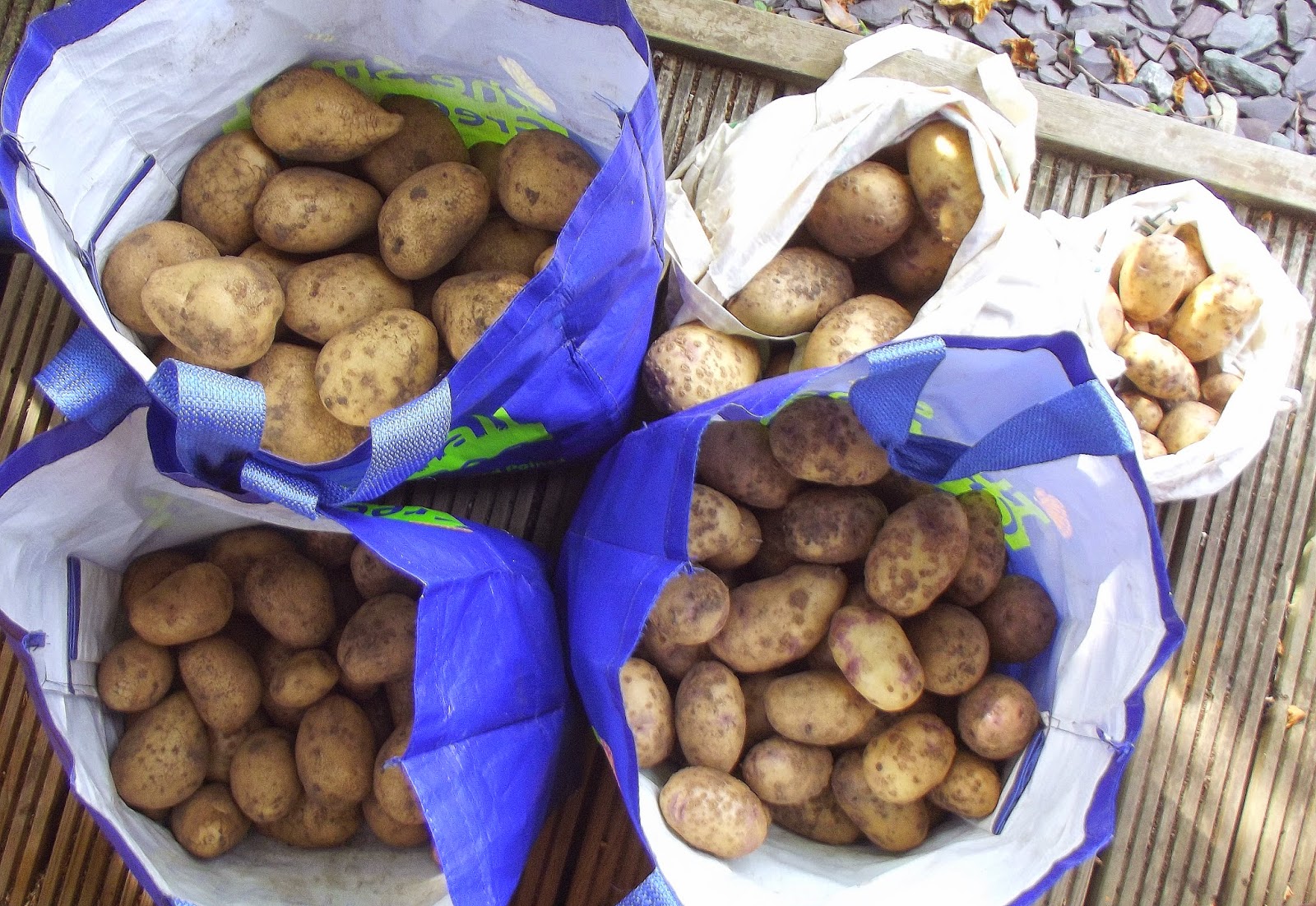
Potatoes did wonderfully - we managed to grow a kilo for every week of the year. (If only I had somewhere better to store them - they are now sprouting and turning soft). Scab was very bad on our old favourite Kestrel, but we also tried Pentland Crown this year, which makes a much better baked jacket spud, seems to store slightly better, and doesn't suffer as much scab, so we will be growing more of these in 2015! On reflection I wondered if I should have left the lime out of the COF applied to this area, as it probably made it worse.


Carrots were our best ever, even though we couldn't find our enviromesh in time to protect our first sowing so we lost some to carrot fly - our later sowings did brilliantly and they even won a first placing in the allotment association show! We have only succeeded with carrots since we added lime to our soil - perhaps they need the extra calcium.


Pumpkins and squashes did brilliantly too; we brought home 18 lovely fruits and many are still sitting around happily on windowsills and doormats waiting to be eaten. Arguably we might have expected even more squashes from our eight plants - some plants only gave us one or two fruits - but they suffered from quite a lot of weed competition... Turns out it wasn't such a good idea to undersow them with clover; clover actually gets quite big and unruly when it wants to!


Leeks, parsnips, swedes, broad beans and beetroots all got along just fine. Beetroots really are just THE easiest vegetable to grow - nothing seems to stop them. I only wish Eddie liked them better as I'm eating them mostly by myself. The leeks are suffering from some allium leaf miner and I think we should cover them with mesh next year. We only grew one variety of French beans - a local heritage variety called Ryder's Blue Coco - and I sowed them rather late due to a lack of space earlier on. They were delightful - really tender - and we were eating them long after our neighbours' beans had finished, but we couldn't save any seeds from them because they didn't have time to mature before the first frost, which was a great shame. I do have just a few seeds left so I MUST do better at this next year!


Our chard and winter spinach, planted out in late summer, suffered a bit of neglect due to an extremely busy autumn, but though we lost a few to slugs and snails, they grew superbly and we really should have harvested more from them before the winter. We will still be able to pick from them when growth starts again in early spring though. Our first attempt at fennel suffered the same neglect but also grew very well indeed, and again we failed to harvest it in good time. It's certainly one to try again this year though. We also have a few spring cabbages nearly ready which have done really well - a nice compact variety called Pixie which, assuming it tastes good come spring, I will certainly grow again.

2014 was our first year growing both celery and celeriac. The celery did okay, though it was a bit thin and stringy (I don't usually eat it raw much anyway - just use it for soups, stocks and stews - so that doesn't really matter). The celeriac was a huge disappointment; no root to speak of at all, and I'm not sure why or what to do differently next year...


The importance of beneficial insects really, properly hit home to me last spring when scores of ladybirds descended on our blackfly-infested broad beans and cleared the whole lot up for us. I'm pretty sure there were more ladybirds around than before because I'd grown phacelia in the next bed over winter - ladybirds seem to be attracted by lacy foliage and as we cleared it up in the spring there were loads of them among it. I always grow a few flowers here and there, but now I will grow more!


In the home garden, our courgettes and tomatoes were just fabulous and kept me busy finding new ways to use them! The tomatoes succumbed to blight in the late summer, as they always do. We tried a local heritage variety of tomato - 'Ryder's Midday Sun' - but sadly didn't find them up to a good standard; the plants grew slowly, the tomatoes were watery and lacked flavour, and they were first to succumb to blight! Maybe they'd do better in a greenhouse... But while I'm very glad to have had the opportunity to try them, I'm not sure I have the space to persist with them. Cucumbers and salad greens in our new raised beds did not do well at all and I'm sure there was a problem with the soil - more on that in another post... Peppers did okay but gosh, they take so long to ripen! We were disappointed in a new variety we tried - 'Hebar' - which had very thin flesh and not much flavour at all. The seller described it as "particularly sweet and tasty" so I'd love to know what anyone else thinks of them! We have bought a plastic greenhouse to put on the allotment this summer, which should be just big enough to grow a few tomatoes, cucumbers and peppers in. This way we hope to have blight free tomatoes and earlier peppers! We'll still grow some at home too though...

Kaibi Round, Ancho Grande, Hebar, Lipstick
The enviromesh over the kale bed got torn in high winds early in the year, and by late summer caterpillars had stripped the plants as I was too lazy to do anything about it... Thankfully some of the plants made a surprisingly good comeback though! Another mistake I will not repeat next year is planting French beans behind courgette plants. After the courgettes had been growing a month I couldn't reach the beans at all, and had to leave them all to pick for drying instead! The mangetout was great - we could hardly keep up with it - and we were really impressed by variety 'Carouby de Maussane' with giant pods! I have never grown ordinary peas, as frozen British peas are extremely good and convenient, and all the podding seemed like too much of a faff, but last year we did grow a multipurpose mangetout/podding pea - 'Ezeta's Krombek Blauwschokker' - and when they got too big to eat as mangetout I was forced to pod a few... They were so lovely that I might just add a few real podding peas to my garden this year...

Carouby de Maussane mangetout - still gorgeously sweet and tender at this size!
The 'perennial salad mix' from Suffolk Herbs turned out to be a mix of chicories and radicchios, which have grown well but... I just don't really like the taste. Admittedly I should have read the back of the pack more carefully, but this picture is a bit misleading I think!


All in all, we will do much the same this year as last, but here are the things we plan to do differently:
  • Grow more flowers - to include a cutting-flower patch!
  • Do even more to balance our soil nutrition according to Steve Solomon's great book 'The Intelligent Gardener'
  • Add a plastic greenhouse to the allotment to grow a few summer veg under cover.
  • Don't plant anything behind courgettes!
  • Improve raised bed soil.
  • Buy more enviromesh, to replace torn piece and cover leeks too.
  • Keep squash bed weed-free - perhaps mulch beneath plants - and grow fewer plants so they don't get so tangled.
  • Grow some proper peas, perhaps.
  • Try harder with celeriac.
  • Grow more Pentland Crown potatoes and less Kestrel - and try another new variety too.
  • There are always new varieties to try; this year new ones for us include oyster leaf, beefsteak plant, pink banana squash, skykomish tomatoes (supposed to have some blight resistance), marconi rosso peppers, and we're going to attempt to grow cauliflowers for the first time, since we buy them quite a lot...
  • We also plan to plant a new fruit patch on the long-neglected and difficult far corner of the allotment, and clear and replant our overgrown herb bed.
Frosty radicchio

Tuesday, 23 September 2014

Crop Rotation Confessions...

I have a confession to make. Crop rotation on a small plot has always rather baffled me. On a big plot it makes sense - on a big plot you can afford to leave a patch of ground empty in preparation for a later crop, or to sow a green manure in the middle of summer just for the heck of it - but on a small allotment where you want to make the most of every space all year round, it can be a real juggling act trying to get your potatoes out early enough for your purple-sprouting broccoli to go in, or clearing your onion patch in time to sow beans and corn, or figuring out what on earth to grow after you've harvested your squashes as late as October - and who uses exactly the same amount of space for every crop group anyway??

Traditionally, the main groups in a crop rotation are potatoes and roots, brassicas, beans, and 'other veg'. The potatoes are manured to enrich and slightly acidify the soil (preventing scab), heavy-feeding beans follow in the nicely broken-up ground after the potatoes are dug, then (often after an application of lime,) leafy brassicas to make good use of the nitrogen the bean roots accumulate. Then, presumably, you throw sweetcorn, cucurbits, tomatoes, leafy greens and everything else in together after that. Sounds simple enough, but questions abound. Do you grow swedes with the root crops or the brassicas? Aren't tomatoes in the same family as potatoes? Cucurbits take up way more space than anything else! And aren't you supposed to avoid manuring carrots?

I don't know, maybe I overthink these things - maybe I'm just too keen to abide by all the rules and to do it "right". But I think, after eight years on our allotment, I've finally cracked it!

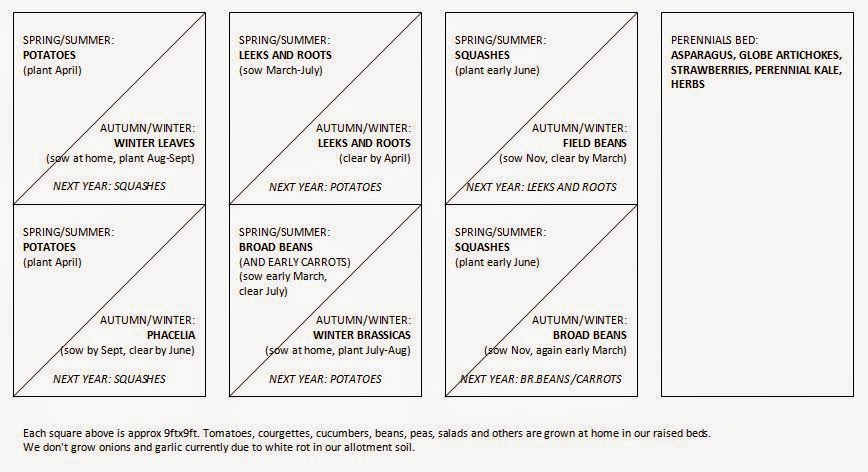
This is partly thanks to slimming down the number of crops we grow on the allotment anyway - we don't grow onions and garlic due to white rot spores in our soil, and we prefer to keep salad leaves and quick-ripening summer crops like French beans, courgettes and tomatoes at home so we can pick them more regularly. On the allotment we grow the lower-maintenance stuff: potatoes, squashes, root veg, broad beans, leeks, and a limited amount of winter brassicas and spinach-type leaves (plus some perennials in a permanent area). We've grouped broad beans, leeks and root veg roughly together: together they take up about the same amount of space we use for more space-hungry crops (potatoes and squashes), and it means we can follow our broad beans (which finish around midsummer) with winter brassicas, thus keeping our earlier-sown swedes in the same area as our other brassicas.

Ladies and gents, I give you our brand new crop rotation plan! (Click pic to enlarge.)


This rotation also allows for two squares to be sown with green manures over winter to add high-nitrogen organic matter to the compost heap, shelter wildlife and protect the soil. Phacelia and field beans are my two favoured green manures since field beans add vital nitrogen to the soil and can be sown as late as November, and phacelia attracts lots of insects and can be sown as late as September. Following squashes with winter-hardy beans means the timing for sowing is perfect; likewise with the winter leaves following the potatoes, and the winter brassicas following the broad beans. And even though we grow most of our beans at home, our allotment soil still gets a nitrogen injection thanks to the broad and field beans. Of course, this rotation doesn't include everything and I should do my best to efficiently rotate our crops at home too, but those on the allotment are the most important ones to rotate: beans for nitrogen, potatoes which are prone to damage from buildups of slugs and eelworms, and brassicas which are susceptible to clubroot, a very nasty fungal disease.

So far it's all going swimmingly. The potatoes are out (an awesome 28kg of Kestrel and 19kg Pentland Crown!) and the winter leaves are in; two rows of chard, two rows of winter spinach and a row of fennel (there's room for more, actually - I must do that). The squashes have finished a little earlier than usual, which means we have plenty of time to clear the soil for winter beans. The leeks, root veg, celery, spring cabbages, kohlrabi and pak choi are coming along nicely and we will slowly harvest them all winter long, making the most of all our space. Brilliant!


There is one complicating factor looming, in that we are planning to clear our old strawberry and asparagus beds (not shown in the plan above) over winter and put them to new use next spring. These two areas don't really fit into the plan so I'm a bit puzzled about what to do with them (and I rather wish we could move our pond and our apple tree into one, which would help us make better use of the other!). Should we grow runner beans or courgettes on the plot again after all? Shall I expand my collection of perennials? Is it time to give in and plant some fruit bushes? Good job I've got all winter to think about it...

Friday, 27 June 2014

Score One for Permaculture

When you think of organic growing, there are a lot of things that might come to mind. You might think of nasty organic pesticides such as pyrethrum or diatomaceous earth; you might think of arduous slug-patrols and endless couchgrass; you might think of sterile white insect-proof mesh covering up beautiful rows of crops. But the best method for growing organically, in my opinion (though slug patrols and insect-proof mesh certainly have their places!), is to work in harmony with nature as much as possible - the permaculture way; sustainable and low-maintenance - and we've seen a great example of this on our plot over the last month.

One important factor when it comes to growing in harmony with nature is simply to give plants the right conditions to promote great health, and that means sowing at the optimum time so that plants don't have to struggle. As much as I like the idea of sowing broad beans in autumn so I can pick them super-early the next season, experience has shown this never turns out well on my plot and the plants get absolutely ravaged by pests come April. Broad beans sown from March onwards, however, seem to grow up stronger and have almost no pest problems.

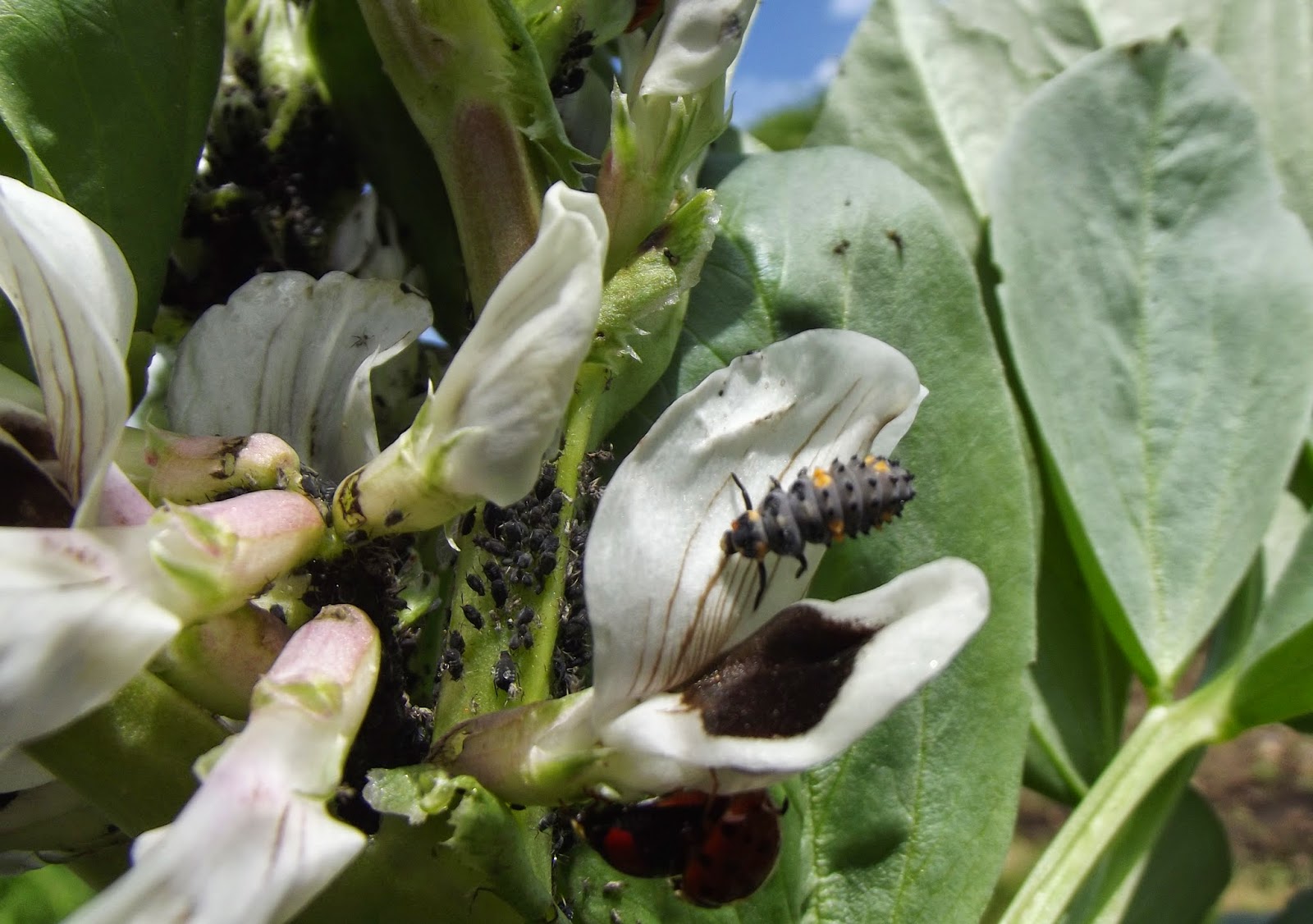
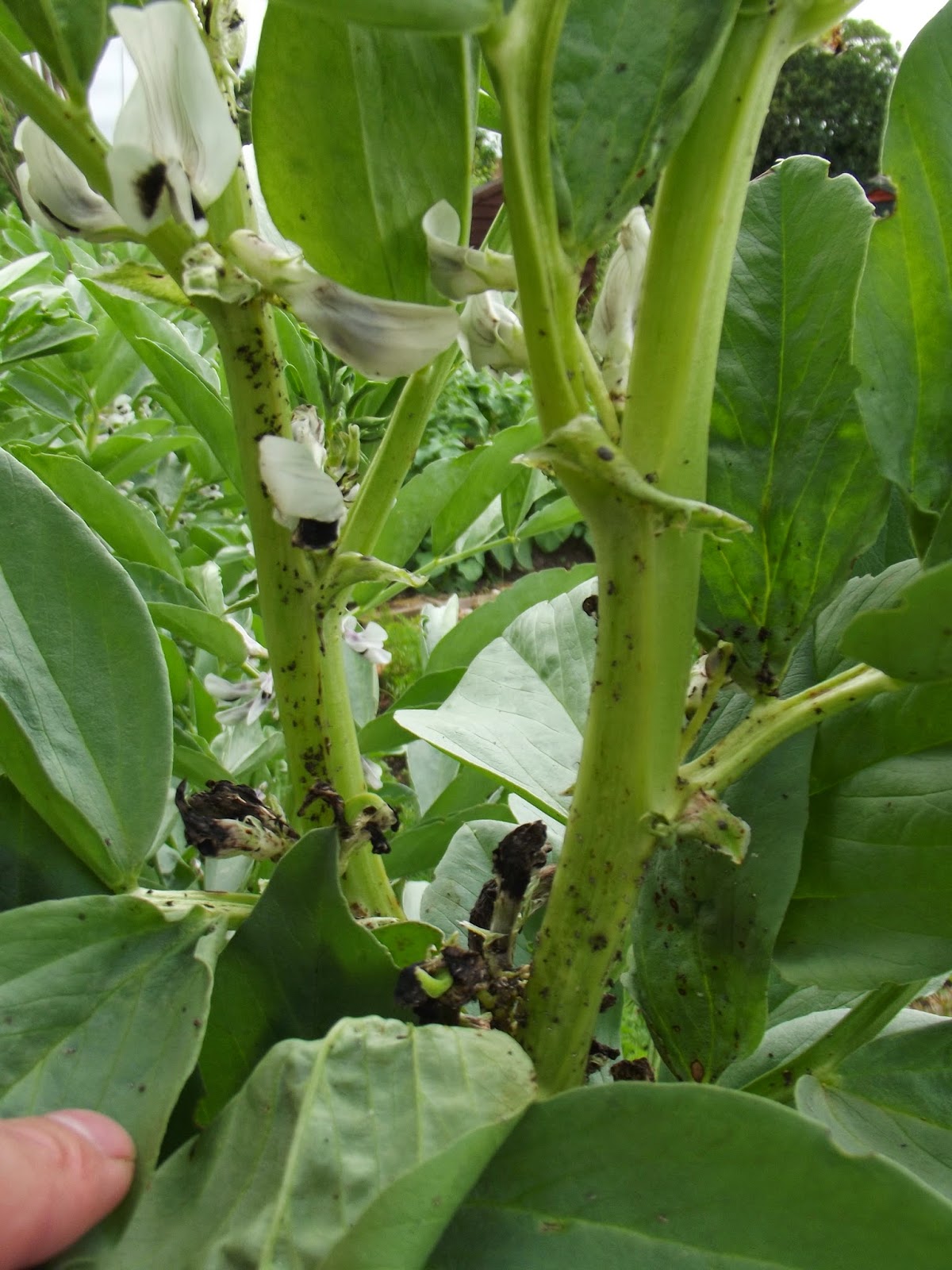
Nevertheless, sometimes the unexpected happens, and a few weeks ago we noticed the stems of just a couple of our broad bean plants were absolutely covered in blackfly. I groaned, but then I looked closer...


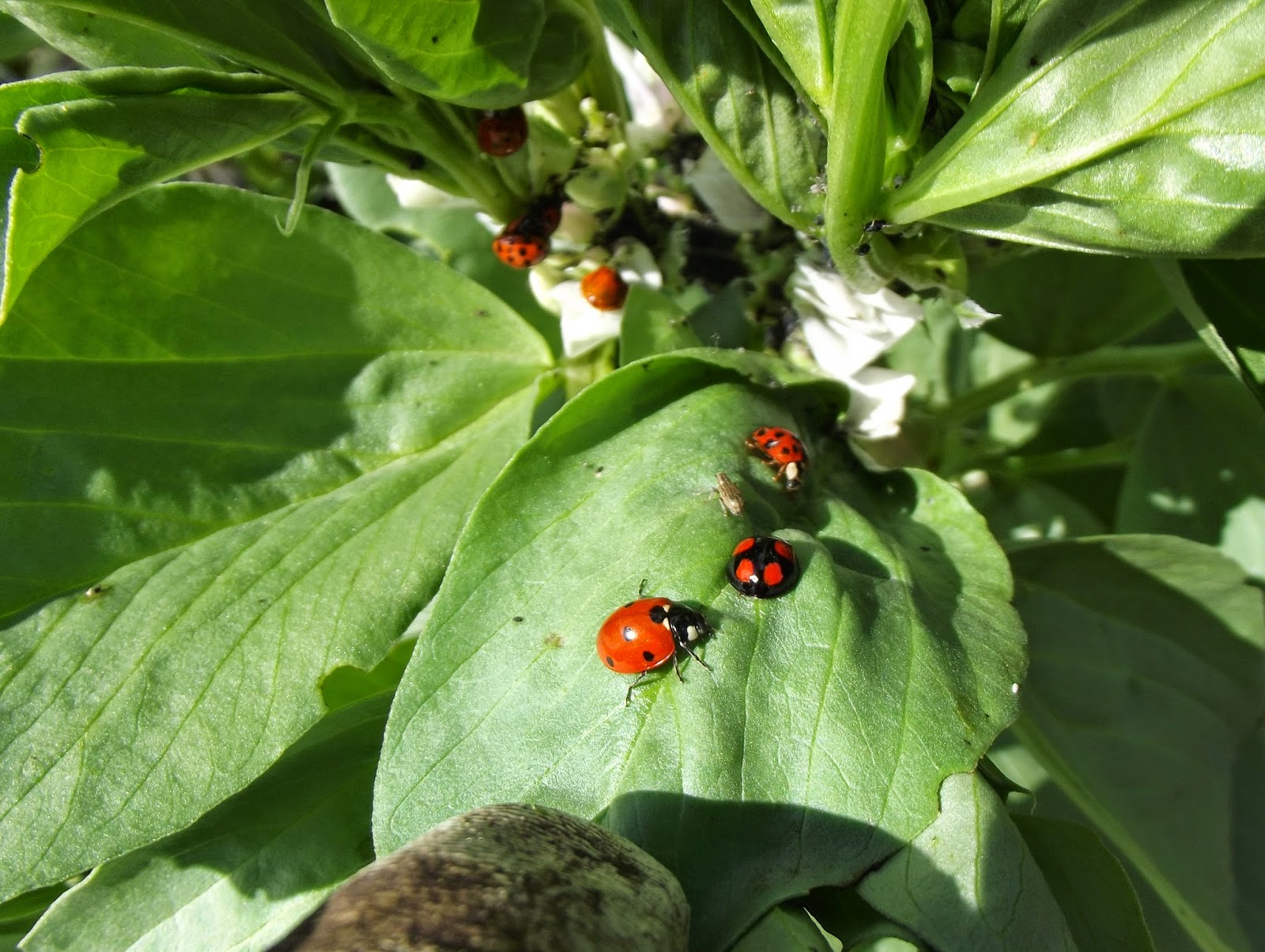
There were ladybirds everywhere - at least 15 on the most affected plant - and many of them were busy mating or laying eggs. Knowing that adult ladybirds eat up to 1000 aphids per day, I didn't see much point rushing to squish all the offending aphids or pinch off the tops of the plants! I just left them to it...


A week or two later there were plenty of ladybirds still around, and lots of their larvae too...


And a week or two after that - no more blackfly! Just a few corpses remain on the stems, ants picking over them rather sadly, and the bean pods are well on their way. That's 100% pest control, with no spraying, squishing or other interference from us. Hurrah!

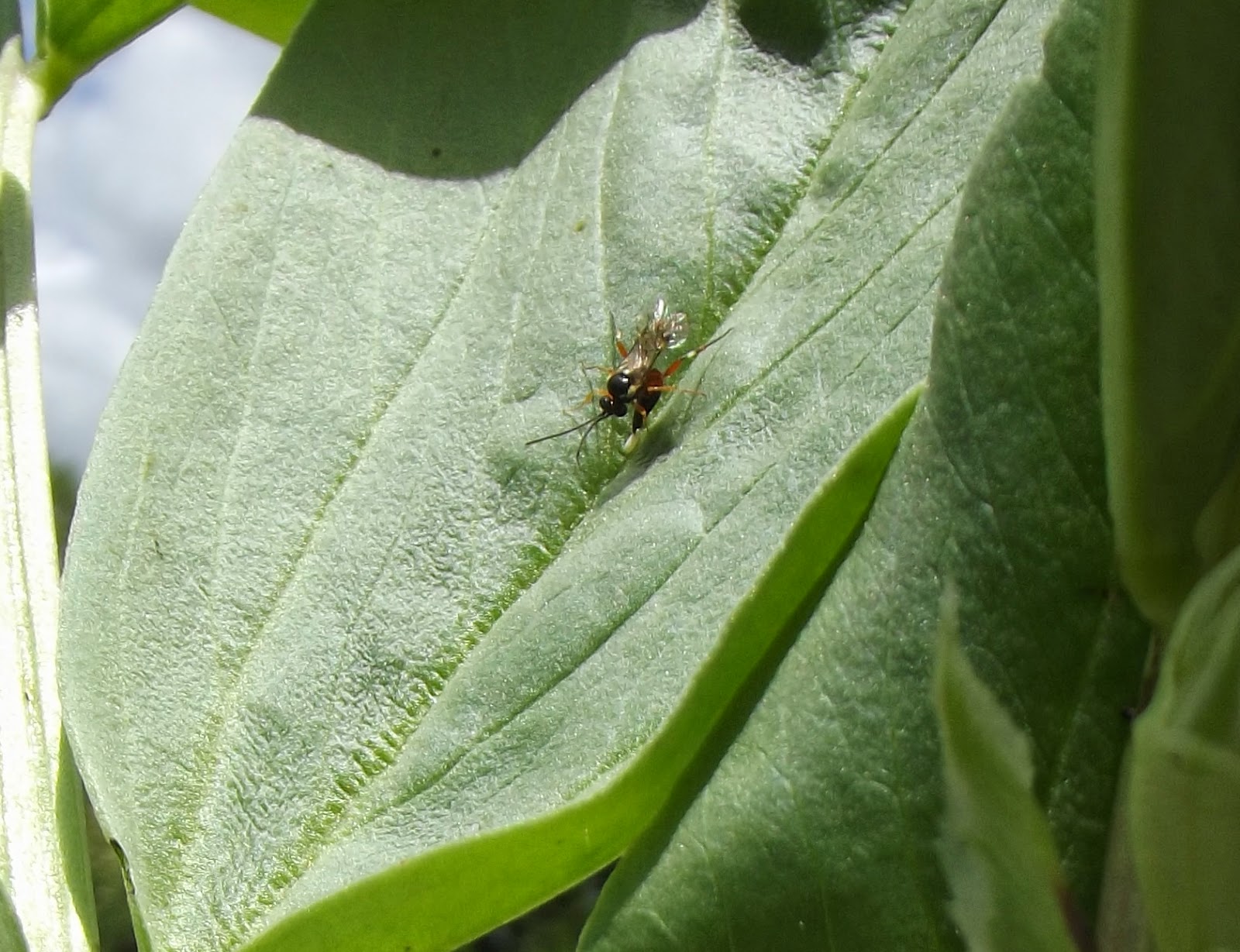
These broad beans are close to where we'd grown some phacelia as a green manure over winter - the phacelia was flowering by this point and covered with busy bees - and since ladybirds tend to like feathery-foliaged plants I presume this is what brought so many to the area. When I finally pulled the phacelia up I certainly found plenty more ladybirds sheltering there! A pesticide-free plot, no-dig beds, and plenty of sheltered places for insects to overwinter are helping make our plot even more hospitable to predatory insects such as these, and there are plenty of other plants we can grow to encourage them too; cosmos, dill, parsley, fennel, angelica, caraway, coriander and yarrow are all good choices which should be left to flower for best effect (slugs ate all my dill - boooo!) as well as flowering herbs such as mint, lemon balm and thyme. They're trickier to photograph, but there are definitely more little parasitic wasps on the plot this year too.

I love it when a plan comes together. Score one for permaculture!

Parasitic wasp laying an egg

Monday, 2 July 2012

Allotment update. Gah!


I'm finally starting to face up to the fact this is a bad, bad year for growing. Between torrential rain and scorching sun, and thanks to weeds thriving through the mild winter, we still haven't cleared enough earth to plant out our sweetcorn, beans, sunflowers and squashes, and they're languishing and potbound at home. Grass is taking over everything and slugs are eating everything else. We've had the worst asparagus crop ever, and the spring hail that blasted blossoms off fruit trees and bushes is going to mean a pretty poor fruit crop too. All my cucumbers and gherkins (at home) yellowed and died for reasons unknown - I suspect they just couldn't take the prolonged cold, wet, dull weather - cutworms (or something) mowed down 90% of my broad beans, and my shallots have inexplicably gone straight to flower without swelling to any kind of decent size.

At least the potatoes are doing okay.


The garlic is looking good and the onions are doing all right, albeit with rather liberal applications of (organic) slug pellets to try to keep it that way.


And despite a lot of slug damage and a few weeds as always, we're picking plenty of strawberries, which are always a joy.


We've achieved one of our allotment goals at least - we've finally planted up the corner patch we hardly ever use (hard, root-filled soil) with some artichokes, perennial cauliflowers and heritage kales - all planted through weedproof fabric to try to keep things under control...


I'm gradually covering it with stones to protect the fabric (it's gonna take a while!), and plan to plant some sage between the brassicas to try to keep caterpillars at bay - apparently cabbage whites hate the smell. I'll believe it when I see it...

At home, our tomatoes, peppers, courgettes, herbs, mangetout, chard and French beans are doing all right, I've resown a couple of cucumbers, and I might actually manage to grow some aubergines this year - they're loving the extra warmth of the plastic greenhouse - so all is not lost.


But I'm gonna have to accept we're just not going to get everything done on the plot this year. Sigh.
Related Posts Plugin for WordPress, Blogger...