We finally made it to the allotment this week, after having not managed to go at all during December, and did some much-needed catching up.
Here it is:
Of course, it doesn't look like much at the moment, but there's plenty going on, and considering what a battle we've always had with couchgrass and other perennial weeds we're pretty pleased with it. But it's been a long time since I took or shared any pictures of it, so let me give you the tour...
It's split roughly into seven sections, more by accident than design, with woodchip paths in between them, lined with bricks and some cheap weedproof fabric that isn't quite doing the job any more.
Section one, above, is where our compost bins are. We built them last spring to replace our old ones, in another spot, which were falling apart, and we relocated them here because it's under the shade of an elder tree and the soil is full of roots - everything we've grown here in the past has struggled a bit, so it's a good spot to use for something other than plants! The area covered in weedproof fabric over there has also been problematic, but we're determined to get it under control this year and plant a new fruit patch here, mulching heavily between the plants to try to beat the couchgrass!
Section two is the first of our three rotation beds. Last year we grew potatoes here - now the near half is covered in a phacelia green manure (and quite a few annual weeds) and the far half has rows of spinach and chard (again with the weeds...) There's also a row of scabiosa I planted out too late to flower, but it seems to be coming through the winter a treat! After we clear this patch in late spring we'll grow squashes and pumpkins here.
Section three (our second rotation bed) is where our root crops were grown, though it's beginning to look a little sparse now. The spring cabbages in the foreground are at a variety of stages - we picked our first this week but others are not ready yet, and one has rotted! :-( Beyond that is a small row of calabrese which should produce in the spring, some carrots, parsnips, swedes, celery and leeks. We've just finished the beetroots. When this patch is clear in early to mid spring, we'll plant our potatoes here.
Section four (our third rotation bed) was pumpkins and squashes last year, but now it's bare, which is pretty disappointing because I sowed most of it with field beans (a green manure) and broad beans in November. (The cardboard is there to protect a patch I left unsown, intending to make a second sowing in March.) I guess I left it just a little too late; they say early November is the latest you should sow but we did it near the end of the month. Still, never mind, there's plenty of time to sow more broad beans, and our root veg and leeks will go here from March onwards.
Section five is what we call our perennials bed, though it's not the only one! We planted it last year with asparagus (along the left hand side) strawberries (in the raised beds) and globe artichokes (far end, under little mounds of woodchip mulch and black plastic to protect the crowns from frost), as well as some parsley, sage, lavender and lemon balm. It's done okay so far but the plants are still getting established - hopefully they will be even better this year. I'd also like to plant some perennial kale among the sage - supposedly sage keeps cabbage white butterflies away, but we will see!
Section six is home to our pond (far end), two columnar 'spur' fruit trees, and our old strawberry patch (this end) which is now under a mulch of thick cardboard until we can dig it over. There used to be a really nice herb garden planted around the pond and the trees, but over the years it's become swamped with couchgrass and very few plants are left, so this area is up for redevelopment this year... We will replant the herb garden - perhaps through a membrane to keep the grass down - and the old strawberry bed will become a flower patch! We'll also be giving away the pear tree - we don't like the fruit! - and we need to right the very wonky apple tree before it goes over! We'll have to do this soon while the trees are still dormant - they won't like having their roots messed with.
Finally, section seven is where we keep our tools in our storage bench, and it's where our old compost bins were (on the right). That spot is now a lovely fertile patch where we'll put a plastic greenhouse this year for a few tomatoes, peppers and cucumbers. We've also got a little comfrey patch here which we use to feed the compost and make plant feed, and at the far end is a little bed which used to grow asparagus, though it's almost all been choked out by grass - another redevelopment project for this year. I think it's just big enough for a couple of bean teepees... or I might decide to grow the beans at home and grow sweet peas here instead, or some more fruit! I'd also like to narrow this path a bit to maximise the growing space in section six on the left.
You'll notice there's not much space here for summer fruiting crops like French beans, courgettes and tomatoes, nor salads or brassicas. A few years ago we decided we were better off only growing reasonably low-maintenance veg at the allotment, since we struggle to get here enough to look after them. It's working out really well, and we can still grow those things at home where we can keep an eye on them and pick them regularly! We don't grow many brassicas simply because we find them so problematic (what with flea beetles, whitefly, rootfly, slugs, three kinds of caterpillars and pigeons all wanting a share!) but we are adding them to our repertoire gradually. And we don't grow onions or shallots because we have dreadful white rot in the soil which destroys the crop, but we manage a bit of garlic and plenty of spring onions at home, and I'm sure we'll return to onion-growing at some point...
During our trip on Monday we pruned the apple and pear trees and made a good job of weeding and tidying the perennials bed, cutting down last year's asparagus ferns, herb flower spikes and sunflower stems. Here's a 'before' picture!
There's much more weeding to be done before things start growing again in spring, and we need to make a start on that digging very soon too. We're all crossing our fingers for no flooding this year, so we can keep at it!
Showing posts with label green manures. Show all posts
Saturday, 10 January 2015
Tuesday, 23 September 2014
Crop Rotation Confessions...
I have a confession to make. Crop rotation on a small plot has always rather baffled me. On a big plot it makes sense - on a big plot you can afford to leave a patch of ground empty in preparation for a later crop, or to sow a green manure in the middle of summer just for the heck of it - but on a small allotment where you want to make the most of every space all year round, it can be a real juggling act trying to get your potatoes out early enough for your purple-sprouting broccoli to go in, or clearing your onion patch in time to sow beans and corn, or figuring out what on earth to grow after you've harvested your squashes as late as October - and who uses exactly the same amount of space for every crop group anyway??
Traditionally, the main groups in a crop rotation are potatoes and roots, brassicas, beans, and 'other veg'. The potatoes are manured to enrich and slightly acidify the soil (preventing scab), heavy-feeding beans follow in the nicely broken-up ground after the potatoes are dug, then (often after an application of lime,) leafy brassicas to make good use of the nitrogen the bean roots accumulate. Then, presumably, you throw sweetcorn, cucurbits, tomatoes, leafy greens and everything else in together after that. Sounds simple enough, but questions abound. Do you grow swedes with the root crops or the brassicas? Aren't tomatoes in the same family as potatoes? Cucurbits take up way more space than anything else! And aren't you supposed to avoid manuring carrots?
I don't know, maybe I overthink these things - maybe I'm just too keen to abide by all the rules and to do it "right". But I think, after eight years on our allotment, I've finally cracked it!
This is partly thanks to slimming down the number of crops we grow on the allotment anyway - we don't grow onions and garlic due to white rot spores in our soil, and we prefer to keep salad leaves and quick-ripening summer crops like French beans, courgettes and tomatoes at home so we can pick them more regularly. On the allotment we grow the lower-maintenance stuff: potatoes, squashes, root veg, broad beans, leeks, and a limited amount of winter brassicas and spinach-type leaves (plus some perennials in a permanent area). We've grouped broad beans, leeks and root veg roughly together: together they take up about the same amount of space we use for more space-hungry crops (potatoes and squashes), and it means we can follow our broad beans (which finish around midsummer) with winter brassicas, thus keeping our earlier-sown swedes in the same area as our other brassicas.
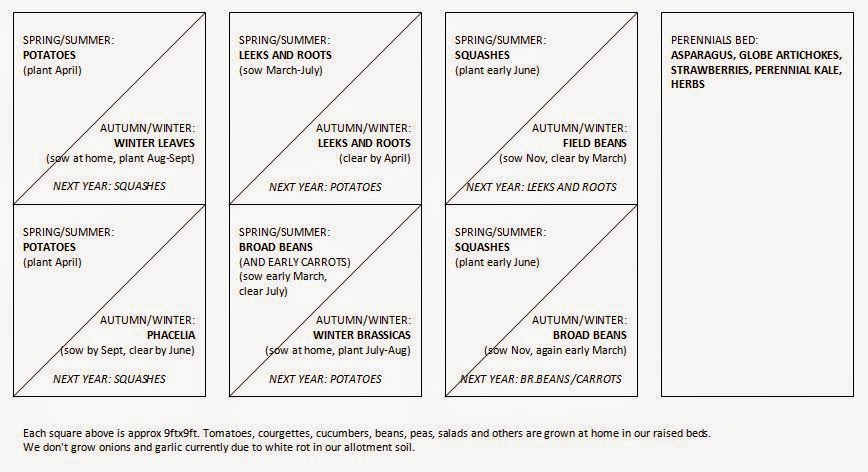
Ladies and gents, I give you our brand new crop rotation plan! (Click pic to enlarge.)
This rotation also allows for two squares to be sown with green manures over winter to add high-nitrogen organic matter to the compost heap, shelter wildlife and protect the soil. Phacelia and field beans are my two favoured green manures since field beans add vital nitrogen to the soil and can be sown as late as November, and phacelia attracts lots of insects and can be sown as late as September. Following squashes with winter-hardy beans means the timing for sowing is perfect; likewise with the winter leaves following the potatoes, and the winter brassicas following the broad beans. And even though we grow most of our beans at home, our allotment soil still gets a nitrogen injection thanks to the broad and field beans. Of course, this rotation doesn't include everything and I should do my best to efficiently rotate our crops at home too, but those on the allotment are the most important ones to rotate: beans for nitrogen, potatoes which are prone to damage from buildups of slugs and eelworms, and brassicas which are susceptible to clubroot, a very nasty fungal disease.
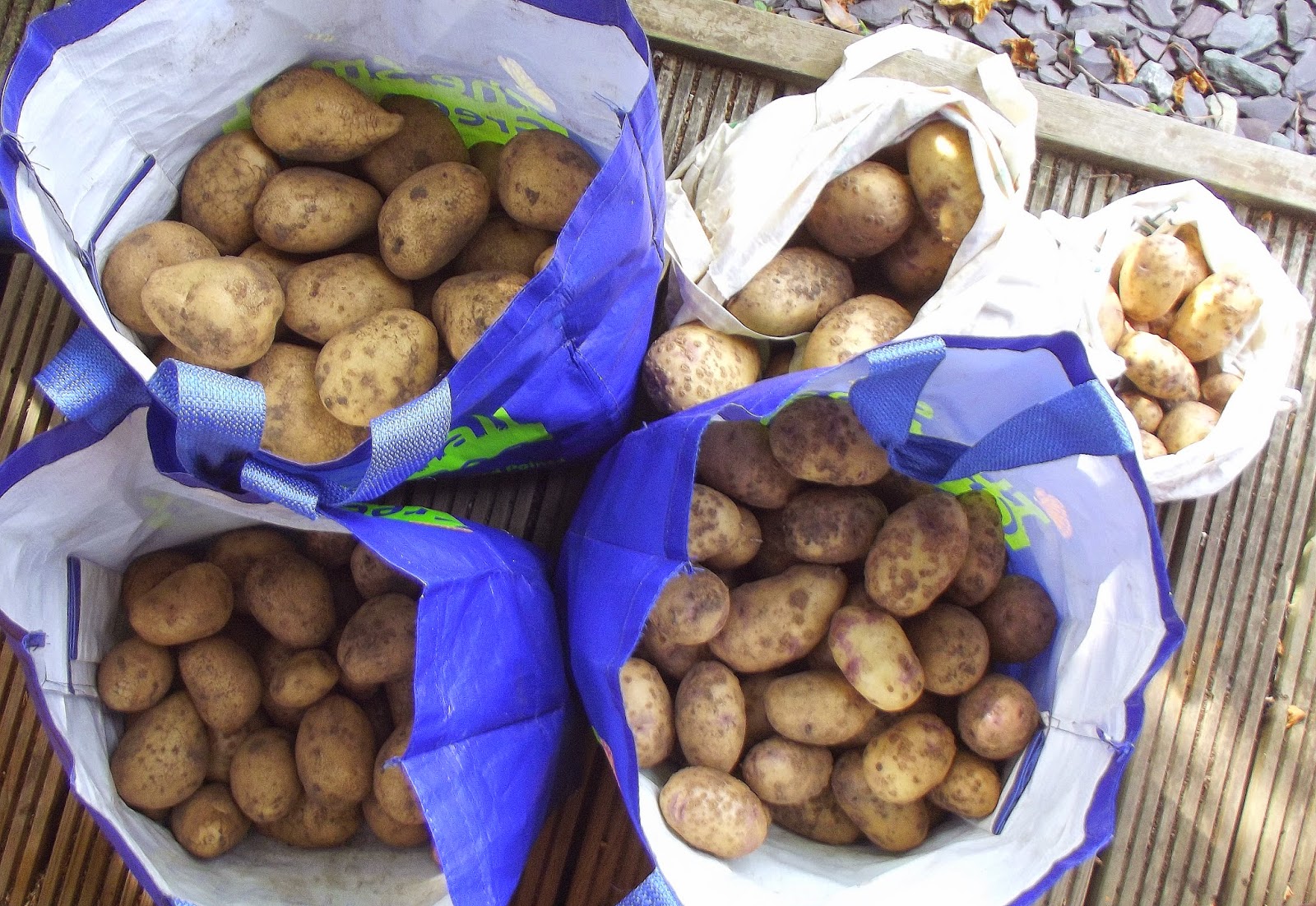
So far it's all going swimmingly. The potatoes are out (an awesome 28kg of Kestrel and 19kg Pentland Crown!) and the winter leaves are in; two rows of chard, two rows of winter spinach and a row of fennel (there's room for more, actually - I must do that). The squashes have finished a little earlier than usual, which means we have plenty of time to clear the soil for winter beans. The leeks, root veg, celery, spring cabbages, kohlrabi and pak choi are coming along nicely and we will slowly harvest them all winter long, making the most of all our space. Brilliant!
There is one complicating factor looming, in that we are planning to clear our old strawberry and asparagus beds (not shown in the plan above) over winter and put them to new use next spring. These two areas don't really fit into the plan so I'm a bit puzzled about what to do with them (and I rather wish we could move our pond and our apple tree into one, which would help us make better use of the other!). Should we grow runner beans or courgettes on the plot again after all? Shall I expand my collection of perennials? Is it time to give in and plant some fruit bushes? Good job I've got all winter to think about it...
Traditionally, the main groups in a crop rotation are potatoes and roots, brassicas, beans, and 'other veg'. The potatoes are manured to enrich and slightly acidify the soil (preventing scab), heavy-feeding beans follow in the nicely broken-up ground after the potatoes are dug, then (often after an application of lime,) leafy brassicas to make good use of the nitrogen the bean roots accumulate. Then, presumably, you throw sweetcorn, cucurbits, tomatoes, leafy greens and everything else in together after that. Sounds simple enough, but questions abound. Do you grow swedes with the root crops or the brassicas? Aren't tomatoes in the same family as potatoes? Cucurbits take up way more space than anything else! And aren't you supposed to avoid manuring carrots?
I don't know, maybe I overthink these things - maybe I'm just too keen to abide by all the rules and to do it "right". But I think, after eight years on our allotment, I've finally cracked it!
This is partly thanks to slimming down the number of crops we grow on the allotment anyway - we don't grow onions and garlic due to white rot spores in our soil, and we prefer to keep salad leaves and quick-ripening summer crops like French beans, courgettes and tomatoes at home so we can pick them more regularly. On the allotment we grow the lower-maintenance stuff: potatoes, squashes, root veg, broad beans, leeks, and a limited amount of winter brassicas and spinach-type leaves (plus some perennials in a permanent area). We've grouped broad beans, leeks and root veg roughly together: together they take up about the same amount of space we use for more space-hungry crops (potatoes and squashes), and it means we can follow our broad beans (which finish around midsummer) with winter brassicas, thus keeping our earlier-sown swedes in the same area as our other brassicas.
Ladies and gents, I give you our brand new crop rotation plan! (Click pic to enlarge.)
This rotation also allows for two squares to be sown with green manures over winter to add high-nitrogen organic matter to the compost heap, shelter wildlife and protect the soil. Phacelia and field beans are my two favoured green manures since field beans add vital nitrogen to the soil and can be sown as late as November, and phacelia attracts lots of insects and can be sown as late as September. Following squashes with winter-hardy beans means the timing for sowing is perfect; likewise with the winter leaves following the potatoes, and the winter brassicas following the broad beans. And even though we grow most of our beans at home, our allotment soil still gets a nitrogen injection thanks to the broad and field beans. Of course, this rotation doesn't include everything and I should do my best to efficiently rotate our crops at home too, but those on the allotment are the most important ones to rotate: beans for nitrogen, potatoes which are prone to damage from buildups of slugs and eelworms, and brassicas which are susceptible to clubroot, a very nasty fungal disease.
So far it's all going swimmingly. The potatoes are out (an awesome 28kg of Kestrel and 19kg Pentland Crown!) and the winter leaves are in; two rows of chard, two rows of winter spinach and a row of fennel (there's room for more, actually - I must do that). The squashes have finished a little earlier than usual, which means we have plenty of time to clear the soil for winter beans. The leeks, root veg, celery, spring cabbages, kohlrabi and pak choi are coming along nicely and we will slowly harvest them all winter long, making the most of all our space. Brilliant!
There is one complicating factor looming, in that we are planning to clear our old strawberry and asparagus beds (not shown in the plan above) over winter and put them to new use next spring. These two areas don't really fit into the plan so I'm a bit puzzled about what to do with them (and I rather wish we could move our pond and our apple tree into one, which would help us make better use of the other!). Should we grow runner beans or courgettes on the plot again after all? Shall I expand my collection of perennials? Is it time to give in and plant some fruit bushes? Good job I've got all winter to think about it...
Saturday, 29 March 2014
Allotment Week, Part Three - Green Manures and Ground Covers
I've dabbled a little with green manures before - mostly scattering phacelia seeds here and there at the last minute of the growing season and then cursing them when they finally appear the following spring right where I want to be planting stuff, and I can't bear to get rid of the lovely flowers before the bees have made the most of them... But last autumn I made my first serious attempt at using green manure properly.
The idea, in case you're not familiar, is that rather than leaving soil bare over winter (or at any time), you sow a cover crop of some sort. This crowds out weeds, keeps the fungal organisms in the soil happy, and protects the soil against leaching, erosion and so on - and when you're ready to plant crops again you dig in the vegetation to add organic matter to the soil. Now that I've seen our plot flood, I can see how important it can be to have roots in the ground, keeping the soil together and preserving its structure in case of extreme weather. The problem I typically have, though, is that I clear my beds too late to sow anything, or, as with the phacelia, poor planning means I want to plant right where a cover crop is doing its thing. I've also always been a bit wary about adding to my weed problem by experimenting with certain green manures which are reportedly not-so-easy to kill off when you're done with them! But after a lot of reading, I've identified a few green manures that I think suit my way of working:
Field beans, often grown for livestock feed and much-resembling a branching broad bean, are winter-hardy and germinate right up to November, so I can get away with sowing them really late in the season. And being in the bean family, their roots fix nitrogen in the soil.
Phacelia needs sowing by September latest, so I'm gonna have to try harder to clear some space for it late summer (maybe after the broad beans...?) but I think it's well worth persisting with for the lovely bee-friendly flowers it produces around May - if I can manage to leave it that long. It'd be ideal for whatever bed I'm going to grow squashes on, since they don't get planted out until May or June.
Mustard is a quick grower which is killed off by frost and can be left where it dies to decompose and mulch the soil. It's not quite the same as having something growing over winter, but I'm interested in giving it a try this year and seeing how it works out. Mustard is said to help keep soil pests under control too, so it might be good to grow this before potatoes.
White clover is hardy and long-lasting, and can be used as a 'living mulch' around perennial or widely-spaced plants. It keeps weeds down and has bee-attracting flowers in the summer, AND it fixes nitrogen. I'm going to start introducing this all over the place: we have already sown it over what is to be our squash bed (too late to sow phacelia here now for flowers by May) and I will start to scatter it round the edges of the perennial bed, letting it spread naturally. If it's growing where I want to plant, I'll simply pull it up to clear a space.
Buckwheat is a quick-growing summer green manure and to be honest, I'm not sure if I'm really going to fit it in anywhere, but like phacelia it has wonderful flowers, loved by insects, and it seems easy to deal with, so I wanted to give it a try and bought some seed anyway...
Back to 'allotment week', and our third big task was to clear last year's green manures and sow a new one. After our potatoes were harvested early last October we sowed field beans in their place, and they've grown pretty well through the mild winter, reaching a height of nine inches or so. But plans have changed since last autumn and I wanted to get some clover started here, so it was time for them to go.
Switching to no-dig gardening means we won't be able to dig our green manures into the soil, but instead we can cut down the growth and either use it as a mulch and let it decompose naturally on the surface, or add it to our compost heap. Leaving the roots in the soil means they'll add loads of nitrogen. Just look at the nitrogen-filled root nodules on this field bean stump I pulled up by mistake!
I cut the beans down at the soil surface, trying to get every shoot to reduce the chance of regrowth. I'm sure some of my allotment neighbours must have thought they were up-and-coming broad beans I was cutting down! The greens made a nice leafy layer on the compost heap.
I hand-weeded the whole bed after this - the beans don't keep weeds down as well as some other green manures are supposed to and there were quite a lot of young dandelions, docks and pineapple weed around. Then I raked and watered in some white clover seed over the whole bed. Hopefully it will have a good chance to get established as a living mulch before I plant the squashes out.
Mulching round plants helps to keep weeds down, reduce evaporation, and absorb excess rainfall in wet periods. A living mulch has all these benefits and more! It can attract and provide shelter for beneficial insects, it doesn't need replacing so often, and it has even been shown to decrease pest attacks in some vegetable plants. I'm really looking forward to seeing how this works out! Earlier this week I also read this interesting post by Alison of Backyard Larder, which talks about using edible plants such as wild strawberries and lambs lettuce as living mulches - something I am going to have to give some thought to now! I'm certain claytonia, one of my favourite home-grown salad leaves, would make a pretty great groundcover too, but judging by the way it gets everywhere in the garden I think it'd be a bit risky on the plot!
We did sow a spot of phacelia last year too, scattering it in odd patches where I pulled up individual squash plants. You can see what remains as a clump in the third bed in the picture at the bottom. I'd really like this to flower before I want to sow my root veg there... I don't think it's going to happen, but I'll wait and see, and if all else fails maybe I'll scatter a few seeds out of the way for the bees (and me!) to enjoy the flowers later in the summer!
So that's it for allotment week. We didn't get our potatoes in like we wanted to - no big deal as it's early yet - but we really did get a good headstart on the season, and did a lot of those little jobs that usually get pushed to the bottom of the list. If you follow this blog I'm sure you'll agree it's probably never looked this neat and tidy! Now, bring on some warmer temperatures and let's get some crops out there!
The idea, in case you're not familiar, is that rather than leaving soil bare over winter (or at any time), you sow a cover crop of some sort. This crowds out weeds, keeps the fungal organisms in the soil happy, and protects the soil against leaching, erosion and so on - and when you're ready to plant crops again you dig in the vegetation to add organic matter to the soil. Now that I've seen our plot flood, I can see how important it can be to have roots in the ground, keeping the soil together and preserving its structure in case of extreme weather. The problem I typically have, though, is that I clear my beds too late to sow anything, or, as with the phacelia, poor planning means I want to plant right where a cover crop is doing its thing. I've also always been a bit wary about adding to my weed problem by experimenting with certain green manures which are reportedly not-so-easy to kill off when you're done with them! But after a lot of reading, I've identified a few green manures that I think suit my way of working:
Field beans, often grown for livestock feed and much-resembling a branching broad bean, are winter-hardy and germinate right up to November, so I can get away with sowing them really late in the season. And being in the bean family, their roots fix nitrogen in the soil.
Phacelia needs sowing by September latest, so I'm gonna have to try harder to clear some space for it late summer (maybe after the broad beans...?) but I think it's well worth persisting with for the lovely bee-friendly flowers it produces around May - if I can manage to leave it that long. It'd be ideal for whatever bed I'm going to grow squashes on, since they don't get planted out until May or June.
Mustard is a quick grower which is killed off by frost and can be left where it dies to decompose and mulch the soil. It's not quite the same as having something growing over winter, but I'm interested in giving it a try this year and seeing how it works out. Mustard is said to help keep soil pests under control too, so it might be good to grow this before potatoes.
White clover is hardy and long-lasting, and can be used as a 'living mulch' around perennial or widely-spaced plants. It keeps weeds down and has bee-attracting flowers in the summer, AND it fixes nitrogen. I'm going to start introducing this all over the place: we have already sown it over what is to be our squash bed (too late to sow phacelia here now for flowers by May) and I will start to scatter it round the edges of the perennial bed, letting it spread naturally. If it's growing where I want to plant, I'll simply pull it up to clear a space.
Buckwheat is a quick-growing summer green manure and to be honest, I'm not sure if I'm really going to fit it in anywhere, but like phacelia it has wonderful flowers, loved by insects, and it seems easy to deal with, so I wanted to give it a try and bought some seed anyway...
Back to 'allotment week', and our third big task was to clear last year's green manures and sow a new one. After our potatoes were harvested early last October we sowed field beans in their place, and they've grown pretty well through the mild winter, reaching a height of nine inches or so. But plans have changed since last autumn and I wanted to get some clover started here, so it was time for them to go.
Switching to no-dig gardening means we won't be able to dig our green manures into the soil, but instead we can cut down the growth and either use it as a mulch and let it decompose naturally on the surface, or add it to our compost heap. Leaving the roots in the soil means they'll add loads of nitrogen. Just look at the nitrogen-filled root nodules on this field bean stump I pulled up by mistake!
I cut the beans down at the soil surface, trying to get every shoot to reduce the chance of regrowth. I'm sure some of my allotment neighbours must have thought they were up-and-coming broad beans I was cutting down! The greens made a nice leafy layer on the compost heap.
I hand-weeded the whole bed after this - the beans don't keep weeds down as well as some other green manures are supposed to and there were quite a lot of young dandelions, docks and pineapple weed around. Then I raked and watered in some white clover seed over the whole bed. Hopefully it will have a good chance to get established as a living mulch before I plant the squashes out.
Mulching round plants helps to keep weeds down, reduce evaporation, and absorb excess rainfall in wet periods. A living mulch has all these benefits and more! It can attract and provide shelter for beneficial insects, it doesn't need replacing so often, and it has even been shown to decrease pest attacks in some vegetable plants. I'm really looking forward to seeing how this works out! Earlier this week I also read this interesting post by Alison of Backyard Larder, which talks about using edible plants such as wild strawberries and lambs lettuce as living mulches - something I am going to have to give some thought to now! I'm certain claytonia, one of my favourite home-grown salad leaves, would make a pretty great groundcover too, but judging by the way it gets everywhere in the garden I think it'd be a bit risky on the plot!
We did sow a spot of phacelia last year too, scattering it in odd patches where I pulled up individual squash plants. You can see what remains as a clump in the third bed in the picture at the bottom. I'd really like this to flower before I want to sow my root veg there... I don't think it's going to happen, but I'll wait and see, and if all else fails maybe I'll scatter a few seeds out of the way for the bees (and me!) to enjoy the flowers later in the summer!
So that's it for allotment week. We didn't get our potatoes in like we wanted to - no big deal as it's early yet - but we really did get a good headstart on the season, and did a lot of those little jobs that usually get pushed to the bottom of the list. If you follow this blog I'm sure you'll agree it's probably never looked this neat and tidy! Now, bring on some warmer temperatures and let's get some crops out there!
Subscribe to:
Posts (Atom)