Showing posts with label complete organic fertiliser. Show all posts

Sunday, 18 January 2015

A Tale of Three Raised Beds

When we first moved into the 'granny annex' at Mum and Dad's house I could only grow vegetables in pots and grow bags on and around the patio - their shrubby, woodlandy garden didn't have any space for vegetables and most of it was too shady anyway. That was okay by me - we had the allotment too, after all. But plant pots have a funny way of multiplying, don't they...? And with Mum and Dad moving toward organic food more and more (100% now I believe!), last year they gave me some more space to grow food for the whole family.

We planned three new veg-growing areas; one garden bed in a rare sunny spot where the shrubs weren't thriving any more, a large raised bed just in front of the patio which was occupied by a multitude of pots and tubs, and two smaller raised beds at the shadier end of the garden, where a small lawn was becoming overrun with moss and weeds and I had already put some moveable growbeds and containers for leafy crops (pic below). We decided against growing straight into the ground mostly because the garden soil is extremely heavy clay - not much fun to work with, but it'll make an excellent nutritious subsoil!


The timing was perfect; early spring when it warm enough to work outside but I'd still be able to sow everything in time. I cleared the garden bed, re-edged it to a slightly higher level and topped it off with the previous year's growbags and tubs. I hacked back the honeysuckle and snowberry that keep moving in from under the fence and planted strawberries round the edge, and it became a nursery bed for young plants for a while, while I worked on the other areas...


The big raised bed was to go on a slated area, so my first task was to scrape back all the slate chips.


We drew up some plans and ordered half sleepers (from UK Sleepers) cut from oak - a naturally long-lasting hardwood that doesn't need treating with chemicals to protect it.


I enlisted the help of my friend Dave (and his power tools!) to cut the wood to size and build the beds, using long outdoor-use 'green organic coated' timber drive screws from Wickes...


And a day and a half later all three were done and ready for filling!


I ordered the four tonnes of  'Veggie Gold' compost to fill them; a "ready-to-use" peat-free mix of compost, topsoil and manure, recommended for raised veg beds, which promised to be from sustainable sources with no added chemicals. I had to wait a while for it to arrive, which was a tad frustrating, but eventually it did...


...and the next two days were spent wheelbarrowing compost from the front of the house to the back (by myself, I'd like to add!). The larger bed has a weed membrane beneath it anyway, but in the two smaller beds I laid cardboard at the bottom to provide a barrier against weeds (until it rots, by which time they should have died from lack of light anyway).


Not a bad job, I think, and certainly a lot tidier than a jumble of containers. Hurrah! I got sowing right away, planning a row of peppers and chillies along the back of the big bed, some dwarf beans in front of them, and square-foot patches of different salad veg and small root crops along the front, with a few herbs and flowers dotted around as well. The two shady beds would take leafy greens - mostly kale and chard.


A few weeks in, I realised that all was not well... Things were growing rather strangely and inconsistently. Along a row of mustard seeds, the seedlings had grown large in patches and stalled at a tiny size in others. Some had bolted. A poached egg plant and some tiny spring onions I'd transplanted had yellowed very badly and become stunted. Spinach plants and radishes had bolted extremely prematurely, before reaching anything like a usable size.


A few weeks later still, little had changed. Those things that were growing were growing painfully slowly, or running straight to seed, while my crops on the allotment and in the garden bed in the corner were doing just fine. I began an experiment which confirmed my worst suspicions...


The two pots on the left contain the same 'Veggie Gold' compost that I filled the raised beds with; the two on the right contain old multipurpose compost out of one of the previous year's containers. The bottom two also have Complete Organic Fertiliser added. I sowed spinach seeds in all four pots at the same time, and thinned to three seedlings per pot after germination. The results are pretty clear I'd say - wouldn't you?

The company I had bought the stuff from - Compost Direct - didn't want to know. After three emails to them they finally replied to say that they only ever had good feedback about this compost and I should just add some more nitrogen or general-purpose fertiliser. I did, in the forms of chicken manure, chicken manure 'tea', and a commercial liquid feed. Nothing helped. I sent them the picture above. They didn't care. Just keep adding extra feed, they said. My blood boiled... All that sweat and hard work and money and anticipation and I couldn't even grow anything in my raised beds!

Luckily there were a few things that did seem to grow okay in the soil; little gem lettuces were slow but getting bigger, the carrots and beetroots didn't seem to mind, and the kale and chard down the garden was not too bad.


After giving it some thought, I suspected perhaps the problem was an excess of potassium; that would explain why adding more nitrogen hadn't helped leaf growth, as potassium blocks it. Potassium also encourages fruiting (perhaps hence the early bolting), and is prevalent in woody matter and straw - there had been loads of partially-composted woody stuff and strawy manure in the compost mix. I try not to consider myself a soil mineral expert after reading just one book but I still feel this is pretty likely the problem! And how do you get too much potassium out of soil? You wait for the rain to leach it out...


Growth improved very gradually throughout the year. I did get a couple of handfuls of beans even though the plants were more dwarf than ever, and the perpetual spinach got going after a while. I took to planting lots of spare plants and more lettuces in the bed - the more plants grow in it, the more potassium they use up, right? Nothing really thrived. I even let the weeds grow! I got a few nice peppers, though again the plants were small. The lettuces, it turned out, tasted starchy and bitter. My cucumbers, which I'd planted in a large container filled with the same compost, yellowed and died.


Happily, however, my bed in the corner of the garden was doing wonderfully! Two huge courgette plants gave us more than six of us could eat from June to September, and from all around them we had strawberries, lovage, tarragon, parsley, mangetout and drying beans. Calendula filled in all the gaps and brought bees buzzing to that corner of the garden. What a delight! I haven't grown courgettes at the allotment for years since we don't go there often enough to pick them, so I've made do with small courgette plants confined to pots and sulking. To see them going crazy like this - like they're meant to - was great!


The growth in the oak beds has continued to improve slowly and I am feeling quietly confident that I'll get better results this year. At the moment the large one has that same perpetual spinach (though it's rather slug-eaten just now!), some new and healthy garlic shoots, a tangle of old carrots and beetroots and a few sorry-looking herbs. The compost level has sunk a lot - nearly 25% - which will give me an opportunity to top it up with something better (though I still have nearly a half-ton of the 'Veggie Gold' sitting around...). I also plan to get the soil lab-tested at the same time as I get the allotment soil done - that'll be interesting... The kale in the bottom bed never really got very big - though caterpillars can be blamed for some of that - but it's okay, and I'm looking forward to a bit more growing success in the months ahead...


Sunday, 4 January 2015

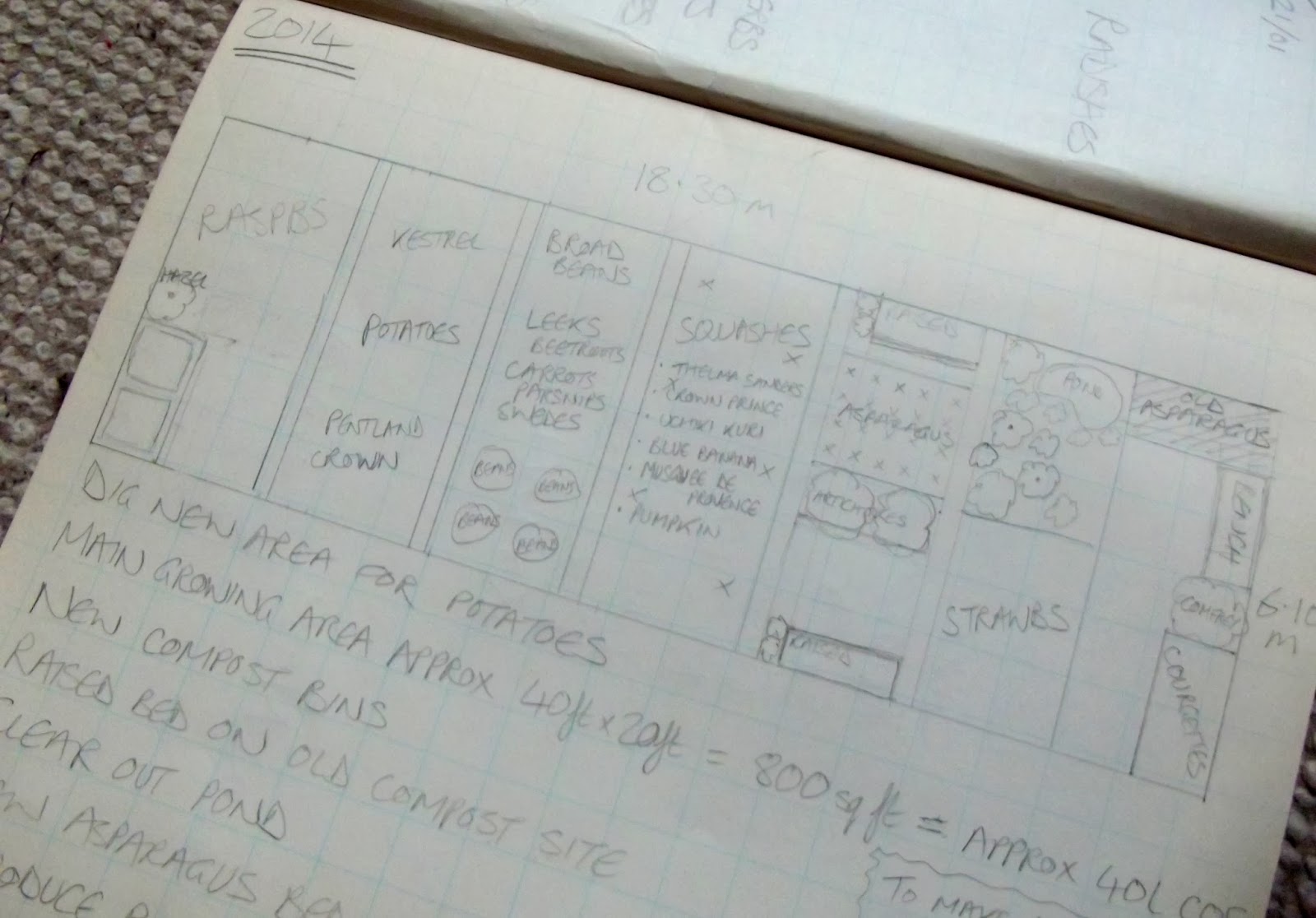
2014

It's easy to think that winter is a quiet time for gardeners, but there's plenty to be done. Between harvesting winter crops, checking fleeces and stakes, winter digging, construction projects and maintenance, nurturing overwintering plants and looking after little seedlings in the greenhouse, there's also plenty of planning to be done, and it inevitably involves a good look back over the past growing season to see what worked and what didn't.

2014 was a pretty bumper year for us, but there are always lessons to be learned. Our plot was under a couple of feet of floodwater for a week early on in the year, but thankfully it didn't do any real damage or set us back - we just had some extra clearing up to do, and to be patient in waiting for the soil to dry out again. We've settled on a new 'structure' for our plot, with three main beds in a rotation plus a number of perennial areas, and we made several new paths. We failed to cultivate the difficult far corner of the plot or our old strawberry bed, but we did clear them and cover them up to stifle the weeds and make the job easier later. We planted a new perennials bed with asparagus, artichokes, strawberries and herbs - hopefully some perennial kale will go in here too. We built new compost bins in a new area, and grew beans on the super-fertile patch where the old bins were. We also upped our growing game in the garden at home, converting a shrub bed to grow vegetables and adding three raised beds - more on all that in another post.

2013, compost bins. 2014, French beans. 2015 greenhouse!
We tried a new way of adding fertility to our plot; the 'Complete Organic Fertiliser' recommended by Steve Solomon for rebalancing soil nutrients for maximum plant health and nutrition. Though I can't quantify the results or compare to a 'control' area, I have to say everything on the plot just grew better than ever with virtually no problems, and I am quite sure the COF helped that happen. I will be going one step further this year: sending some soil samples off for laboratory analysis and creating a custom mix to balance it even better.

Another thing we trialled was 'Rootgrow' or mycorrhizal fungi, endorsed by the RHS; a mix of natural fungi that forms symbioses with plant roots and gives plants access to more nutrients and water. It's primary recommended use is in planting trees and shrubs, to help them establish quicker and more easily, but it is supposed to help any plant so I used it under every single crop to see what happened. In theory it should drought-proof plants and help fruits and roots to swell more steadily and evenly. In practice, though we had great growth almost everywhere and the new asparagus and artichokes established without a hitch, my container potatoes gave identical yields whether I used the Rootgrow or not, the newly-planted strawberries didn't establish well for some reason, squashes and swedes came in a huge mix of sizes, and my celeriac completely failed to swell, so I'm not entirely convinced...

Potatoes did wonderfully - we managed to grow a kilo for every week of the year. (If only I had somewhere better to store them - they are now sprouting and turning soft). Scab was very bad on our old favourite Kestrel, but we also tried Pentland Crown this year, which makes a much better baked jacket spud, seems to store slightly better, and doesn't suffer as much scab, so we will be growing more of these in 2015! On reflection I wondered if I should have left the lime out of the COF applied to this area, as it probably made it worse.


Carrots were our best ever, even though we couldn't find our enviromesh in time to protect our first sowing so we lost some to carrot fly - our later sowings did brilliantly and they even won a first placing in the allotment association show! We have only succeeded with carrots since we added lime to our soil - perhaps they need the extra calcium.


Pumpkins and squashes did brilliantly too; we brought home 18 lovely fruits and many are still sitting around happily on windowsills and doormats waiting to be eaten. Arguably we might have expected even more squashes from our eight plants - some plants only gave us one or two fruits - but they suffered from quite a lot of weed competition... Turns out it wasn't such a good idea to undersow them with clover; clover actually gets quite big and unruly when it wants to!


Leeks, parsnips, swedes, broad beans and beetroots all got along just fine. Beetroots really are just THE easiest vegetable to grow - nothing seems to stop them. I only wish Eddie liked them better as I'm eating them mostly by myself. The leeks are suffering from some allium leaf miner and I think we should cover them with mesh next year. We only grew one variety of French beans - a local heritage variety called Ryder's Blue Coco - and I sowed them rather late due to a lack of space earlier on. They were delightful - really tender - and we were eating them long after our neighbours' beans had finished, but we couldn't save any seeds from them because they didn't have time to mature before the first frost, which was a great shame. I do have just a few seeds left so I MUST do better at this next year!


Our chard and winter spinach, planted out in late summer, suffered a bit of neglect due to an extremely busy autumn, but though we lost a few to slugs and snails, they grew superbly and we really should have harvested more from them before the winter. We will still be able to pick from them when growth starts again in early spring though. Our first attempt at fennel suffered the same neglect but also grew very well indeed, and again we failed to harvest it in good time. It's certainly one to try again this year though. We also have a few spring cabbages nearly ready which have done really well - a nice compact variety called Pixie which, assuming it tastes good come spring, I will certainly grow again.

2014 was our first year growing both celery and celeriac. The celery did okay, though it was a bit thin and stringy (I don't usually eat it raw much anyway - just use it for soups, stocks and stews - so that doesn't really matter). The celeriac was a huge disappointment; no root to speak of at all, and I'm not sure why or what to do differently next year...


The importance of beneficial insects really, properly hit home to me last spring when scores of ladybirds descended on our blackfly-infested broad beans and cleared the whole lot up for us. I'm pretty sure there were more ladybirds around than before because I'd grown phacelia in the next bed over winter - ladybirds seem to be attracted by lacy foliage and as we cleared it up in the spring there were loads of them among it. I always grow a few flowers here and there, but now I will grow more!


In the home garden, our courgettes and tomatoes were just fabulous and kept me busy finding new ways to use them! The tomatoes succumbed to blight in the late summer, as they always do. We tried a local heritage variety of tomato - 'Ryder's Midday Sun' - but sadly didn't find them up to a good standard; the plants grew slowly, the tomatoes were watery and lacked flavour, and they were first to succumb to blight! Maybe they'd do better in a greenhouse... But while I'm very glad to have had the opportunity to try them, I'm not sure I have the space to persist with them. Cucumbers and salad greens in our new raised beds did not do well at all and I'm sure there was a problem with the soil - more on that in another post... Peppers did okay but gosh, they take so long to ripen! We were disappointed in a new variety we tried - 'Hebar' - which had very thin flesh and not much flavour at all. The seller described it as "particularly sweet and tasty" so I'd love to know what anyone else thinks of them! We have bought a plastic greenhouse to put on the allotment this summer, which should be just big enough to grow a few tomatoes, cucumbers and peppers in. This way we hope to have blight free tomatoes and earlier peppers! We'll still grow some at home too though...

Kaibi Round, Ancho Grande, Hebar, Lipstick
The enviromesh over the kale bed got torn in high winds early in the year, and by late summer caterpillars had stripped the plants as I was too lazy to do anything about it... Thankfully some of the plants made a surprisingly good comeback though! Another mistake I will not repeat next year is planting French beans behind courgette plants. After the courgettes had been growing a month I couldn't reach the beans at all, and had to leave them all to pick for drying instead! The mangetout was great - we could hardly keep up with it - and we were really impressed by variety 'Carouby de Maussane' with giant pods! I have never grown ordinary peas, as frozen British peas are extremely good and convenient, and all the podding seemed like too much of a faff, but last year we did grow a multipurpose mangetout/podding pea - 'Ezeta's Krombek Blauwschokker' - and when they got too big to eat as mangetout I was forced to pod a few... They were so lovely that I might just add a few real podding peas to my garden this year...

Carouby de Maussane mangetout - still gorgeously sweet and tender at this size!
The 'perennial salad mix' from Suffolk Herbs turned out to be a mix of chicories and radicchios, which have grown well but... I just don't really like the taste. Admittedly I should have read the back of the pack more carefully, but this picture is a bit misleading I think!


All in all, we will do much the same this year as last, but here are the things we plan to do differently:
  • Grow more flowers - to include a cutting-flower patch!
  • Do even more to balance our soil nutrition according to Steve Solomon's great book 'The Intelligent Gardener'
  • Add a plastic greenhouse to the allotment to grow a few summer veg under cover.
  • Don't plant anything behind courgettes!
  • Improve raised bed soil.
  • Buy more enviromesh, to replace torn piece and cover leeks too.
  • Keep squash bed weed-free - perhaps mulch beneath plants - and grow fewer plants so they don't get so tangled.
  • Grow some proper peas, perhaps.
  • Try harder with celeriac.
  • Grow more Pentland Crown potatoes and less Kestrel - and try another new variety too.
  • There are always new varieties to try; this year new ones for us include oyster leaf, beefsteak plant, pink banana squash, skykomish tomatoes (supposed to have some blight resistance), marconi rosso peppers, and we're going to attempt to grow cauliflowers for the first time, since we buy them quite a lot...
  • We also plan to plant a new fruit patch on the long-neglected and difficult far corner of the allotment, and clear and replant our overgrown herb bed.
Frosty radicchio

Friday, 11 April 2014

Complete Organic Fertiliser

My last post, Grow Your Own Nutrition, was all about how I'm intending to remineralise my soil for the best results in my garden and allotment, and how it's really all about feeding the soil, not the plants - if you missed it please do take a look. The best way to remineralise a soil is to send off a soil sample to a lab, find out exactly what it's got and calculate exactly what it needs, and my new favourite book The Intelligent Gardener can help to do that. But The Intelligent Gardener offers a simpler one-size-fits-all solution too, and because I've got a lot else going on this spring and I could really do with another read-through of the book before I jump in too deep, I've decided to use this recommended 'Complete Organic Fertiliser' (COF) for my plot this year. Steve Solomon, the author, stresses that COF has its limitations and can cause its own imbalances if used year on year, but promises much better results - better growth, better plant health, better flavour and far more nutritious food - than with the conventional organic way of feeding soil just with compost and manure.

There's a version of the COF recipe online here in Solomon's own words, so it can't hurt to share the recipe I've settled on with you here. In the book, Solomon recommends a few other optional additions, but I'm keeping it simple this year and sticking to the main ingredients below:

4 parts seedmeal
Seedmeal is what's left over when oils are pressed, and added to soil it provides a natural, highly-effective, slow-release source of nitrogen as the soil organisms feed on it.

1/3 part lime, 1/3 part dolomite lime, 1/3 part gypsum
The lime provides calcium - probably the most important soil mineral - while the dolomite and gypsum provide more calcium plus doses of magnesium and sulphur, respectively.

1 part bonemeal
This provides phosphorus. There are other things you could use, such as hard or soft rock phosphate - arguably better as it doesn't contain the sodium that bonemeal does - but bonemeal is more sustainable and more easily available, and soil needs a little sodium anyway.

1 part seaweed meal
Seaweed meal is rich in trace elements and also provides plant hormones which boost plants' natural defences.

This mix is to be applied once a year, at a rate of 4-6 litres per 100 square feet, along with a modest amount of compost or manure. If the thought of adding lime to soil every year challenges you, or you're wondering why there's no potassium in the mix (actually, there's just a little in the seedmeal), do go back and read my previous post!


Bonemeal and lime were easy to find in a garden centre, and I ordered the seaweed meal, dolomite and gypsum from The Organic Gardening Catalogue. The seedmeal presented a bit more of a challenge: it's apparently sold as animal feed in the US and Tasmania, where Solomon lives, but here in the UK I struggled to find it anywhere - but I eventually found a friendly local farmer growing rapeseed for oil who was happy to sell me a couple of big bagfuls. It came as quite large pellets, which wouldn't mix well with the powdered ingredients, so I've been stomping on it in a washing up bowl to smash the pellets up.


They don't break down completely - it'd take ages! - but it's a big improvement. I found using a stick blender worked really well too - until the thing overheated. Now I have to buy a new stick blender... Doh!


I've been making COF in small 7 litre batches using 1 litre as 1 part - partly because I have only ordinary-sized buckets to mix it in, partly because I'm using it bit-by-bit anyway as each bed gets prepared for planting, and partly to reduce any effects of the stuff not mixing together evenly: if I find a pile of seedmeal pellets at the bottom of the bucket it's easy enough to remedy on a small area.

It's dusty stuff, and I've had to be careful to mix it (and spread it) when winds are low to stop all the gypsum and dolomite blowing away!


Solomon recommends digging it into the soil, but it can also just be raked into the surface for no dig plots like (most of) mine.

I've spread it over much of the plot already and I intend to use it everywhere. It's too early to see the results, but you can be sure I'll keep you posted!

Friday, 4 April 2014

Grow Your Own Nutrition!

Okay, this post is going to be long, and I'm sorry about that, but I promise it will be absolutely worth it! During the winter I had the pleasure of reading two fascinating and wonderful books about soil nutrition and its impact on our health, and I've got to tell you why my approach to growing food will never be the same again.


The first book, which I just happened upon while idly browsing for free Kindle books one day, was Beyond Organic: Growing for Maximum Nutrition by Dr Jana Bogs. It kicks off with an analysis showing how vastly different the levels of vitamins and minerals could be in vegetables grown in different soils across the US: "not by just 10 or 20 percent, or even a two-fold difference..." but "...as great as 1,938ppm (parts per million) iron in some tomatoes as opposed to only 1ppm in other tomatoes of the same variety. This is nearly a 2000-fold difference!" Not rocket science, is it, to work out that more nutritious soils would grow more nutritious veggies? But I'd always assumed that a carrot was a carrot was a carrot, and any variations would be so small as to be irrelevant.

It's funny the way we often just go on doing things the way we were taught, without really thinking about them. For years I've believed it when I was told that all my soil needed was as much compost as I could make, plus a bit of horse manure or fish, blood and bone for a boost, and some lime every few years to keep the pH level where it should be. 

Nutrition levels in our food have dropped off by around 75% in the last hundred years or so. Concerns about depleted soils and nutrition deficiency leading to poor health in Americans were first brought to the US Senate way back in 1936. Between 1948 and 1991, Australia's 'Commonwealth Scientific and Industrial Research Organization' recorded an 80% drop in vitamin C in apples, an 82% drop in magnesium in broccoli, a 75% drop in iron in potatoes and an 89% drop in calcium in potatoes, and a similar American study showed that roughly half the vitamins in vegetables had significantly decreased between 1950 and 1999. An analysis on canned peaches over a hundred years old found that they contained more vitamins, even after a hundred years in a can, than today's canned peaches do! We'd need to eat a huge amount of today's fruit and veg to get the same nutrients we would have got from our 'five-a-day' a hundred or a thousand years ago. Is it any wonder we're all fat and sick??

Dr Bogs explains some of the complex interplay between nutrients in plants: minerals taken up by their roots activate enzymes which create the proteins, fats and vitamins we need. Though plants need only around 20 nutrients to survive (some say up to 42), if given a fuller range of nutrients they are capable of generating all the 50+ (some say up to 90) nutrients that we humans need. In other words, a vegetable might have everything it needs to reach maturity looking and tasting good, but that doesn't mean it has reached its full potential by producing all the nutrition it can, and should, contain: plants pass on a certain amount of nutrition from the soil (iron, copper, magnesium, calcium) but they're also little factories producing fatty acids, proteins and vitamins, as long as they have the building blocks to do so. You might have plied your plot with N:P:K fertilisers, but have you ever wondered whether your veggies get enough zinc, cobalt, boron, molybdenum or selenium? I hadn't!


The second book, The Intelligent Gardener: Growing Nutrient Dense Food by Steve Solomon, was even more eye-opening and exciting, not to mention more practical, offering a full hands-on approach to finding out what your soil needs and making it the best it can be, and I have to thank Douglas of @SweetPeaSalads for recommending it to me! This book busts some myths about the usual organic approach to feeding the soil, and offers a really good and easy-to-understand lesson in soil science. Solomon speaks from a broad range of experience from gardening on a variety of soils in several different parts of the world, and tells of healthier, tastier plants, a complete halt to fungal disease, and dramatic improvements in his own health when the soil on which he grows his food is properly nutritionally balanced. He also keeps a free online library - The Soil and Health Library - full of books, papers and studies on holistic agriculture, the connections between soil and health, and more, and he draws heavily on the works in this library to explain his theory and method.

He particularly highlights a study published in 1939 by one Weston Price called Nutrition and Physical Degeneration. Price visited remote communities around the world; tribes and isolated villages that as yet had no access to the mass-produced "foods of civilization", but survived on what they hunted, foraged or grew on a small scale locally with old methods. Despite his subjects having a wide variety of colours and shapes, of diets and of lifestyles, across the board their health was far, far better and when analysed, their foods were found to contain a huge amount more nutrition; for example, the primitive people's diets contained at least ten times more vitamins A and D than the American diet even back in the 1930s! Steve Solomon believes that the ideal human diet "has more to do with the soil food comes from than which foods are chosen"; some of these people ate no animal products while others ate virtually no vegetables, and others subsisted on just fish and oats supplemented with a few leafy greens. You can read Solomon's in-depth review of Price's book here, and I highly recommend it.

It would be impossible to share everything of importance in The Intelligent Gardener here - it's a fabulous and fascinating book - but here are my main take-aways:

Leaching is the factor with the biggest impact on nutrient density. Leaching is what happens when soil becomes saturated with rain, which dissolves a lot of the soil minerals and eventually drains downward carrying those minerals with it so that they end up in the subsoil or offsite altogether. Leaching is worse in climates where evaporation is also low - warmer weather slows leaching - and in climates where there is a lot of heavy rain in a short period of time. It's also a great deal worse where soil is left bare. Some nutrients leach out of soil more easily than others: calcium goes fast, while potassium tends to get left behind. This leads to imbalances.

Loss of soil microlife and organic matter is another major factor that harms nutrient density, since micro-organisms help to release the nutrients from the soil for use by plants, and high-quality humus holds a lot of nutrition in the soil and helps prevent leaching! This isn't generally a big problem for us organic food-gardeners, but industrial farming methods have devastated agricultural soils.

Compost isn't enough! Composting waste from the plot to feed the plot cannot provide all the nutrition the plot needs - unless the plot is already perfectly balanced. In fact, feeding a plot exclusively with compost from the plot will only magnify existing imbalances! There's a sustainability discussion to be had here: feeding your plot with compost alone is a permaculture ideal; a natural recycling process where we make the most of our waste to fulfil another need without importing costly additional materials from elsewhere. But Solomon explains that a soil can virtually sustain itself nutritionally - once it's properly healthy and balanced and cared for.

Remineralisation is the answer, Solomon says. Soils that have not been cared for properly have lost their ability to stay balanced, and their mineral content has been devastated. Solomon's own experiences and research (and Jana Bogs' studies) show that remineralised soil allows crops to reach their full genetic potential, enjoy proper health with much less chance of pest attack and disease, and provide the maximum nutrition for us.

Total Cation Exchange Capacity (TCEC) is a measurement (calculated in a lab) of how much minerals a soil can hold. Clay and humus particles in the soil have a tiny electrical charge that makes positively charged mineral particles in the soil attach to them - a bit like static cling. These positively charged particles are called cations, and include calcium, magnesium, potassium, sodium and others. The clay and humus particles have a set number of 'exchange points' where cations can stick, so a soil with lots of clay and humus has a high TCEC and a lot of these exchange points, and a light sandy soil with very little organic matter has a low TCEC and few exchange points. Some cations cling harder than others: calcium will always take first priority, magnesium second and the others will follow suit if there's space left. Solomon likens the TCEC to the number of shelves in a pantry. Calcium will fill up the shelves first and the others fill up the gaps in order. If the shelves are empty, they just fill up with air - hydrogen actually, from the soil water. As well as from the TCEC, plants can also get nutrition from the soil solution: mineral particles in the soil (or in slow-release fertilisers) breaking down slowly in tiny amounts and dissolving in the soil water. But that soon runs out and needs recharging. The soil solution is like plates on the table. When the plates are empty they can be refilled from the pantry (the TCEC). The bigger the pantry, the longer the meal goes on. Thus while a plant relying on nutrients in the soil solution would require very regular feeding to keep up with its needs, the TCEC buffers plants against nutritional ups and downs: with big reserves, their plates are never empty!

Balance, balance, balance. It's not about having a certain weight or volume of each nutrient in your soil, nor about throwing all the nutrients you can at it; too much of a good thing can lead to overdosing and cause even more problems. Instead, it's all about balance and the interplay between the nutrients.

Not all compost is made equal. As we all know, organic matter is vital for healthy soil. It improves texture, structure, and moisture retention. Most crucially, it feeds soil life, and it holds anions (negatively-charged mineral particles such as phosphorus, sulphur, nitrogen and boron) in the soil. But Solomon warns against adding too much organic matter and recommends only a 1/4" to 1/2" inch layer per year! Too much compost, he says, can overload the soil and its nutrients can end up just going to waste. He also warns that you never know what you're getting when you buy in compost (or organic waste to compost yourself); it may contain contaminants, or you could be importing unbalanced material that adds to your soil's imbalances without you knowing it. Most crucially, he teaches that much of our home-made compost (and shop-bought compost) is only partially decomposed organic matter, but our goal should be truly mature humus...

Humus and clay, clay and humus. These are the two most important components of soil, and they must both be present in abundance to hold a lot of nutrition. Humus is organic matter that has broken down to a point of stability and will change no further. It stays in the soil, instead of breaking down and disappearing. And while clay holds cations in the soil, humus holds both cations and anions. But great humus needs clay to form properly, so it will only form in your compost heap if you add enough clay to the heap as well. Solomon recommends adding around 5% by volume soil, of which 40% should be clay, to your compost heap. If your soil doesn't contain much clay, he recommends finding some, creating a clay slurry with water in a bucket, and sprinkling it generously between layers! Humus might also form in the ground when you add your partially-decomposed compost to a clayey soil - but when added to a light, low-clay soil, little humus will form, if any, and the organic matter will rot away to nothing, and so light sandy soils have great difficulty building up a useful level of organic matter.


Calcium is arguably the most important mineral in a garden soil, not because plants need a lot of it, but because it is critical for good soil structure: not enough calcium but too much of the other cations (especially magnesium) leads to a closed and airless soil structure in which microlife cannot thrive and other nutrients remain unavailable. Calcium is also the mineral most often lacking, as it's so easily leached away. A soil's TCEC should be around 68% full of calcium.

Magnesium takes second priority after calcium, when it comes to sticking to these exchange points in the soil, so it's the magnesium/calcium balance which will most often cause a problem. Magnesium is present in dolomite lime, often used by organic gardeners, so care must be taken to avoid an excessive build-up. Magnesium should fill around 12% of the soil's TCEC.

Potassium always rolls to the front of the pantry shelves, so if there's an abundance of it, plants use it first instead of reaching to the back for the other cations. When plants have lots of potassium they make lots of sugars and starches, but fewer proteins and vitamins and other more important nutrients. An excess of potassium, therefore, can boost yields, but those yields will be lower in nutrition than they should be, and higher in calories. Potassium can accumulate in soils because it doesn't leach away as much as other cations, and because imported composts made with hay, straw and woody wastes are often very high in it (potassium accumulates in the structural parts of plants; the trunks, barks and stems). I guess endlessly throwing N:P:K fertiliser at a plot might well add to this imbalance too, and presumably potassium is a particularly beneficial yield-booster for commercial growers whose primary concern is the size of the crop. Solomon recommends a soil balance that leaves potassium "just a little bit scarce" - just a few percent of the TCEC - for crops with the highest nutrition.

Sodium. We all know salt isn't good for most plants, but a small amount of sodium in soil is crucial and some crops need it. However, Solomon warns that growers using tapwater to irrigate their crops should be aware of the sodium level in their irrigation water. Annually, twelve inches of water containing 50ppm sodium would bring 200lbs per acre of sodium! There's something I'd never considered before! My local mains water contains an average 17ppm sodium, according to an analysis on my water company's website, but I have no idea how many inches of it I put on my soil... There should be around 1-2% sodium in the TCEC.

Phosphorus is a controversial soil amendment, since it is mined from the ground and we are steadily running out - but even a slight deficiency slows plant growth. Many agricultural soils are severely depleted of phosphorus and heavily dependent on phosphate fertilisers, but a healthy balanced soil can hold on to phosphorus for decades, because phosphorus is held in the soil by humus. If it fails to connect with humus, it soon connects with other minerals and becomes insoluble iron phosphate or calcium phosphate instead, and remains unavailable to plants long-term. Solomon suggests there should be around the same amount of phosphorus as potassium in soil, but that it should be added gradually over a number of years to ensure as little as possible goes to waste. Bonemeal provides a sustainable source, but comes with additional sodium and calcium too.

Nitrogen is crucial for healthy green growth: it's vital for production of the plant protein chlorophyll, which plants absolutely depend on for photosynthesis and energy. Dark leafy greens grown on fully mineralised soil can contain up to 20% protein - as much as beef steak! Nitrogen is released when soil organisms feed on organic matter - annually, every 1% of organic matter existing in a soil will provide 15-25lbs of nitrogen per acre, and to produce a good crop, 100lbs/acre is needed. So a healthy soil with 4-7% organic matter should have plenty of nitrogen available (although if it is hitherto dependent on nitrogen fertilisers, it might need weaning off them first). Solomon also advocates digging in leguminous green manures to provide nitrogen naturally, and points out that a healthy stand of field beans can provide the full 100lbs/acre needed.

Sulphur is a really interesting nutrient which helps plants to form amino acids (proteins) and enzymes, and boosts flavour. While we see sulphur as a fungicide and dust it on our plants as a defence, Solomon suggests that fungal disease is actually a symptom of sulphur deficiency, and describes how the onion root-rot on his plot completely disappeared when he rebalanced his soil. This is great news for me, as I've had to give up growing onions on my allotment thanks to my white rot problem! Sulphur is another anion, held in the soil by humus, and when it dissolves into the soil solution it bonds with cations to become a water soluble sulphate (iron sulphate, calcium sulphate, zinc sulphate etc.) Thus too much sulphur can leach cations from the soil - or it can be used, with care, to deliberately deal with a cation excess.


Micro-nutrients and trace nutrients are vital for maximum plant health and maximum nutrition too, and Solomon reveals the amounts needed for good balance and recommends amendments such as seaweed or Azomite for adding trace elements. Surprisingly, he's not such a fan of rock dust, and his analysis of it makes interesting reading.

pH. Wow, now this is important! pH is NOT the be-all-and-end-all of soil health, but a side-effect of the chemical and microbiological activity in the soil. It's not really as meaningful as we tend to think, and it fluctuates in a much more complex way than most of us know! pH stands for 'potential hydrogen' and is defined as the density of hydrogen atoms in water (or in a solution of a substance, such as soil). All the exchange points in the soil must always be filled up, so if there is no calcium, magnesium or other useful minerals around, hydrogen atoms from the water in the soil will stick instead, and the soil will contain a lot of hydrogen and have a low pH (an acidic soil). A soil rich in cations such as calcium and magnesium, on the other hand, has very little hydrogen and a high pH (an alkaline soil). So the pH of your soil can indicate how nutrient-rich it is - certainly an acid soil is lacking in cations. BUT a soil high in cations (alkaline) may have completely the wrong balance of cations and still benefit from liming, and in fact, the liming might not raise the pH further (since the new calcium ions knock off and replace the excess magnesium, potassium or sodium ions) but allow it to fall because correcting the balance allows the microlife to thrive again and kicks off the normal cycles of nitrate release and so on!

Soil testing is the only way to really know what's going on in a soil, and this is the method Solomon recommends to get the maximum potential out of any food-growing plot. The book explains how to take a soil sample and where to send it, and provides worksheets for readers to interpret the results and work out a perfect prescription of amendments for their soil. He also acknowledges that a soil test and a bunch of calculations won't be for everyone and might be severely over the top in a very small plot - so he offers a generic one-size-fits-all solution too, which he promises will greatly improve virtually all garden soils and increase its benefits year by year. He calls this his Complete Organic Fertiliser, or COF.

The Intelligent Gardener is a garden-changing book - maybe even a life-changing book - and I thoroughly recommend it to all home-growers. It's the kind of book that, once you've read and understood it, you just have to put into action. Steve Solomon believes that "many of our current social problems would also vanish by themselves, if only the mass average health of people were uplifted", and I'm inclined to agree, having seen the enormous variation possible in the nutrient content of our foods, and considering how far the impact of an unhealthy soil can reach into every part of our diets. If I'm going to grow my own food, then I want to do it properly and really get the best out of it. And if brilliant health is within my grasp (and my family's), just by changing what I feed my soil... well, no-one's getting in my way!

I intend to have my soil analysed and to remineralise it with The Intelligent Gardener's guidance, but not this year, with so much else going on. This year I'm trying Steve Solomon's Complete Organic Fertiliser (more on this in a future post), both on the allotment and on my beds at home, and I have high hopes for some excellent results.

I hope you're itching to go out and read this book for yourself right away! (I don't get anything for that, by the way.) But if money's tight or you're not convinced yet, there are three great interviews with Steve Solomon available free on the Ruminant Podcast website, here, here and here - do have a listen. And watch this space for more on Complete Organic Fertiliser...

Wednesday, 29 January 2014

New Beginnings

Well hello. It's been a long time, but I finally got round to realising that the only reason I wasn't posting anymore was simply for that reason; because it had been such a long time. Sometimes the hardest part is just showing up, isn't it?

So I'm not going to do a big long catch-up about everything I've done in the last year - partly because it's too much work and partly because it'd probably bore you all in one go anyway (and because the last time I did that was only three posts ago, which is a bit embarrassing). Instead, I'll just let you know that last year was pretty good and plans are afoot for an even better year ahead.


We seem to have finally beaten the grass in the middle section of our plot, allowing us to convert to no-dig growing for the most part, and this year we plan to work hard on the even grassier area down the bottom, and beat that too. This will involve some serious weeding and mulching of the raspberry bed, moving our compost bin to smother some of the troublesome grass, and digging over a tough area to plant our potatoes. Meanwhile, growing beans, roots and squashes on the middle part should be easy-peasy (though we've given up on onions and garlic thanks to the pernicious white rot in our soil), and we're going to commit one weed-free strip to perennial vegetables, including a brand new asparagus bed, some globe artichokes, and space for a new strawberry patch which we hope to plant next winter from this summer's runners. We've got some exciting new varieties to try, such as sweet-leafed stevia and Suffolk Herbs' "perennial salad mix", and we're also going to be trying out a new system for fertilising and remineralising the soil, from a fascinating book by Steve Solomon called The Intelligent Gardener: Growing Nutrient-Dense Food. More on all that to come!

For now, I'm sitting on my hands trying to resist sowing seeds, and wondering if this is it for winter or if it's finally going to kick in next week... or maybe in March or April just to wind us all up... I will permit myself to sow peppers from 1st February but, well, this happened...


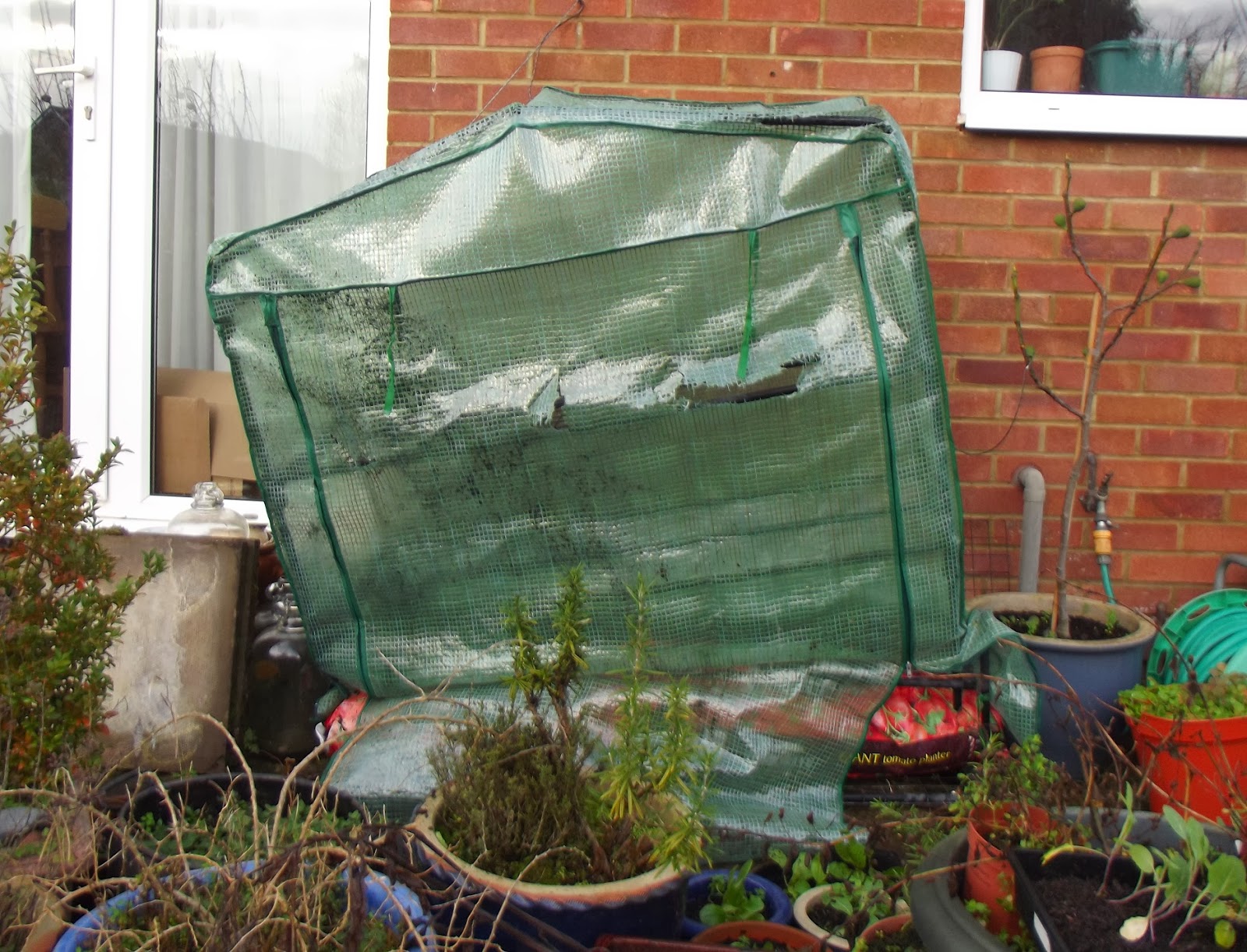
...so before that, my first priority needs to be somewhere new to put this year's tender seedlings!
Related Posts Plugin for WordPress, Blogger...