Fungi are amazing organisms. They're everywhere, but their lives go on unseen, in secret, for the most part. They're crucial for decomposition and recycling of waste. They grow like plants but are made of chitin like insects and other invertebrates and, just like humans, they produce vitamin D when exposed to sunlight - in fact, some consider fungi to be more closely related to animals than to plants. They can absorb toxic waste and chemical pollutants, using them as food and rendering them harmless. They can MAKE IT RAIN! Their rootlike mycelium - the main body of the organism - can spread underground for miles (the largest fungus on earth is believed to be a honey fungus which covers nearly nine square kilometres in Oregon's Blue Mountains!) while the mushrooms and toadstools we see on the surface are just their flowers and fruits! And it's fungi that form the vast underground network which scientists believe allows plants to communicate, warning each other of pest attack and other troubles.
These mycorrhizal fungi - fungi which connect to the roots of plants and form a symbiotic relationship with them - have other benefits for their hosts too; a vast mycelium acts as a secondary root system for a plant, bringing nutrients and water from far deeper and further away, effectively increasing its root system by up to 700 times! Plants with roots colonised by mycorrhizal fungi establish faster, grow better thanks to the additional nutrients, have more resistance to pests and disease, and suffer less in drought. It's estimated that 90% of land plants have associations with these fungi. Just one gram of woodland soil can contain over a million microscopic
fungi, and in one square inch of decomposing organic matter, such as a
decaying tree trunk, there can be 70 miles of mycelium. The stuff is everywhere!
Well, not everywhere. Guess where you won't find mycorrhizal fungi...
You won't find it in the kind of sterile shop-bought compost you raise young plants in. And you won't find it on highly-cultivated, regularly disturbed allotment soil. Nope.
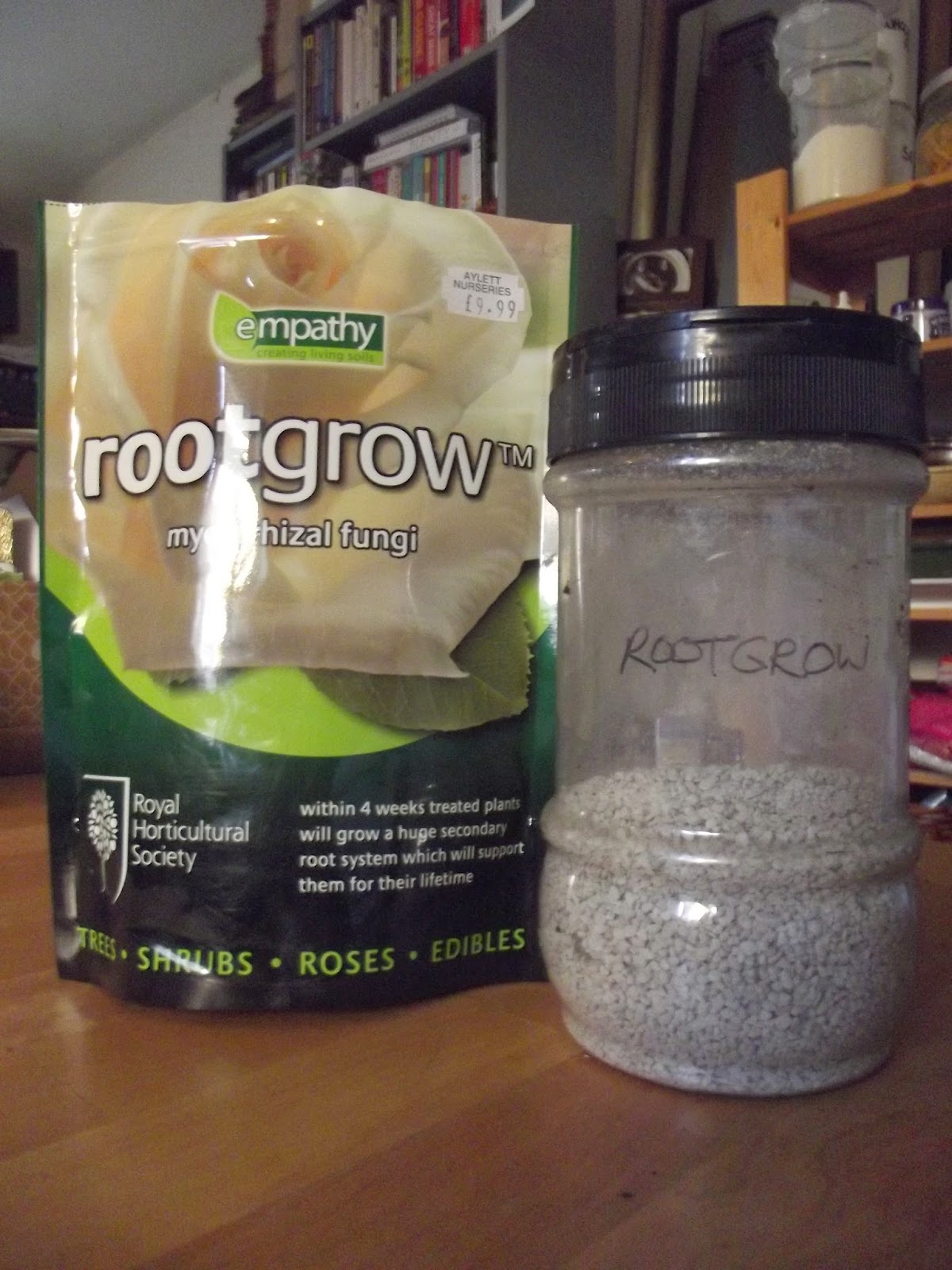
So I think it's pretty cool that you can now buy it in a packet. :-)
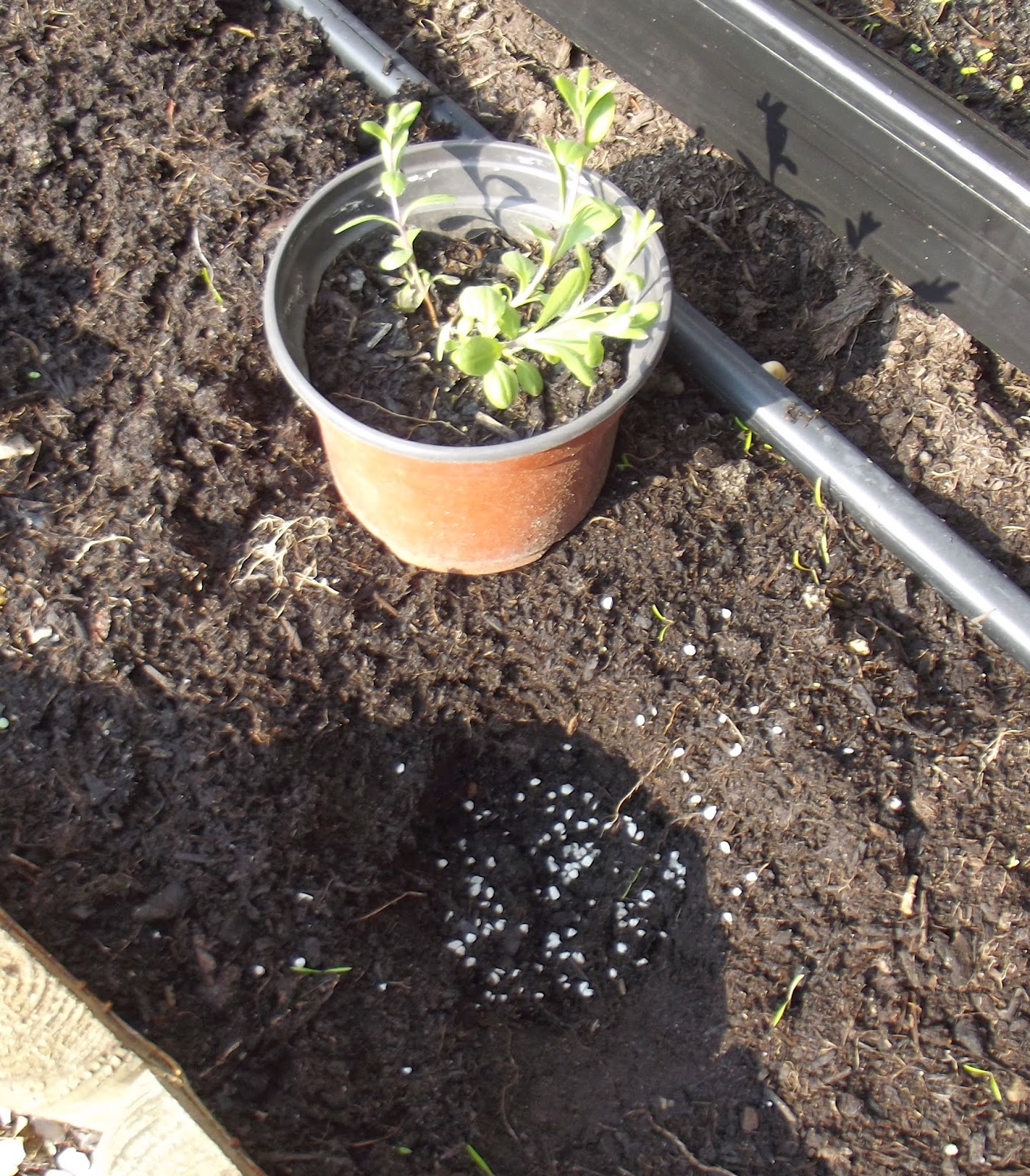
The fungi spores, native to the UK and grown here, are dried and bound in clay. To use them you just sprinkle them in the planting hole when transplanting, or add them to a drill under a sprinkling of soil before sowing seeds. I have put mine into an old herb jar with a shaker top for easy application!
Needless to say, I will be using this this year, especially under my new perennials, and have already added it when planting my strawberries and asparagus, and sowing my broad beans. Of course, switching to no-dig growing and using ground-covers will mean that fungi can survive much better in our soil from now on, and should colonise the area nicely, so personally I can't see myself using it year on year, but it certainly looks like it has great benefits for growers whatever their methods (look here for some photos comparing plants with and without mycorrhizae) and the RHS particularly recommends it when planting out trees, roses and shrubs, to ensure less transplant shock and help plants establish faster.
Mycorrhizal fungi apparently don't help brassicas, since brassica roots release a natural anti-fungal defence which stops them thriving, nor acid-loving plants such as cranberries, blueberries, heathers, azaleas and rhododendrons. Some other plants however, like grapes and roses, depend heavily on the mycorrhizae and can really struggle without them, and a few species of orchid cannot live without them at all.
It's crazy to think that our traditional method of digging the soil over before growing crops actually breaks this beneficial natural relationship that does so much good in the wild, and stops us benefiting right where we need it most. It's another one-up for no-dig gardening, and I can't wait to see the results!
Showing posts with label mushrooms. Show all posts
Monday, 31 March 2014
Thursday, 21 February 2013
Winter catch-up!
By the end of October our garden beds were looking good, full of pak choi, turnips, kale, radishes, winter lettuces, perpetual spinach, kai lan, lamb's lettuce, purple sprouting broccoli and carrots, not to mention self-seeded claytonia everywhere.
The greenhouse was full of pots of rocket, mustard, pak choi, lettuce and spring cabbages.
The saffron came up but didn't flower, which was disappointing. I've been feeding it all winter to try to build it up for next year. I'm not sure whether it's supposed to be this floppy...
On the plot, we had a few leeks doing well, and our over-winter onions and garlic got off to a great start. We even managed to pick a couple of big bags of chickweed for the dinner table, and turned them into a creamy green sauce to serve with rostis and poached eggs with lots of parmesan.
In November, I was given a mushroom growing kit for my birthday, and proceeded to grow lots of lovely pearl oyster mushrooms. The kit, from Fungi Futures, is easy to grow indoors and produces three flushes of mushrooms over a couple of months.
Good, huh? Growing mushrooms like this is fun and a great experience, and it's amazing to watch how fast they grow! This kit makes a great gift, but it's a rather expensive way to get your mushrooms and there must be more cost-effective alternatives to grow them long term... I've always been a bit put-off by 'gourmet' mushrooms as I find some varieties rather rubbery and weird, but now I can safely say I like oyster mushrooms so maybe I'll see what I can do about growing some more...
In December I discovered this wonderful recipe for Seville orange cheesecake - the best orange cheesecake you're ever likely to taste and possibly the bestest ever cheesecake ever. And, being someone who doesn't like traditional fruity spicy Christmas desserts, I made this equally awesome choc-and-nut Christmas pudding for the big day. The recipe is adapted from a Delicious Magazine recipe, but after a trial run I decided there was plenty of room for improvement, so here's my version.
Choc-and-nut Christmas Pudding
In January, during a mild spell, we harvested our Jerusalem artichokes. The crop was smaller than I was expecting - I don't know if they didn't do very well (I didn't notice them flower) or if we just missed them in the heavy clay soil! I read somewhere that they were good for breaking up heavy soils but they were extremely hard to dig and even harder to find, caked in clay! I'll soon find out how many we missed when those we left behind start growing in spring...
I picked a few more bits and pieces from the garden, and was delighted to find I could put a whole meal together with homegrown ingredients - in January!
I slow-roasted some pork shoulder with herbs and red wine til it was fall-apart tender, and served it up with pureed Jerusalem artichokes, fresh patio-grown new potatoes, braised turnips and baby onions (stored from summer), and garlicky kale and chard. It was a fab meal and so satisfying to be able to do that in January, even if it was just the once! The Jerusalem artichokes were a new one on us and we were both very pleasantly surprised by their sweetness and flavour. I do hope we get more next year!
I've had three chilli plants overwintering on my windowsill, all full of fruit which I seem to use up terribly slowly (I'm too used to just chucking some powder in), so I picked them all, strung thread through their stalks and hung them up to dry.
We're in February now and the garden's looking a bit sorry for itself, having spent several weeks under snow recently. My remaining radishes are rotten, the pak choi is bolting (already??), and the outdoor winter lettuces have vanished. The carrots are doing about as well as they always do for me - I might as well give up sowing carrots altogether! The greenhouse lettuces are doing really well, but a late family of caterpillars ate most of the rocket and the rest has now bolted. The broccoli is not really big enough in its containers - I'm getting the feeling it really needs to go in open ground.
I've had quite a few pickings from my winter garden - kale has probably fed me most, and the Jerusalem artichokes and winter potatoes (fleeced on the patio) were definitely worthwhile. There are still quite a few turnips, winter lettuces, lamb's lettuce and pak choi to be eaten, claytonia as always, and some very small spring cabbages which I hope will reach a useful size as spring comes on. The perpetual spinach and chard are just starting to get going again and signs of new growth are everywhere. Hurrah!
And of course, the sowing has begun for the new season, with leeks in pots outside, and slow-growing chillies, peppers and aubergines on the windowsill. I started them early this month - later than last year, as they got a bit much to cope with before planting out, but still early enough, I hope, to give them a decent head start and an earlier crop.
Writing this, I've just remembered I started my first early potatoes about this time last year, and this year I haven't even bought my seed potatoes yet! I must get a move on! The plastic greenhouse is on its last legs, poor thing, and needs replacing, and I must find a pot for the plum tree I've ordered too. I haven't even thought about broad beans yet and I dread to think what the allotment is looking like right now! February 21st? It's practically March!
The greenhouse was full of pots of rocket, mustard, pak choi, lettuce and spring cabbages.
The saffron came up but didn't flower, which was disappointing. I've been feeding it all winter to try to build it up for next year. I'm not sure whether it's supposed to be this floppy...
On the plot, we had a few leeks doing well, and our over-winter onions and garlic got off to a great start. We even managed to pick a couple of big bags of chickweed for the dinner table, and turned them into a creamy green sauce to serve with rostis and poached eggs with lots of parmesan.
In November, I was given a mushroom growing kit for my birthday, and proceeded to grow lots of lovely pearl oyster mushrooms. The kit, from Fungi Futures, is easy to grow indoors and produces three flushes of mushrooms over a couple of months.
Good, huh? Growing mushrooms like this is fun and a great experience, and it's amazing to watch how fast they grow! This kit makes a great gift, but it's a rather expensive way to get your mushrooms and there must be more cost-effective alternatives to grow them long term... I've always been a bit put-off by 'gourmet' mushrooms as I find some varieties rather rubbery and weird, but now I can safely say I like oyster mushrooms so maybe I'll see what I can do about growing some more...
In December I discovered this wonderful recipe for Seville orange cheesecake - the best orange cheesecake you're ever likely to taste and possibly the bestest ever cheesecake ever. And, being someone who doesn't like traditional fruity spicy Christmas desserts, I made this equally awesome choc-and-nut Christmas pudding for the big day. The recipe is adapted from a Delicious Magazine recipe, but after a trial run I decided there was plenty of room for improvement, so here's my version.
Choc-and-nut Christmas Pudding
- Grease a 1.5 litre pudding basin and dust with cocoa powder to prevent sticking.
- Beat together 175g unsalted butter (at room temp), 100g caster sugar and 60g soft brown sugar until light and fluffy.
- Beat three medium eggs into the mix, a little at a time.
- Stir in then sift in 100g plain flour, 45g cocoa powder, 2 tsp baking powder and 1/2 tsp bicarbonate of soda and fold in thoroughly.
- Fold in 50g chopped hazelnuts and 50g ground almonds, 1 tsp vanilla extract, 2 tsp mixed spice, 75ml full-fat milk, the zest of one large orange, and 150g chopped dark chocolate (or dark chocolate chips).
- Pour into the pudding basin and seal with greaseproof paper, foil and string - Lesley Waters shows how here. Then put the pudding basin in a large pan with a lid, add enough hot water to come halfway up the sides of the basin, cover, and simmer for two hours. Make sure the pan doesn't dry out.
- For the sauce, place 125g dark chocolate (broken up) in a jug with 2 tbsp golden syrup and a good splash of brandy. Heat 250ml double cream and 150ml full-fat milk in a pan until almost boiling, then pour over the chocolate and stir until it makes a smooth, glossy sauce. (If it doesn't come together, transfer to a bain marie and keep stirring, or microwave it for a few seconds at a time, stirring in between, until it does.)
- Unwrap the pudding, run a knife carefully round the edge, and turn it out onto a serving plate. Dust with icing sugar or add other decoration as desired, and serve hot with the chocolate sauce.
In January, during a mild spell, we harvested our Jerusalem artichokes. The crop was smaller than I was expecting - I don't know if they didn't do very well (I didn't notice them flower) or if we just missed them in the heavy clay soil! I read somewhere that they were good for breaking up heavy soils but they were extremely hard to dig and even harder to find, caked in clay! I'll soon find out how many we missed when those we left behind start growing in spring...
I picked a few more bits and pieces from the garden, and was delighted to find I could put a whole meal together with homegrown ingredients - in January!
I slow-roasted some pork shoulder with herbs and red wine til it was fall-apart tender, and served it up with pureed Jerusalem artichokes, fresh patio-grown new potatoes, braised turnips and baby onions (stored from summer), and garlicky kale and chard. It was a fab meal and so satisfying to be able to do that in January, even if it was just the once! The Jerusalem artichokes were a new one on us and we were both very pleasantly surprised by their sweetness and flavour. I do hope we get more next year!
I've had three chilli plants overwintering on my windowsill, all full of fruit which I seem to use up terribly slowly (I'm too used to just chucking some powder in), so I picked them all, strung thread through their stalks and hung them up to dry.
We're in February now and the garden's looking a bit sorry for itself, having spent several weeks under snow recently. My remaining radishes are rotten, the pak choi is bolting (already??), and the outdoor winter lettuces have vanished. The carrots are doing about as well as they always do for me - I might as well give up sowing carrots altogether! The greenhouse lettuces are doing really well, but a late family of caterpillars ate most of the rocket and the rest has now bolted. The broccoli is not really big enough in its containers - I'm getting the feeling it really needs to go in open ground.
I've had quite a few pickings from my winter garden - kale has probably fed me most, and the Jerusalem artichokes and winter potatoes (fleeced on the patio) were definitely worthwhile. There are still quite a few turnips, winter lettuces, lamb's lettuce and pak choi to be eaten, claytonia as always, and some very small spring cabbages which I hope will reach a useful size as spring comes on. The perpetual spinach and chard are just starting to get going again and signs of new growth are everywhere. Hurrah!
And of course, the sowing has begun for the new season, with leeks in pots outside, and slow-growing chillies, peppers and aubergines on the windowsill. I started them early this month - later than last year, as they got a bit much to cope with before planting out, but still early enough, I hope, to give them a decent head start and an earlier crop.
Writing this, I've just remembered I started my first early potatoes about this time last year, and this year I haven't even bought my seed potatoes yet! I must get a move on! The plastic greenhouse is on its last legs, poor thing, and needs replacing, and I must find a pot for the plum tree I've ordered too. I haven't even thought about broad beans yet and I dread to think what the allotment is looking like right now! February 21st? It's practically March!
Friday, 9 December 2011
Wild Food Night - November
A bit late again, but I can't miss it out - here's what we enjoyed at Wild Food Night a couple of weeks back.
Canapes were a mixed bag; a sloe shot - far too dry for my taste! - a spicy venison kofta bite with black pepper mayo, and a chocolate-dipped 'bramble candy' - a really lovely confection, soft inside like an after-dinner mint, but berry-flavoured of course.
The starter was wild mushroom soup, made with oyster, field and dried penny bun mushrooms, and pheasant and port pate - both delicious, and I could eat that soup again and again. (I've been eyeing the mushrooms popping up all over my lawn all autumn - I think they're edible blewitts but I just can't quite be sure... I'd love to get into mushroom identification but it seems such a tricky business. Maybe one day...)
The main was a venison pie, made with local fallow deer and red wine, topped with shortcrust pastry and served with locally-grown veg; sweet potato, cauliflower puree and buttered cabbage. Tasty and very filling! Venison is such a lovely meat and seems to suit pies, stews and curries really well - we should all use more of it!
Dessert was a triumph. I was a bit apprehensive when I read 'crab apple cheesecake' on the menu, but of course the crab apples were sweetened to a rich syrup and it was a delight, served with more of that lovely wild plum ice cream we've had before. Delicious!
A great meal and a great night!
Canapes were a mixed bag; a sloe shot - far too dry for my taste! - a spicy venison kofta bite with black pepper mayo, and a chocolate-dipped 'bramble candy' - a really lovely confection, soft inside like an after-dinner mint, but berry-flavoured of course.
The starter was wild mushroom soup, made with oyster, field and dried penny bun mushrooms, and pheasant and port pate - both delicious, and I could eat that soup again and again. (I've been eyeing the mushrooms popping up all over my lawn all autumn - I think they're edible blewitts but I just can't quite be sure... I'd love to get into mushroom identification but it seems such a tricky business. Maybe one day...)
The main was a venison pie, made with local fallow deer and red wine, topped with shortcrust pastry and served with locally-grown veg; sweet potato, cauliflower puree and buttered cabbage. Tasty and very filling! Venison is such a lovely meat and seems to suit pies, stews and curries really well - we should all use more of it!
Dessert was a triumph. I was a bit apprehensive when I read 'crab apple cheesecake' on the menu, but of course the crab apples were sweetened to a rich syrup and it was a delight, served with more of that lovely wild plum ice cream we've had before. Delicious!
A great meal and a great night!
Wednesday, 15 June 2011
Posh Courgette Pasta
And so courgette season is upon us. I know we're not exactly in desperate times yet (they'll come, they'll come), but in the never-ending search for great ways to use courgettes, I poshed-up this Jamie Oliver recipe using Boursin with garlic (which was on special offer at Tesco) and adding some mushrooms, to make a really quick and easy supper that Eddie said he'd have been happy to pay for at a restaurant! The rich creaminess and the bacon go so well with the courgettes!
Courgette Boursin Pasta
(serves two)
Courgette Boursin Pasta
(serves two)
- Put pasta on to boil. A flattish shape, such as farfalle, works best.
- Slice a courgette and four or five mushrooms, and cut four rashers of bacon into roughly 2cm pieces.
- Fry off the bacon, then add the veggies and fry gently until soft.
- Add the Boursin (about half a pack or 75g) and lots of freshly ground black pepper. Lower the heat and stir gently until the cheese is completely melted. (Of course, any other soft garlic/herb cheese would work too.)
- Drain the pasta, stir into the sauce, and serve! Great with crusty bread...
Thursday, 8 July 2010
Easy Courgette Risotto
Nah, this isn't a 'real' risotto, where you have to buy special rice and watch it for ages and never stop stirring. I can't be bothered with all that stuff. It's a variation on something my Mum used to make, and feels fabulously healthy with loads of vegetabley goodness. But what really makes this dish is the sprinkling of good cheddar cheese on top, and the crunch of the toasted sunflower seeds. Next time you need yet another courgette recipe, you have to try it.
Easy Courgette Risotto
Easy Courgette Risotto- Put rice on to boil - 50g per person - with a veg or chicken stock cube in the water.
- Dice onion, courgette and mushrooms, and pan-fry in a little oil for 5 minutes, then cover, lower the heat, and let the veg steam in their own juices. You don't need to add anything - the stock will provide all the seasoning you need.
- When the rice is just cooked, drain well and stir into the vegetables. Remove from the heat and let it soak up the vegetable juices.
- Toast a handful of sunflower seeds in a dry pan until just turning golden-brown. (Cashews are good with this too.)
- Serve the risotto with toasted seeds on top and a generous sprinkling of grated cheddar.
Thursday, 17 June 2010
Spinach Gnocchi
I first saw it this recipe on Oliver Rowe's 'Urban Chef' programme a few years back, and rediscovered it saved in my computer documents recently! Oliver set out to open a restaurant in London sourcing its ingredients only from inside the M25, and it was a really interesting series, although I do remember watching the bit about the mushroom farm under a motorway and being more than a little concerned about environmental pollutants...
Anyway, this recipe was somewhat more time consuming and fussy than most dinners I make, and I had a small issue with the consistency of the mixture, but it tasted so, so good - really rich and indulgent and classy. Will definitely make again. Not too often though - it's packed with vast amounts of cheese, butter and cream!

Spinach Gnocchi with Mushroom Sauce
(serves two)


Anyway, this recipe was somewhat more time consuming and fussy than most dinners I make, and I had a small issue with the consistency of the mixture, but it tasted so, so good - really rich and indulgent and classy. Will definitely make again. Not too often though - it's packed with vast amounts of cheese, butter and cream!

Spinach Gnocchi with Mushroom Sauce
(serves two)
- Steam 250g spinach, refresh in cold water, and squeeze the water out. Do not rush this step - get your hands in there and make sure it's as dry as you can get it!
- Chop the spinach finely, then add to a pan with 15g butter and 150g ricotta cheese over a lowish heat. Let everything soften and mix it together well.
- Take it off the heat, add 50g parmesan, an egg and 2 tbsps flour, and season.
- Spread the mixture out on a plate and chill in the fridge for half an hour.

- Meanwhile, finely chop 250g mushrooms, a couple of shallots and a couple of cloves of garlic.
- Fry the shallots and garlic gently in 15g butter of butter until soft, then add the mushrooms and seasoning, and stir in.
- Add 75ml white wine, increase the heat, and simmer a few minutes.
- Then add 100ml double cream and a pinch of nutmeg. Leave simmering gently while you make the gnocchi...
- With generously floured hands, mould the spinach mixture into tablespoon-sized dumplings and set them on a floured plate. (This is where I started running into trouble - the mixture was much too wet to work with easily. My immediate thought was that there should be more flour in the mix, but in retrospect I probably just didn't drain that spinach well enough!)
- Place the dumplings, in batches, into boiling water for 3-4 minutes until they rise to the surface. Then lift them out with a slotted spoon and place on an oiled baking tray.

- When they're all cooked, drizzle a little melted butter over the dumplings, sprinkle with parmesan, and place under a hot grill. (I had to reshape mine somewhat at this stage too, but hopefully if your mixture isn't so sloppy they will hold together better!)
- When they brown on top, remove from the grill and serve with the mushroom sauce on top. I recommend some crusty bread to mop up with as well!
Wednesday, 21 May 2008
Foiled!
Well I hope so anyway... I recently read a letter in a gardening magazine from a woman who swore that putting tin-foil round her plants kept the slugs off them. So I have made brassica collars out of foil for my newly-transplanted winter cabbages, brussels and broccolis, as well as the swedes I sowed direct here back in April. We'll see what happens...
In this bed I have also sowed kale seeds, and left some room for spring cabbage which will be sown later on in the summer.
There's so much to transplant now, I don't know when I'm going to get it all done. I held off planting out the tomatoes last weekend when I heard we were due a few cold nights, but I think I'll take the plunge on Friday when I have a day off. I'm really fearing for their health now; some have developed tiny black spots on the leaves, which is surely a sign that I'm doomed to fail yet again. Perhaps next year I'll skip the toilet rolls and go for good old-fashioned flower pots, where there's less risk of fungus developing.
Then there's the cucumbers and squashes. We're going to grow the cukes, butternut and spaghetti squashes up obelisks, so we've been busy building them and seiving bucketloads of compost to mulch the bed.
And I got home this evening to find my 60 young leeks and 16 free sweetcorn plants had arrived from Mr Fothergills! I've bunged them all in a trough in the garden temporarily, but I'll have to plant them out on Friday too.

And then there's the beans! I've had mixed germination success - I think I let one half of the tray dry out at a critical moment during the hot weather - so some will have to be resown, and I don't have any more space at home but I know the slugs will get them if I sow them direct, and anyway the bean patch is covered in self-seeded borage and last year's leftover potatoes sprouting, which I'll have to sort out before I do anything else there! Aaargh!
I thought it was high time I took the final step with mushrooms (a month after leaving the grains to spawn), and when I checked under the damp newspaper I found the manure was covered in these mould-like strands, as it should be.

It's covered now with a good layer of sterile soil, well firmed down, and with a few criss-crossing sticks over the top to try to keep the cats off! Can't wait to start picking my very own mushrooms...
And on a windy day over the weekend I noticed how much the asparagus is beginning to suffer (we're only picking a little this year - its second year - so some has grown into quite tall ferns already, and the wind damaged it quite badly last year) so I set up canes at the ends of each row with string running between the two to try to give it some support.

As you can see we're still fighting the weeds in the asparagus patch, but it's doing pretty well otherwise, with still no sign of any asparagus beetles yet (sssshh)!
In this bed I have also sowed kale seeds, and left some room for spring cabbage which will be sown later on in the summer.There's so much to transplant now, I don't know when I'm going to get it all done. I held off planting out the tomatoes last weekend when I heard we were due a few cold nights, but I think I'll take the plunge on Friday when I have a day off. I'm really fearing for their health now; some have developed tiny black spots on the leaves, which is surely a sign that I'm doomed to fail yet again. Perhaps next year I'll skip the toilet rolls and go for good old-fashioned flower pots, where there's less risk of fungus developing.
Then there's the cucumbers and squashes. We're going to grow the cukes, butternut and spaghetti squashes up obelisks, so we've been busy building them and seiving bucketloads of compost to mulch the bed.
And I got home this evening to find my 60 young leeks and 16 free sweetcorn plants had arrived from Mr Fothergills! I've bunged them all in a trough in the garden temporarily, but I'll have to plant them out on Friday too.

And then there's the beans! I've had mixed germination success - I think I let one half of the tray dry out at a critical moment during the hot weather - so some will have to be resown, and I don't have any more space at home but I know the slugs will get them if I sow them direct, and anyway the bean patch is covered in self-seeded borage and last year's leftover potatoes sprouting, which I'll have to sort out before I do anything else there! Aaargh!
I thought it was high time I took the final step with mushrooms (a month after leaving the grains to spawn), and when I checked under the damp newspaper I found the manure was covered in these mould-like strands, as it should be.

It's covered now with a good layer of sterile soil, well firmed down, and with a few criss-crossing sticks over the top to try to keep the cats off! Can't wait to start picking my very own mushrooms...
And on a windy day over the weekend I noticed how much the asparagus is beginning to suffer (we're only picking a little this year - its second year - so some has grown into quite tall ferns already, and the wind damaged it quite badly last year) so I set up canes at the ends of each row with string running between the two to try to give it some support.

As you can see we're still fighting the weeds in the asparagus patch, but it's doing pretty well otherwise, with still no sign of any asparagus beetles yet (sssshh)!
Tuesday, 15 April 2008
Mushrooms
I've said before that my home garden doesn't get very much sun - indeed there's one corner that gets no sun at all and is always very damp and dark. I wondered for ages what I could grow there, and suddenly it hit me; mushrooms! Why go out of my way to create shade on the allotment when I've got it right here?
My one previous attempt at growing mushrooms was in one of those 'mushroom kits' in a box in the kitchen. I got a few mushrooms out of it, but all sorts of flies and spiders liked the dark, damp environment and it got absolutely infested with creepy crawlies. The mushrooms got covered in cobwebs and were impossible to clean, and all in all, the experience was so icky I swore never to try it like that again!
So, open air this time. The spawn packet assures me complete darkness is not needed; just plenty of shade. The spawn packet also goes into great detail about how to rot down straw to create the perfect mushroom compost - something I feel I should have been told before buying the product! I have neither the time nor the space to rot down heaps of straw (nor the straw, for that matter), so a bag of farmyard manure from Homebase will have to do (hey, the things are spreading their little white threads even in the packet - they obviously want to grow, right?)
To hold my mushrooms, I picked up a few of these wooden boxes from the market while they were clearing up. I put them on a few thick sticks just to keep them off the ground and allow them to drain when it rains.
I filled them with manure. It's supposed to be to a depth of 6 to 8 inches but this is only about 5. Surely it can't make that much difference...?
The spawn, which appear to be wheatberries impregnated with the white mushroom spores, are spread thickly on the surface of the manure then mixed in to the top 5cm or so and pressed down well:
And then the whole lot is covered with wet newspaper to keep the moisture in:
I'm supposed to leave it like this for 2-4 weeks until the spawn work their little white threads throughout the soil, then remove the newspaper and put a 'casing' layer of peat or subsoil on top. (I went and bought topsoil. Whoops.) Then I sit back and wait for my mushrooms... Do you know, I think this is the most exciting thing I'm growing yet!
In other garden news, I don't know what this rose thinks it's doing, do you?

It was put upside-down in the shop at a crucial stage of new growth is my guess, but it doesn't seem to want to recover and starting growing upwards. I should have checked in the box before I bought it; that'll teach me.
I've trimmed the shoots off and am trying them as cuttings. I don't know much about it but I don't have much to lose either, and a shoot I accidentally knocked off one of the other roses while planting has established itself nicely where I dropped it, so it can't be that hard!
My one previous attempt at growing mushrooms was in one of those 'mushroom kits' in a box in the kitchen. I got a few mushrooms out of it, but all sorts of flies and spiders liked the dark, damp environment and it got absolutely infested with creepy crawlies. The mushrooms got covered in cobwebs and were impossible to clean, and all in all, the experience was so icky I swore never to try it like that again!
So, open air this time. The spawn packet assures me complete darkness is not needed; just plenty of shade. The spawn packet also goes into great detail about how to rot down straw to create the perfect mushroom compost - something I feel I should have been told before buying the product! I have neither the time nor the space to rot down heaps of straw (nor the straw, for that matter), so a bag of farmyard manure from Homebase will have to do (hey, the things are spreading their little white threads even in the packet - they obviously want to grow, right?)
To hold my mushrooms, I picked up a few of these wooden boxes from the market while they were clearing up. I put them on a few thick sticks just to keep them off the ground and allow them to drain when it rains.
I filled them with manure. It's supposed to be to a depth of 6 to 8 inches but this is only about 5. Surely it can't make that much difference...?
The spawn, which appear to be wheatberries impregnated with the white mushroom spores, are spread thickly on the surface of the manure then mixed in to the top 5cm or so and pressed down well:
And then the whole lot is covered with wet newspaper to keep the moisture in:
I'm supposed to leave it like this for 2-4 weeks until the spawn work their little white threads throughout the soil, then remove the newspaper and put a 'casing' layer of peat or subsoil on top. (I went and bought topsoil. Whoops.) Then I sit back and wait for my mushrooms... Do you know, I think this is the most exciting thing I'm growing yet!In other garden news, I don't know what this rose thinks it's doing, do you?

It was put upside-down in the shop at a crucial stage of new growth is my guess, but it doesn't seem to want to recover and starting growing upwards. I should have checked in the box before I bought it; that'll teach me.
I've trimmed the shoots off and am trying them as cuttings. I don't know much about it but I don't have much to lose either, and a shoot I accidentally knocked off one of the other roses while planting has established itself nicely where I dropped it, so it can't be that hard!
Subscribe to:
Posts (Atom)


