I have a confession to make. Crop rotation on a small plot has always rather baffled me. On a big plot it makes sense - on a big plot you can afford to leave a patch of ground empty in preparation for a later crop, or to sow a green manure in the middle of summer just for the heck of it - but on a small allotment where you want to make the most of every space all year round, it can be a real juggling act trying to get your potatoes out early enough for your purple-sprouting broccoli to go in, or clearing your onion patch in time to sow beans and corn, or figuring out what on earth to grow after you've harvested your squashes as late as October - and who uses exactly the same amount of space for every crop group anyway??
Traditionally, the main groups in a crop rotation are potatoes and roots, brassicas, beans, and 'other veg'. The potatoes are manured to enrich and slightly acidify the soil (preventing scab), heavy-feeding beans follow in the nicely broken-up ground after the potatoes are dug, then (often after an application of lime,) leafy brassicas to make good use of the nitrogen the bean roots accumulate. Then, presumably, you throw sweetcorn, cucurbits, tomatoes, leafy greens and everything else in together after that. Sounds simple enough, but questions abound. Do you grow swedes with the root crops or the brassicas? Aren't tomatoes in the same family as potatoes? Cucurbits take up way more space than anything else! And aren't you supposed to avoid manuring carrots?
I don't know, maybe I overthink these things - maybe I'm just too keen to abide by all the rules and to do it "right". But I think, after eight years on our allotment, I've finally cracked it!
This is partly thanks to slimming down the number of crops we grow on the allotment anyway - we don't grow onions and garlic due to white rot spores in our soil, and we prefer to keep salad leaves and quick-ripening summer crops like French beans, courgettes and tomatoes at home so we can pick them more regularly. On the allotment we grow the lower-maintenance stuff: potatoes, squashes, root veg, broad beans, leeks, and a limited amount of winter brassicas and spinach-type leaves (plus some perennials in a permanent area). We've grouped broad beans, leeks and root veg roughly together: together they take up about the same amount of space we use for more space-hungry crops (potatoes and squashes), and it means we can follow our broad beans (which finish around midsummer) with winter brassicas, thus keeping our earlier-sown swedes in the same area as our other brassicas.
Ladies and gents, I give you our brand new crop rotation plan! (Click pic to enlarge.)
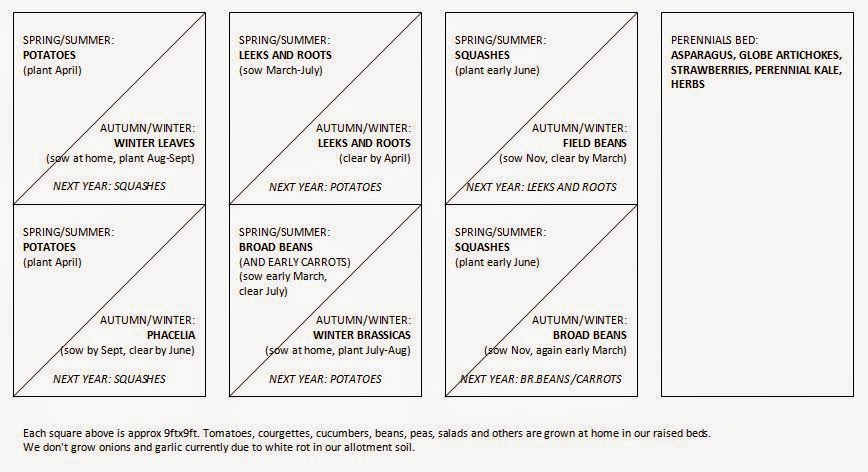
This rotation also allows for two squares to be sown with green manures over winter to add high-nitrogen organic matter to the compost heap, shelter wildlife and protect the soil. Phacelia and field beans are my two favoured green manures since field beans add vital nitrogen to the soil and can be sown as late as November, and phacelia attracts lots of insects and can be sown as late as September. Following squashes with winter-hardy beans means the timing for sowing is perfect; likewise with the winter leaves following the potatoes, and the winter brassicas following the broad beans. And even though we grow most of our beans at home, our allotment soil still gets a nitrogen injection thanks to the broad and field beans. Of course, this rotation doesn't include everything and I should do my best to efficiently rotate our crops at home too, but those on the allotment are the most important ones to rotate: beans for nitrogen, potatoes which are prone to damage from buildups of slugs and eelworms, and brassicas which are susceptible to clubroot, a very nasty fungal disease.
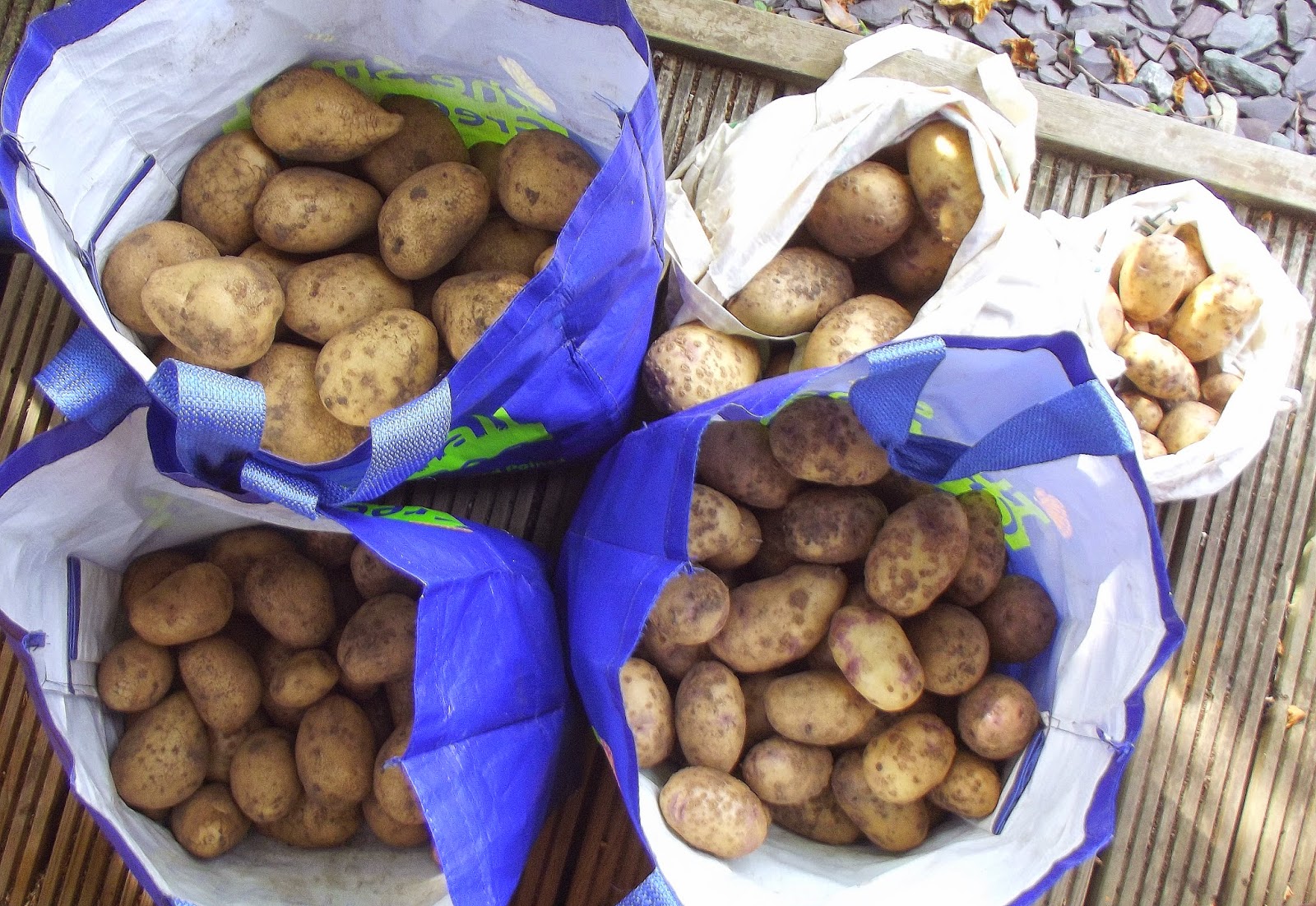
So far it's all going swimmingly. The potatoes are out (an awesome 28kg of Kestrel and 19kg Pentland Crown!) and the winter leaves are in; two rows of chard, two rows of winter spinach and a row of fennel (there's room for more, actually - I must do that). The squashes have finished a little earlier than usual, which means we have plenty of time to clear the soil for winter beans. The leeks, root veg, celery, spring cabbages, kohlrabi and pak choi are coming along nicely and we will slowly harvest them all winter long, making the most of all our space. Brilliant!
There is one complicating factor looming, in that we are planning to clear our old strawberry and asparagus beds (not shown in the plan above) over winter and put them to new use next spring. These two areas don't really fit into the plan so I'm a bit puzzled about what to do with them (and I rather wish we could move our pond and our apple tree into one, which would help us make better use of the other!). Should we grow runner beans or courgettes on the plot again after all? Shall I expand my collection of perennials? Is it time to give in and plant some fruit bushes? Good job I've got all winter to think about it...
Showing posts with label beans. Show all posts
Tuesday, 23 September 2014
Wednesday, 18 July 2012
Perfect Paella
There's no cuisine quite as summery as Spanish food, packed with spice and summer vegetables such as peppers, green beans and tomatoes, and in my recent - and ongoing - efforts to feel summery no matter what the damn weather's doing, I've been cooking quite a lot of Spanish food lately. I've long been a fan of tapas, but one thing I'd never tried to make before was paella, so I gave it a try.
This is my first attempt. Meat and veggies plus short-grain rice, cooked in stock, with smoked paprika and chilli. What could be wrong? It was nice, but... it wasn't exciting. It was lacking something and I couldn't put my finger on what. So I made it my mission to find out a bit more about making the perfect paella... And three or four paellas later, I think I've cracked it!
The Pan
Paella must be cooked in a wide, flat pan, to make sure the rice cooks in a shallow layer and the stock reduces effectively. But if you don't have a proper paella pan, another large flat pan will do just fine - I made the recipe below in a 28cm saute pan (though a few cm larger would have made life a bit easier).
The Rice
Authentic paella rices are Spanish and include Bomba (the best!), Bahia or Calasparra, but you can use any short grain rice and Arborio - the Italian rice commonly used for risottos - is a pretty good option. (In fact, I preferred Arborio to Sainsbury's 'Paella Rice', the variety of which is unspecified.) These types of rice hold their shape by remaining firm in the middle, whereas long-grain rice goes soft throughout, and they absorb a great deal of flavour as they cook, increasing drastically in size.
The Sofrito
This is simply a paste of chopped onions and tomatoes, cooked down to a dark, rich reduction. It adds so much to the flavour and really transforms the dish - paella isn't paella without it.
The Saffron
I've never been much of a believer in buying massively expensive foodstuffs that don't last very long or go very far... But I was really glad I bought saffron for my paella - there isn't really a substitute for the subtle richness and aroma it adds. (And I hope to be growing my own saffron in the garden starting this autumn - woohoo!) Use it.
The Soccarat
Now here's something I really didn't know, and which many of the recipes you'll find online don't seem to know either; you mustn't stir paella after adding the rice and stock. This is for two reasons. First, stirring encourages rice to release starch, go gooey and lose its shape, and in paella you want each grain to keep its shape. And second, you want the bottom to brown lightly; the crispy browned layer of toasted rice on the bottom is called the soccarat and is considered the best part of the dish - and trust me, it really is good. To get a good soccarat, add the right quantity of liquid (just over one-and-a-half times the volume of the rice) and turn the heat up high for a few minutes after most of the liquid has been absorbed, until you hear a light crackling at the bottom of the pan. After this, the paella should be covered and allowed to rest for five minutes, to allow the rice to soak up the last of the liquid.
The 'Fillings'
A traditional Valencian paella is made with chicken, rabbit, butter beans and green beans, with a seafood mix replacing both meat and veg in coastal towns. But mixed paellas using virtually whatever ingredients are handy have become popular across Spain, and across the world, so while many Spaniards will scoff at the addition of, say, chorizo, if you fancy it I say chuck it in! However, paella is primarily (traditionally) a rice dish, so try not to go so overboard with additions that the rice fades to insignificance! As well as meat, I like to have a green vegetable and a 'meaty' vegetable, such as butter beans or artichoke hearts, plus peppers for that summery sweet flavour. Or of course you could go for a veggie paella with peppers, a variety of beans, peas, fresh tomatoes, aubergines, artichokes, and even some olives. (If you're not going to use chorizo in your paella, I'd recommend adding more garlic, chilli and paprika than in the recipe below, as chorizo adds sso much of these flavours by itself.)
Nome's Perfect Paella
(serves 5-6)
This is my first attempt. Meat and veggies plus short-grain rice, cooked in stock, with smoked paprika and chilli. What could be wrong? It was nice, but... it wasn't exciting. It was lacking something and I couldn't put my finger on what. So I made it my mission to find out a bit more about making the perfect paella... And three or four paellas later, I think I've cracked it!
The Pan
Paella must be cooked in a wide, flat pan, to make sure the rice cooks in a shallow layer and the stock reduces effectively. But if you don't have a proper paella pan, another large flat pan will do just fine - I made the recipe below in a 28cm saute pan (though a few cm larger would have made life a bit easier).
The Rice
Authentic paella rices are Spanish and include Bomba (the best!), Bahia or Calasparra, but you can use any short grain rice and Arborio - the Italian rice commonly used for risottos - is a pretty good option. (In fact, I preferred Arborio to Sainsbury's 'Paella Rice', the variety of which is unspecified.) These types of rice hold their shape by remaining firm in the middle, whereas long-grain rice goes soft throughout, and they absorb a great deal of flavour as they cook, increasing drastically in size.
The Sofrito
This is simply a paste of chopped onions and tomatoes, cooked down to a dark, rich reduction. It adds so much to the flavour and really transforms the dish - paella isn't paella without it.
The Saffron
I've never been much of a believer in buying massively expensive foodstuffs that don't last very long or go very far... But I was really glad I bought saffron for my paella - there isn't really a substitute for the subtle richness and aroma it adds. (And I hope to be growing my own saffron in the garden starting this autumn - woohoo!) Use it.
The Soccarat
Now here's something I really didn't know, and which many of the recipes you'll find online don't seem to know either; you mustn't stir paella after adding the rice and stock. This is for two reasons. First, stirring encourages rice to release starch, go gooey and lose its shape, and in paella you want each grain to keep its shape. And second, you want the bottom to brown lightly; the crispy browned layer of toasted rice on the bottom is called the soccarat and is considered the best part of the dish - and trust me, it really is good. To get a good soccarat, add the right quantity of liquid (just over one-and-a-half times the volume of the rice) and turn the heat up high for a few minutes after most of the liquid has been absorbed, until you hear a light crackling at the bottom of the pan. After this, the paella should be covered and allowed to rest for five minutes, to allow the rice to soak up the last of the liquid.
The 'Fillings'
A traditional Valencian paella is made with chicken, rabbit, butter beans and green beans, with a seafood mix replacing both meat and veg in coastal towns. But mixed paellas using virtually whatever ingredients are handy have become popular across Spain, and across the world, so while many Spaniards will scoff at the addition of, say, chorizo, if you fancy it I say chuck it in! However, paella is primarily (traditionally) a rice dish, so try not to go so overboard with additions that the rice fades to insignificance! As well as meat, I like to have a green vegetable and a 'meaty' vegetable, such as butter beans or artichoke hearts, plus peppers for that summery sweet flavour. Or of course you could go for a veggie paella with peppers, a variety of beans, peas, fresh tomatoes, aubergines, artichokes, and even some olives. (If you're not going to use chorizo in your paella, I'd recommend adding more garlic, chilli and paprika than in the recipe below, as chorizo adds sso much of these flavours by itself.)
Nome's Perfect Paella
(serves 5-6)
- Heat a little oil in your pan and add 2 or 3 diced chicken breasts. Cook until they're just lightly sealed all over, and stir in 225g chorizo, diced or sliced, and a green and a red pepper, diced. Cook over a high heat for a couple of minutes until the oil starts coming out of the chorizo, then push it all to the outside of the pan or, if you don't have room, remove from the pan and set aside for a few minutes.
- Add a large onion, finely chopped, to the pan, cook a couple of minutes until translucent, then add a 400g can chopped tomatoes, keeping a little of the liquid back. Keep stirring and cooking until it reduces and darkens, but don't let it burn. This is the sofrito and adds loads of flavour to your paella.
- To the sofrito, add 2-3 cloves chopped garlic, 1 tsp mild chilli powder and 1 tsp smoked sweet paprika and stir in. Then stir the chicken/chorizo/pepper mix back in to the pan.
- Add 300g short grain rice (see 'The rice' above) and stir quickly through the contents of the pan. Now put that spoon away - you're not going to be doing any more stirring.
- Add 250ml dry white wine, 500ml light, quality chicken/fish/veg stock and about 1/2 teaspoon saffron threads, soaked in a little hot water. Sprinkle on 200g frozen/fresh peas or chopped green beans. Give the pan a little shake to even things out, and bring to the boil.
- Taste the stock to check the flavour, spice and seasoning. Adjust if necessary, but try not to disturb the rice too much.
- Reduce to a simmer and leave uncovered to cook. It should take around 20 minutes for all the liquid to absorb/reduce - check at around the 15 minute mark and if it's still very wet, raise the heat, or if it's dry already but the rice isn't tender add a little more stock.
- When the rice is tender and almost all the liquid is absorbed, arrange 225g cooked king prawns and a can of artichoke hearts or butter beans (or 100g dried butter beans, soaked overnight then simmered 40-60 minutes until tender) on the top of the paella to heat through.
- Raise the heat to brown the bottom. When you hear popping and crackling it's happening - stick a fork down there and keep an eye on it as you want a good layer of brown but no black! When it's done, turn the heat off.
- Cover the pan with a lid, foil or a clean towel, and let the dish rest for five minutes.
- Sprinkle the juice of half a lemon and a couple of good handfuls of chopped fresh parsley over the paella, and serve, remembering to scrape the lovely soccarat off the bottom!
Friday, 1 June 2012
There goes May...
I've been pretty busy these last two weeks and neglecting my poor blog again, but with June (and some sunshine!) here now it's got to be time for at least a little update on things in the garden.
The early potatoes are loving their grow sacks and their sheltered spot by the house. No sign of any flowers yet, which will mean time to start harvesting spuds, but it won't be long.
The tomatoes and peppers are all settled into their pots and tubs and planters. There's a lot of em! In the picture below you can also see lettuces and radishes, kailan, mangetout, strawberries, various herbs and a courgette.
The tomatoes are starting to flower.
The French beans I planted during the wet, cold weather a few weeks back never germinated, but a new sowing is now popping up, both below left and in another big planter. And I've planted up a lot of smaller pots with Swiss chard and perpetual spinach, and sown salad burnet in others. Hate to see pots empty!
The first courgettes are on their way...
The mangetout is flowering, and beautiful!
The aubergines and West Indian gherkins (pictured) are planted permanently in the plastic greenhouse for a little extra warmth and shelter. I've never managed to grow an aubergine yet - I'm hoping this is the year!
And the herb garden is flourishing and wonderful! I am actually remembering to sow successional crops of spring onions (tucked at the back there), and getting loads of use out of the herbs. Wooo!
I also have beetroots growing in a window box, cucumbers in a grow bag and various pots of poached-egg plant, poppies and marigolds on their way.
At the allotment I'm afraid it's another story. The weeks of rain really helped the grass to run riot and kept us away for the most part, and we're still catching up. The maincrop potatoes are planted and just shooting up now, the asparagus is plodding along despite less-than-ideal conditions, and we've got some garlic and onions doing fabulously well, but the strawberries are under a jungle of weeds and we still have to clear room for our pumpkins and squashes, artichokes, a new batch of perennial brassicas and some cabbages and calabrese. Oh, and some kohlrabi, celery and celeriac... Not exactly sure where I'm gonna put those... I haven't sown any parsnips and I guess it's probably too late now. But more on that another day...
The early potatoes are loving their grow sacks and their sheltered spot by the house. No sign of any flowers yet, which will mean time to start harvesting spuds, but it won't be long.
The tomatoes and peppers are all settled into their pots and tubs and planters. There's a lot of em! In the picture below you can also see lettuces and radishes, kailan, mangetout, strawberries, various herbs and a courgette.
The tomatoes are starting to flower.
The French beans I planted during the wet, cold weather a few weeks back never germinated, but a new sowing is now popping up, both below left and in another big planter. And I've planted up a lot of smaller pots with Swiss chard and perpetual spinach, and sown salad burnet in others. Hate to see pots empty!
The first courgettes are on their way...
The mangetout is flowering, and beautiful!
The aubergines and West Indian gherkins (pictured) are planted permanently in the plastic greenhouse for a little extra warmth and shelter. I've never managed to grow an aubergine yet - I'm hoping this is the year!
And the herb garden is flourishing and wonderful! I am actually remembering to sow successional crops of spring onions (tucked at the back there), and getting loads of use out of the herbs. Wooo!
I also have beetroots growing in a window box, cucumbers in a grow bag and various pots of poached-egg plant, poppies and marigolds on their way.
At the allotment I'm afraid it's another story. The weeks of rain really helped the grass to run riot and kept us away for the most part, and we're still catching up. The maincrop potatoes are planted and just shooting up now, the asparagus is plodding along despite less-than-ideal conditions, and we've got some garlic and onions doing fabulously well, but the strawberries are under a jungle of weeds and we still have to clear room for our pumpkins and squashes, artichokes, a new batch of perennial brassicas and some cabbages and calabrese. Oh, and some kohlrabi, celery and celeriac... Not exactly sure where I'm gonna put those... I haven't sown any parsnips and I guess it's probably too late now. But more on that another day...
Monday, 21 May 2012
It's National Vegetarian Week...
I'm not a vegetarian, and despite my fussiness about the meat I eat, I don't aspire to be one. I believe we humans are meant to eat meat and animal products - that it is an important part of healthy nutrition. (This account from a young vegan forced to realise that not everybody can survive on a vegan diet is fascinating and eye-opening.) I also believe the replenishment animals provide to the soil is vital to farming; that the healthiest way to produce food is in a polycultural system where animals and plants support and feed off each other, and that a wide variety of produce reduces the need for chemicals and treatments and encourages a healthier, more natural ecosystem where 'good' and 'bad' organisms are in balance.
But I also believe the amount of meat many are accustomed to eating these days is far too much. The amount we eat can be detrimental to our health, and too-often takes the place in our diets of other essentials such as vegetables. The amount we eat forces producers to farm animals intensively, which compromises animal welfare as well as the quality of the meat we eat. The amount we eat necessitates vast monocultures to feed the livestock, which deplete the soil, interfere with natural ecosystems and are detrimental to the planet. The amount we eat is ultimately unsustainable, and if we all ate less meat - perhaps just two or three times a week - the world would undoubtedly be a better place.
So this week, why not try a few meat-free recipes and cut down a little? I don't mean baked potatoes and beans, or macaroni cheese, or a mushroom pizza - vegetarian food can be far more exciting and nutritious than that; if you're stuck for ideas, try here or here for inspiration. Or check out Meat Free Monday - a campaign to get everyone eating meat-free at least once a week, with lots of recipes to tempt you to join in! (I was thinking of feeding my lot meat-free all week this week and seeing if they noticed, but planned badly and have half a pack of mince in my fridge to use up, and I promised I'd do steak one night... but five nights out of seven still ain't bad!)
And here's a simple offering to get your mouth watering; a beanburger recipe I've been working on recently (loosely based on a standard recipe that's all over the internet in various forms) which my family loves. (Not exciting enough for you? You haven't tasted it yet!) It's not quite seasonal right now, I confess, but summer round the corner means burgers on my mind. It's seriously tasty, family-friendly, and couldn't be much healthier either. Give it a try!
Mexican Beanburgers
(makes eight large burgers)
But I also believe the amount of meat many are accustomed to eating these days is far too much. The amount we eat can be detrimental to our health, and too-often takes the place in our diets of other essentials such as vegetables. The amount we eat forces producers to farm animals intensively, which compromises animal welfare as well as the quality of the meat we eat. The amount we eat necessitates vast monocultures to feed the livestock, which deplete the soil, interfere with natural ecosystems and are detrimental to the planet. The amount we eat is ultimately unsustainable, and if we all ate less meat - perhaps just two or three times a week - the world would undoubtedly be a better place.
So this week, why not try a few meat-free recipes and cut down a little? I don't mean baked potatoes and beans, or macaroni cheese, or a mushroom pizza - vegetarian food can be far more exciting and nutritious than that; if you're stuck for ideas, try here or here for inspiration. Or check out Meat Free Monday - a campaign to get everyone eating meat-free at least once a week, with lots of recipes to tempt you to join in! (I was thinking of feeding my lot meat-free all week this week and seeing if they noticed, but planned badly and have half a pack of mince in my fridge to use up, and I promised I'd do steak one night... but five nights out of seven still ain't bad!)
And here's a simple offering to get your mouth watering; a beanburger recipe I've been working on recently (loosely based on a standard recipe that's all over the internet in various forms) which my family loves. (Not exciting enough for you? You haven't tasted it yet!) It's not quite seasonal right now, I confess, but summer round the corner means burgers on my mind. It's seriously tasty, family-friendly, and couldn't be much healthier either. Give it a try!
Mexican Beanburgers
(makes eight large burgers)
- Finely chop a large onion, a green pepper and a red pepper, and fry gently in a teaspoon of olive or rapeseed oil.
- Peel and chop a large carrot, and steam/boil in a little water until soft.
- When the onions are translucent and the peppers soft, add a small can sweetcorn (160g), a clove or two chopped garlic, 2 tsp ground cumin, 2 tsp ground ginger, 1 tsp chilli powder (or to taste), 1 tsp dried oregano, 1 tsp dried coriander leaf, a tbsp lemon or lime juice, a good grinding of black pepper and a pinch or two of salt. Stir in and cook for a couple more minutes, then turn off the heat.
- Mash the carrot (or puree in the food processor) and add it to the pan.
- Drain and rinse two cans beans (I use one can cannellini, one can kidney), pulse half in the food processor until finely chopped, then add the rest and pulse until coarsely chopped for texture. Add to the pan.
- Add 100g plain flour. Mix everything together really well.
- Separate the mixture into eight balls and flatten them into patties about 2cm thick. It's messy, but stick with it!
- Place on an oiled and floured baking tray, and bake at 200C for around 20 minutes, turning halfway through, until the burgers are lightly browned and firm.
- Serve in bread rolls, with guacamole (or avocado), salsa (or sliced tomato), salad and a little cheese.
Wednesday, 24 August 2011
Summer Harvests
We've harvested our onions recently, and they're spread out to dry at home. A disappointing result, as usual, despite the fact I bought a 'giant' variety this year! There's definitely something lacking in our soil, despite the generous dressing of manure we gave it in the spring; next year I'll have to invest in some onion fertiliser.
I was also surprised that several onions suffered white rot as usual, despite the Armillatox fiasco... (On which note, I'm pleased to report that there is indeed no trace of the Armillatox in the soil now, and no smell or taste of it in the onions! However, I won't be bothering again since it doesn't stop the problem...) Perhaps I'm wrong and it's not white rot but just a few weak plants going bad, but they do seem to have all the right signs; yellowed leaves, white mould underneath, and weak or rotten roots.
Our shallots (on the right above) and garlic are harvested now too - it's a pretty good garlic crop, and there are more to come, although a few bulbs seem to have disappeared!
We've dug up our first few potatoes, and boy, was I surprised! I was pretty concerned about them because when we returned from our holiday the foliage had all died down and I hadn't seen a single flower! I guess I just wasn't paying attention...
These are Kestrel - a 'second early' variety that's particularly good for roasting, baking and mashing. They've got some pretty bad scab in places, but it's only cosmetic. We scattered some potato fertiliser from the Organic Garden Catalogue over the bed before planting and it looks like it did its job! These babies weigh up to 360g each!
Fat hen swallowed our French bean bed while we were away, but as we weeded we found a great crop of beans hiding in the jungle. We also found a surprise late handful of broad beans when we cleared the plants - I thought they were finished ages ago! I pureed them with some lemon juice and a spoonful of fat hen pesto, spread them on toast and topped them with cheese for lunch one day. Mmmmmmm.
And we're now harvesting our runner beans. The beans are setting well in this damp weather and there are hundreds of them! But somehow I don't think we'll be winning any shows with these crazy shapes...
I was also surprised that several onions suffered white rot as usual, despite the Armillatox fiasco... (On which note, I'm pleased to report that there is indeed no trace of the Armillatox in the soil now, and no smell or taste of it in the onions! However, I won't be bothering again since it doesn't stop the problem...) Perhaps I'm wrong and it's not white rot but just a few weak plants going bad, but they do seem to have all the right signs; yellowed leaves, white mould underneath, and weak or rotten roots.
Our shallots (on the right above) and garlic are harvested now too - it's a pretty good garlic crop, and there are more to come, although a few bulbs seem to have disappeared!
We've dug up our first few potatoes, and boy, was I surprised! I was pretty concerned about them because when we returned from our holiday the foliage had all died down and I hadn't seen a single flower! I guess I just wasn't paying attention...
These are Kestrel - a 'second early' variety that's particularly good for roasting, baking and mashing. They've got some pretty bad scab in places, but it's only cosmetic. We scattered some potato fertiliser from the Organic Garden Catalogue over the bed before planting and it looks like it did its job! These babies weigh up to 360g each!
Fat hen swallowed our French bean bed while we were away, but as we weeded we found a great crop of beans hiding in the jungle. We also found a surprise late handful of broad beans when we cleared the plants - I thought they were finished ages ago! I pureed them with some lemon juice and a spoonful of fat hen pesto, spread them on toast and topped them with cheese for lunch one day. Mmmmmmm.
And we're now harvesting our runner beans. The beans are setting well in this damp weather and there are hundreds of them! But somehow I don't think we'll be winning any shows with these crazy shapes...
Thursday, 4 August 2011
Garden Update
Okay, okay, here I am. I've been back from our holiday in Whitby a week and a half, but very busy focusing on a writing deadline, so here's a belated update on what's been going on in the garden.
I was delighted when we got home from Whitby to find the cucumbers finally appearing. After a few disastrous cucumber-growing attempts, I sought out some 'Moneta' seeds - my favourite variety, but hard to find (I finally got them from Germany!) - and they're doing me proud. I'm watering hard to try to avoid any bitterness in this hot weather, and will be picking later today...
The tomatoes are doing fabulously well and are sooo delicious. We're getting at least a good handful most days now. The leaves of the 'Hundreds and Thousands' have been yellowing and showing black spots since mid-June now. I've pruned, I've sprayed milk, I've sprayed chamomile, but now the tell-tale black patches are appearing on the stems it's clear they've got blight. I'm just glad it's taken so long to progress!
There's still no sign of damage to the fruits so I'm just gonna keep harvesting for now, hope for the best, and try to prevent it spreading to the 'Angelle' tomatoes which are looking much healthier. Last year I raved about how easy-to-keep the Angelle plants were, because they didn't put out any suckers. Well, turns out they do when they're planted at the proper time in the proper amount of properly-nutritious soil... They're growing like crazy and I can hardly keep on top of pruning! The whole lot fell over the other day, the plants got so heavy, and I had to restake them. However, despite their luxuriance, they haven't minded one bit being planted six-to-a-bag.
I'm also pleased to see the first green peppers swelling. We've got a bit of a pepper experiment going on this year, with a few different varieties, so I can't wait to see how they all do... I think this one is 'King of the North' - the same as we grew last year.
Sadly our French beans, which started off so well, are having some trouble. They're empty!
The pods are just flat and sort of limp - and going purple, which this variety does not usually do. They're still edible, but not nearly so good to eat. I can only imagine the problem is poor pollination, but I don't understand - they're only a few feet from the tomatoes, and they're obviously getting plenty of attention. Our garden is buzzing with bees and hoverflies! So what's gone wrong? Perhaps they're planted too close together and the insects just aren't finding the flowers. I wonder if there's time for a second sowing...
I was delighted when we got home from Whitby to find the cucumbers finally appearing. After a few disastrous cucumber-growing attempts, I sought out some 'Moneta' seeds - my favourite variety, but hard to find (I finally got them from Germany!) - and they're doing me proud. I'm watering hard to try to avoid any bitterness in this hot weather, and will be picking later today...
The tomatoes are doing fabulously well and are sooo delicious. We're getting at least a good handful most days now. The leaves of the 'Hundreds and Thousands' have been yellowing and showing black spots since mid-June now. I've pruned, I've sprayed milk, I've sprayed chamomile, but now the tell-tale black patches are appearing on the stems it's clear they've got blight. I'm just glad it's taken so long to progress!
There's still no sign of damage to the fruits so I'm just gonna keep harvesting for now, hope for the best, and try to prevent it spreading to the 'Angelle' tomatoes which are looking much healthier. Last year I raved about how easy-to-keep the Angelle plants were, because they didn't put out any suckers. Well, turns out they do when they're planted at the proper time in the proper amount of properly-nutritious soil... They're growing like crazy and I can hardly keep on top of pruning! The whole lot fell over the other day, the plants got so heavy, and I had to restake them. However, despite their luxuriance, they haven't minded one bit being planted six-to-a-bag.
I'm also pleased to see the first green peppers swelling. We've got a bit of a pepper experiment going on this year, with a few different varieties, so I can't wait to see how they all do... I think this one is 'King of the North' - the same as we grew last year.
Sadly our French beans, which started off so well, are having some trouble. They're empty!
The pods are just flat and sort of limp - and going purple, which this variety does not usually do. They're still edible, but not nearly so good to eat. I can only imagine the problem is poor pollination, but I don't understand - they're only a few feet from the tomatoes, and they're obviously getting plenty of attention. Our garden is buzzing with bees and hoverflies! So what's gone wrong? Perhaps they're planted too close together and the insects just aren't finding the flowers. I wonder if there's time for a second sowing...
Monday, 4 July 2011
Beans!
We picked our first French beans at the weekend! Beans are one of my favourite crops; they're easy to grow, productive, delicious and versatile. I especially like pairing them with tuna, and we enjoyed this lovely lot in an easy pasta dish of tuna, tinned tomates, garlic, basil, a little double cream, a sprinkle of parmesan and lots of black pepper. Lovely!
Sunday, 26 June 2011
Signs of Trouble
I've been spotting a few problems arising in some of the plants in the garden during the last month or so. It always seems to happen as summer hits us - I guess warm, humid weather is the best time for pests and disease to thrive.
The sorrel is full of leaf-miners - you can see three wormy grubs inside the left here on the right. Apparently the parent - a flying insect of some sort - lays its eggs on the edge of the leaf, and the grubs burrow straight inside to feed.
It's not a problem I've had before, and there doesn't seem to be anything I can do except pick and destroy the affected leaves (or net the whole plants, but that ain't gonna happen). Any tips, anyone?
The French beans are well on their way now - I'll be picking the first this week - but several plants have discoloured leaves and I really have no idea what it is. Some look like this...
And some look like this...
The plants seem to be in great health otherwise, but it's hard to know whether this is the start of something bad, or nothing to worry about!
Some of the courgette leaves are yellowing badly - another problem I've never seen like this before.
And the 'Hundreds and Thousands' tomato plants have some very yellow leaves in the middle too, and some black spots. We surely haven't had the right conditions for blight yet. I'm thinking maybe it's some kind of leaf-spot...?
Can anyone can help identify any of these problems?
The sorrel is full of leaf-miners - you can see three wormy grubs inside the left here on the right. Apparently the parent - a flying insect of some sort - lays its eggs on the edge of the leaf, and the grubs burrow straight inside to feed.
It's not a problem I've had before, and there doesn't seem to be anything I can do except pick and destroy the affected leaves (or net the whole plants, but that ain't gonna happen). Any tips, anyone?
The French beans are well on their way now - I'll be picking the first this week - but several plants have discoloured leaves and I really have no idea what it is. Some look like this...
And some look like this...
The plants seem to be in great health otherwise, but it's hard to know whether this is the start of something bad, or nothing to worry about!
Some of the courgette leaves are yellowing badly - another problem I've never seen like this before.
And the 'Hundreds and Thousands' tomato plants have some very yellow leaves in the middle too, and some black spots. We surely haven't had the right conditions for blight yet. I'm thinking maybe it's some kind of leaf-spot...?
Can anyone can help identify any of these problems?
Thursday, 19 May 2011
Allotment Update
Despite being way ahead of ourselves earlier in the season, it's a real struggle keeping up with things at the allotment at this time of year and we've got the usual mix of good and bad going on.
Good: the potatoes are doing well, and ready to be earthed up just as soon as I pluck all the bindweed out.
Good: I've planted the leeks out. 12 Autumn Giant, 12 Malabar F1 and 12 Musselburgh. These were sown in seed trays in late February.
We plant them in a grid, pushing a 6" deep hole in the soil using the end of a hoe, dropping the baby leek in and watering well. I do think some of them were still a bit small really, so fingers crossed they're not too swamped! I'm keeping the extra seedlings on standby just in case.
Bad: the spinach has gone to seed in the warm, dry weather, and I barely got to harvest any! Boooooo.
The chard is finished too, and will need clearing a.s.a.p. to make room for a new lot.
Good: the broad beans are thriving and flowering away. As always, please ignore the carpet of weeds...
The two lefthand rows are Aquadulce, the two righthand rows are Bunyards Exhibition. I know which one I'm growing next year!
Good: We've weeded the asparagus (again) and planted out the petunias (reputed to keep away the dreaded asparagus beetle).
Bad: the asparagus beetles are really going for it this year and causing serious damage. Some of this could be slug/snail damage too. I've never seen anything like this - the whole tips are gone!
Good: we've netted the strawberries, adopting a much simpler system than the rickety frame we constructed last year!
The net is simply draped over a few canes topped with plastic bottles, and weighed down round the edges with stones tied into the netting.
Good: I've direct-sown runner beans (Polestar) round the feet of four obelisks, and a few rows of French beans (Delinel) in front. Eddie's grandparents kindly sent us a few runner bean plants back at Eastertime, too. They've been getting a bit stressed and lanky in their little pots and will take some settling in, but they're out there now and will hopefully give us a small early crop!
Bad: we still have to finish digging the brassica patch and the three squash patches! The weeds have really taken over since last growing season and the soil is very hard and dry because of the weather we've been having, so progress is slow. I'd hoped to have cleared the paths and got some weed-proof membrane down on them by this time too, but I guess that can wait til everything else is sorted.
Good: the potatoes are doing well, and ready to be earthed up just as soon as I pluck all the bindweed out.
Good: I've planted the leeks out. 12 Autumn Giant, 12 Malabar F1 and 12 Musselburgh. These were sown in seed trays in late February.
We plant them in a grid, pushing a 6" deep hole in the soil using the end of a hoe, dropping the baby leek in and watering well. I do think some of them were still a bit small really, so fingers crossed they're not too swamped! I'm keeping the extra seedlings on standby just in case.
Bad: the spinach has gone to seed in the warm, dry weather, and I barely got to harvest any! Boooooo.
The chard is finished too, and will need clearing a.s.a.p. to make room for a new lot.
Good: the broad beans are thriving and flowering away. As always, please ignore the carpet of weeds...
The two lefthand rows are Aquadulce, the two righthand rows are Bunyards Exhibition. I know which one I'm growing next year!
Good: We've weeded the asparagus (again) and planted out the petunias (reputed to keep away the dreaded asparagus beetle).
Bad: the asparagus beetles are really going for it this year and causing serious damage. Some of this could be slug/snail damage too. I've never seen anything like this - the whole tips are gone!
Good: we've netted the strawberries, adopting a much simpler system than the rickety frame we constructed last year!
The net is simply draped over a few canes topped with plastic bottles, and weighed down round the edges with stones tied into the netting.
Good: I've direct-sown runner beans (Polestar) round the feet of four obelisks, and a few rows of French beans (Delinel) in front. Eddie's grandparents kindly sent us a few runner bean plants back at Eastertime, too. They've been getting a bit stressed and lanky in their little pots and will take some settling in, but they're out there now and will hopefully give us a small early crop!
Bad: we still have to finish digging the brassica patch and the three squash patches! The weeds have really taken over since last growing season and the soil is very hard and dry because of the weather we've been having, so progress is slow. I'd hoped to have cleared the paths and got some weed-proof membrane down on them by this time too, but I guess that can wait til everything else is sorted.
Tuesday, 17 May 2011
Home Garden Tour
I took advantage of a couple of free days last week to get lots of things sorted in the garden. I planted out the tomatoes and peppers and gave the rest of the potted plants a bit of TLC and a tidy up.
As you know, I share a garden with my parents, and their ideas on gardening and mine are not really the same... So I try to keep my pots under control and squeeze them into as small a corner as I can! This is our little bit of patio:
On the lefthand side of the door is our 'herb garden', with flat-leaf parsley, curly parsley, basil, thai basil, red basil, sage, oregano, thyme, rosemary, chives, garlic chives, and some rather sickly and pot-bound lovage. Ooh, and a jalapeno pepper.
And on the right of the door, our salad bar!
Here we have, at the back, 'pizzo' mustard, mizuna, and little gem lettuce, and at the front, the last of our winter gems, purslane, the much more vigorous and highly recommended winter purslane (aka claytonia, aka miner's lettuce), chervil (not going down too well as a salad leaf, with its thin dry texture and aniseed flavour, but I think I'll try cutting and drying some to use as a herb), spring onions, and saltwort.
The saltwort's a funny thing. It's not at all salty - I wonder if I'm supposed to give it salt, as with samphire... And the plants are very small, with rather insubstantial narrow leaves. A quick bit of research shows that I'm supposed to pick the whole plant at once. Doh! I should have sown LOADS more!
Here are our tomatoes, planted out in their growbags. I've been a bit daring and planted six to a bag instead of the recommended three. As I've said before, these 'Angelle' plants are not very vigorous or leafy, so I think they'll get on fine like this.
And here are our peppers - four in a big trough, and four in individual pots, dotted around the place.
Some sorrel, grown from seed this spring, and French tarragon, bought from the garden centre on Saturday!
A lone strawberry plant, 'Eau de Cologne' mint, cat mint, and our 'Hundreds and Thousands' tomato plant (from saved seed). There's also a 'Sub-Arctic Plenty' tomato hiding in the background.
Wedged next to the bike shed is our potted courgette plant, some feverfew, and another pepper, with a growbag stuffed down the back and supports ready for our cucumber plants...
But the cucumbers have to get a bit bigger first - and I'm crossing my fingers they even get that far! A villainous mollusc climbed right to the top of our greenhouse to get at this one the other night:
Luckily the growing tip doesn't seem to be damaged, so hopefully it'll make a full recovery.
And on top of the shed are our leek and brassica seedlings and some back-up tomatoes! I'm wondering if I can keep them long enough for a late-season crop, or if they'll get too pot-bound while they wait...
I've been a bit anxious about the leek seedlings. Despite a late Feb sowing and a couple of doses of feed, they still seem so tiny! But I put a ruler to them today and actually, most of them are about six inches now - big enough to be planted out. I'll try to do that today...
Elsewhere in the garden we've got another tub of strawberries, a little behind compared to the ones on the allotment...
...and a column of mangetout! There are two varieties here; a golden-podded one and a giant-podded one! They seem to be struggling a bit to climb, but they're getting there.
Next to the greenhouse, our French beans are doing pretty well. (Why is it the ones in the corners are always smaller?)
And inside the greenhouse we have a couple of spare peppers and tomatoes, all our squashes waiting to be planted out, and a tray of pea-shoots.
Gosh! I've been starting to wonder if we still really need the allotment, with all this going on! Then I remember that without it, we wouldn't have room for potatoes, onions, leeks, root veg, brassicas, and my beloved pumpkins and winter squashes. We've been busy there over the weekend too, but I think that's enough for today. Allotment round-up tomorrow!
As you know, I share a garden with my parents, and their ideas on gardening and mine are not really the same... So I try to keep my pots under control and squeeze them into as small a corner as I can! This is our little bit of patio:
On the lefthand side of the door is our 'herb garden', with flat-leaf parsley, curly parsley, basil, thai basil, red basil, sage, oregano, thyme, rosemary, chives, garlic chives, and some rather sickly and pot-bound lovage. Ooh, and a jalapeno pepper.
And on the right of the door, our salad bar!
Here we have, at the back, 'pizzo' mustard, mizuna, and little gem lettuce, and at the front, the last of our winter gems, purslane, the much more vigorous and highly recommended winter purslane (aka claytonia, aka miner's lettuce), chervil (not going down too well as a salad leaf, with its thin dry texture and aniseed flavour, but I think I'll try cutting and drying some to use as a herb), spring onions, and saltwort.
The saltwort's a funny thing. It's not at all salty - I wonder if I'm supposed to give it salt, as with samphire... And the plants are very small, with rather insubstantial narrow leaves. A quick bit of research shows that I'm supposed to pick the whole plant at once. Doh! I should have sown LOADS more!
Here are our tomatoes, planted out in their growbags. I've been a bit daring and planted six to a bag instead of the recommended three. As I've said before, these 'Angelle' plants are not very vigorous or leafy, so I think they'll get on fine like this.
And here are our peppers - four in a big trough, and four in individual pots, dotted around the place.
Some sorrel, grown from seed this spring, and French tarragon, bought from the garden centre on Saturday!
A lone strawberry plant, 'Eau de Cologne' mint, cat mint, and our 'Hundreds and Thousands' tomato plant (from saved seed). There's also a 'Sub-Arctic Plenty' tomato hiding in the background.
Wedged next to the bike shed is our potted courgette plant, some feverfew, and another pepper, with a growbag stuffed down the back and supports ready for our cucumber plants...
But the cucumbers have to get a bit bigger first - and I'm crossing my fingers they even get that far! A villainous mollusc climbed right to the top of our greenhouse to get at this one the other night:
Luckily the growing tip doesn't seem to be damaged, so hopefully it'll make a full recovery.
And on top of the shed are our leek and brassica seedlings and some back-up tomatoes! I'm wondering if I can keep them long enough for a late-season crop, or if they'll get too pot-bound while they wait...
I've been a bit anxious about the leek seedlings. Despite a late Feb sowing and a couple of doses of feed, they still seem so tiny! But I put a ruler to them today and actually, most of them are about six inches now - big enough to be planted out. I'll try to do that today...
Elsewhere in the garden we've got another tub of strawberries, a little behind compared to the ones on the allotment...
...and a column of mangetout! There are two varieties here; a golden-podded one and a giant-podded one! They seem to be struggling a bit to climb, but they're getting there.
Next to the greenhouse, our French beans are doing pretty well. (Why is it the ones in the corners are always smaller?)
And inside the greenhouse we have a couple of spare peppers and tomatoes, all our squashes waiting to be planted out, and a tray of pea-shoots.
Gosh! I've been starting to wonder if we still really need the allotment, with all this going on! Then I remember that without it, we wouldn't have room for potatoes, onions, leeks, root veg, brassicas, and my beloved pumpkins and winter squashes. We've been busy there over the weekend too, but I think that's enough for today. Allotment round-up tomorrow!
Subscribe to:
Posts (Atom)


