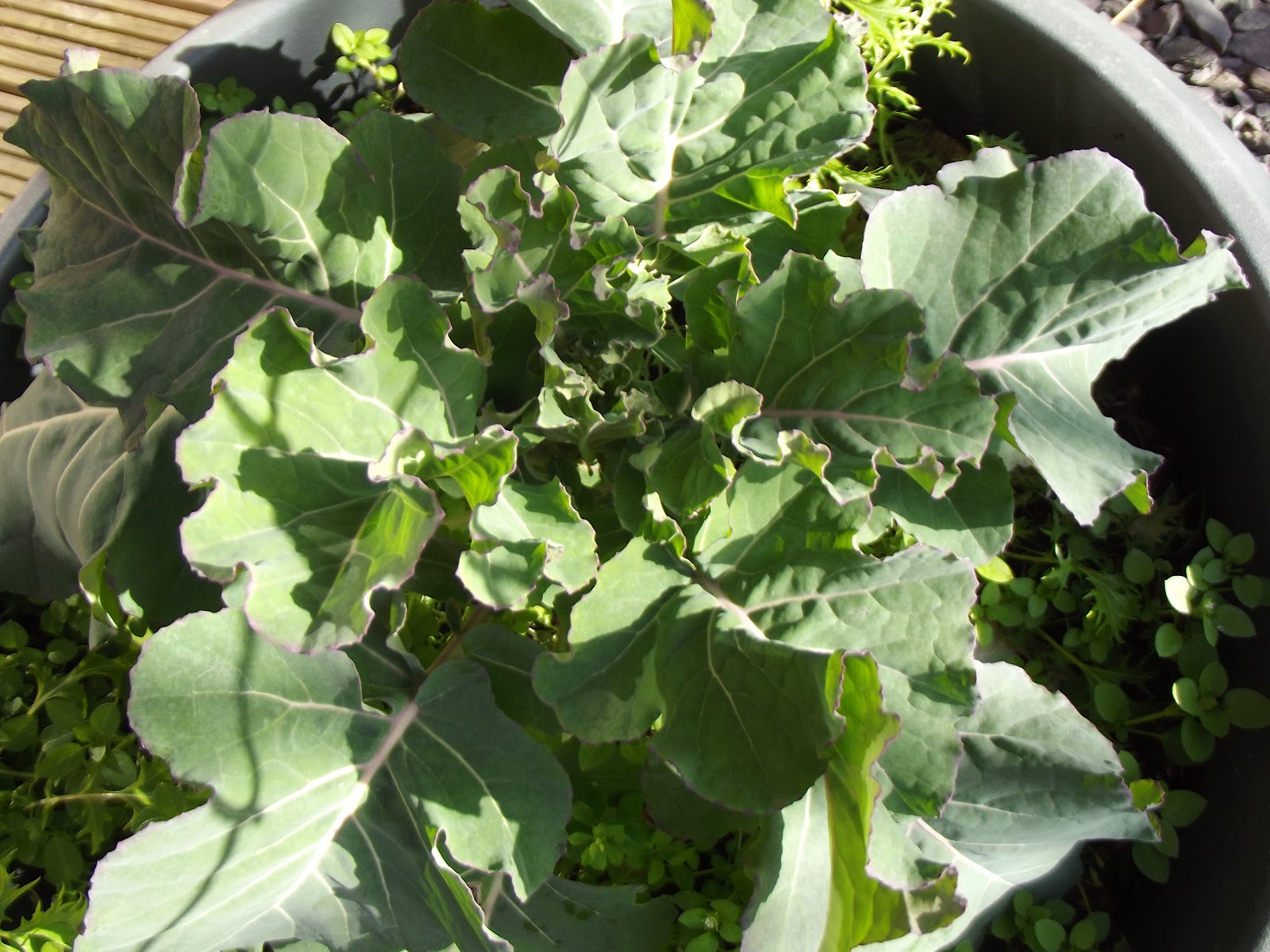
There's no doubt about it - spring is definitely in the air. The birds are singing, the sun is shining, flowers are popping up all over the place and everything is starting to grow again.
It's nice to see the sorrel and chives sprouting fresh new growth.
I know some people are harvesting purple sprouting broccoli by now, but mine still isn't showing any signs. Maybe it didn't get big enough before the winter. I wait with bated breath...
The lamb's lettuce is big enough to eat now, at last. This definitely needs an earlier start next year - and more of it too!
The radishes in the greenhouse haven't done anything worthwhile and are starting to look a bit sickly, but the spring onions have put on excellent growth over winter and are about ready to eat.
The claytonia has been going steady all winter long - I've picked handfuls from time to time, but I could (should) have eaten much more of it! In fact, I think I'd better thin this lot before the kale gets swamped!
The perpetual spinach, too, has kept producing slowly all winter, and I've picked the odd handful to add to veg dishes. The normal spinach did not do so well - something killed all but two of the plants! Next winter I'll make sure I have lots more perpetual spinach and chard going, since they stand so well through cold weather.
Like most gardeners, I'm chomping at the bit to start sowing again. I've already started a few potatoes - three 'Foremost' earlies - in a planter in the shelter of the house. I wouldn't plant them in open soil this early, but in dry fresh compost in a well-drained portable container it's another matter. The right temperature for planting spuds is about 8C, and most of our nights are 7 or higher at the moment, so as long as I protect them if we have another cold snap I reckon we're in with a good chance of a few super-earlies!
I bought six of these huge fold-away planters to use this year, thinking it'd be tidier than hoardes and hoardes of pots, the soil would be deeper, and I could plant lots of things closer together, rather than all in individual containers. The huge bags don't half hold a lot of soil! I don't know how I'm going to fill them all! In the first one I have planted my nine (one went mouldy in the greenhouse during the snow) everbearing 'Albion' strawberries, plus three which were too cramped in a pot in the garden. There's another planter ready and waiting in the background for some early carrots, lettuce, radishes and things, which I'll sow soon under a protective layer or two of fleece...
Oh, and my leek seedlings are doing well. They looked a bit frazzled today because I accidentally left them out in the cold last night, which must have come as a bit of a shock, but they'll recover, and I'm glad they got this head-start.
Can't wait to get stuck into some more sowing...
Saturday, 25 February 2012
Monday, 20 February 2012
When you next eat a meal...
I was challenged today by this tweet from Brigit Strawbridge: "When you next eat a meal ask yourself 'Do I know where this came from?
How it grew? How it died? Who picked it?' If you don't know find out."
While I am already well aware of the reasons for knowing where my food comes from and I didn't expect any surprises, I thought it would be an interesting exercise - to check up on how I'm doing, if you like, and see if there's anything I should improve. Of course, it's near impossible to figure out the finer details such as 'who picked it', but I would find out as much as I could.
Tonight's dinner was my favourite sausage and squash casserole - planned since yesterday with all ingredients already bought, so no prep was done with the exercise in mind!
Here we go...
Butter - Sainsbury's Basics. British, like all Sainsbury's milk too, though there's no other info on the pack.
Oil - Cold pressed Borderfields' rapeseed, grown by 'Coastal Grains' in Northumberland.
Sausages - Sainsbury's Butcher's Choice reduced fat sausages - the only ones I ever buy (I stock up every time they're on offer and freeze them). They're British - Sainsbury's sells only British pork sausages - and they bear the Red Tractor 'Assured Food Standards' logo too, which means they comply with the safety, welfare and environmental standards found here. Great stuff. British standards for pig welfare are much higher in the UK than pretty much anywhere else in the EU or US, as outlined here, so this is really important.
Onion - Sainsbury's again. Grown by 'Martin Greenshoots', it says on the bag, in Cambridgeshire. Their website says “Greenshoots' objective is to help our members to collaborate in producing and marketing vegetables in an environmentally sustainable way, whilst exceeding our customers expectations”.
Garlic - Ummm, I don't know where I got this. I think it was from Budgens, who use British suppliers wherever possible (see here), so that's cool.
Sage - I get this from my garden when I can, but my plant is looking a bit weak and weather-beaten at the moment, so I used dried sage, which I got from the market - a local St Albans business called Sycamore Wholefoods which sells every herb and spice you could wish for (and a few others too) in big bags, plus grains, pulses and other bits and pieces. I refill old jars with these great-value bags. The label on the bag says... 'product of Turkey'. Ah.
Squash - This beauty was from Budgens, under a big 'local growers' sign!
Vinegar - Sainsbury's White Wine Vinegar, 'produced in the UK'.
Sugar - Silver Spoon, who grow all their sugar in the UK and claim to be 'the most efficient sugar manufacturer in Europe'.
Black pepper - Schwartz, 'packed in the EU'. (I'm guessing you probably can't grow black pepper in this country.) Schwartz's parent company, McCormick, says here "Over the years... we have created joint ventures in India and Indonesia, developed key strategic alliances in other major spice growing countries and generated a network of over 150 suppliers. Our joint ventures and strategic alliances provide year-round work for more than 1,000 employees, offering fair wages, medical assistance and advancement opportunities."
Chopped tomatoes - Sainsbury's Basics, 'produced in Italy'.
Cannellini beans - Sainsbury's. These say 'produced in the UK', which pleasantly surprises me!
Stock - From a Knorr Chicken Stock Pot. Knorr seem to have most of their factories in Germany, Austria and Switzerland, and are owned by Unilever, one of those huge global corporations I automatically don't quite trust. But Unilever's website is pretty encouraging, with details of their three big goals to halve the environmental footprint of their products, 'help more than one billion people take action to improve their health and well-being', and source 100% of their agricultural raw materials sustainably - and it seems they invest billions a year in communities and have strict standards for their suppliers which ban child labour, less-than-minimum wages, poor working conditions and the like.
Potatoes - Charlotte spuds from Sainsburys, grown in Cornwall.
Peas - Birdseye 'Field Fresh' Garden Peas, which means they were grown either in Lincolnshire, Yorkshire or Perthshire, using "sustainable farming methods". Nice.
That's eleven out of fifteen products from the UK (one from Turkey, one from Italy, two don't-knows), Red-Tractor-approved meat, and eight companies clearly striving for welfare, fairness, sustainability and low environmental impact. Not bad at all.
So what should I change?
If I grew more and stored better I could perhaps have been eating my own potatoes, peas, squash, onions, garlic and maybe even beans in the winter - that's an ongoing process and I'm sure I'll keep getting better and better at it. But there's nothing inherently bad about industry or trade - Britain's businesses need our support, of course, and so do food growers and communities abroad. I use a heck of a lot of chopped tomatoes, but I want to preserve some of my own this year, which will hopefully cut down those particular food miles.
I don't really think the black pepper is a massive problem, and it seems like the company's doing right by its suppliers. The sage from Turkey is a surprise - surely we grow sage here in England that would be more economical? I looked for information on where and how Sycamore Wholefoods sources its goods but they don't appear to have a website - maybe I'll chat to them next time I'm there and find out.
Then there's the stock. Nothing really bad going on, and I like the Knorr stock pots - and honestly, I'm not about to start making my own on a regular chuck-it-in-for-a-bit-of-extra-oomph basis. But perhaps there is a better option; Kallo's stock cubes are all organic and natural, made in the UK and Europe only, and the company is commited to sustainability, fair trade, recyclable packaging and all other good things. And they're cheaper. And they have a low-salt option. Right then, decision made.
And what have I learned?
Well, it looks like even the global giants are really pushing for sustainable and fair principles these days - great news - and we're seeing things like hydrogenated fats and monosodium glutamate slip more and more out of use.
I've learned that, though I got lucky this time, I don't always pay enough attention to where vegetables come from when I buy - I didn't know what to expect about most of these items until I went round the kitchen and checked. Buying British is important to me - I just need to remember that more often while I'm actually shopping! And I don't buy much organic stuff, do I?
And I've learned - okay, reaffirmed - that Sainsbury's is pretty awesome! A glance through their policies shows they source produce from the UK absolutely whenever possible (of foodstuffs that can be grown in this country, they say they source over 90% from Britain) with 100% of their milk, eggs, fresh chicken and frozen whole chickens, fresh sausages, and own-brand crisps and ice-cream all British, plus 100% of lamb when in season, and all cooked hams. All their bananas, coffee, tea and chocolate are fair trade, all their tuna is pole-and-line caught, and they're working hard towards using only sustainable palm oil. They use regional produce as much as possible, they use MSC certified fish whenever possible and keep a close eye on sustainability when it's not, all their kitchen towel, tissues and toilet roll are FSC certified, they have over 800 organic lines, they don't use hydrogenated fats, and they're committed to reducing waste, improving health and reducing their carbon footprint. As supermarkets go, it rocks.
Interesting. Well I thought so. I might even try it again a few more times.
Anyone else care to take up the challenge and assess your next meal?
Or do you see anything else wrong here that I should fix?
While I am already well aware of the reasons for knowing where my food comes from and I didn't expect any surprises, I thought it would be an interesting exercise - to check up on how I'm doing, if you like, and see if there's anything I should improve. Of course, it's near impossible to figure out the finer details such as 'who picked it', but I would find out as much as I could.
Tonight's dinner was my favourite sausage and squash casserole - planned since yesterday with all ingredients already bought, so no prep was done with the exercise in mind!
Here we go...
Butter - Sainsbury's Basics. British, like all Sainsbury's milk too, though there's no other info on the pack.
Oil - Cold pressed Borderfields' rapeseed, grown by 'Coastal Grains' in Northumberland.
Sausages - Sainsbury's Butcher's Choice reduced fat sausages - the only ones I ever buy (I stock up every time they're on offer and freeze them). They're British - Sainsbury's sells only British pork sausages - and they bear the Red Tractor 'Assured Food Standards' logo too, which means they comply with the safety, welfare and environmental standards found here. Great stuff. British standards for pig welfare are much higher in the UK than pretty much anywhere else in the EU or US, as outlined here, so this is really important.
Onion - Sainsbury's again. Grown by 'Martin Greenshoots', it says on the bag, in Cambridgeshire. Their website says “Greenshoots' objective is to help our members to collaborate in producing and marketing vegetables in an environmentally sustainable way, whilst exceeding our customers expectations”.
Garlic - Ummm, I don't know where I got this. I think it was from Budgens, who use British suppliers wherever possible (see here), so that's cool.
Sage - I get this from my garden when I can, but my plant is looking a bit weak and weather-beaten at the moment, so I used dried sage, which I got from the market - a local St Albans business called Sycamore Wholefoods which sells every herb and spice you could wish for (and a few others too) in big bags, plus grains, pulses and other bits and pieces. I refill old jars with these great-value bags. The label on the bag says... 'product of Turkey'. Ah.
Squash - This beauty was from Budgens, under a big 'local growers' sign!
Vinegar - Sainsbury's White Wine Vinegar, 'produced in the UK'.
Sugar - Silver Spoon, who grow all their sugar in the UK and claim to be 'the most efficient sugar manufacturer in Europe'.
Black pepper - Schwartz, 'packed in the EU'. (I'm guessing you probably can't grow black pepper in this country.) Schwartz's parent company, McCormick, says here "Over the years... we have created joint ventures in India and Indonesia, developed key strategic alliances in other major spice growing countries and generated a network of over 150 suppliers. Our joint ventures and strategic alliances provide year-round work for more than 1,000 employees, offering fair wages, medical assistance and advancement opportunities."
Chopped tomatoes - Sainsbury's Basics, 'produced in Italy'.
Cannellini beans - Sainsbury's. These say 'produced in the UK', which pleasantly surprises me!
Stock - From a Knorr Chicken Stock Pot. Knorr seem to have most of their factories in Germany, Austria and Switzerland, and are owned by Unilever, one of those huge global corporations I automatically don't quite trust. But Unilever's website is pretty encouraging, with details of their three big goals to halve the environmental footprint of their products, 'help more than one billion people take action to improve their health and well-being', and source 100% of their agricultural raw materials sustainably - and it seems they invest billions a year in communities and have strict standards for their suppliers which ban child labour, less-than-minimum wages, poor working conditions and the like.
Potatoes - Charlotte spuds from Sainsburys, grown in Cornwall.
Peas - Birdseye 'Field Fresh' Garden Peas, which means they were grown either in Lincolnshire, Yorkshire or Perthshire, using "sustainable farming methods". Nice.
That's eleven out of fifteen products from the UK (one from Turkey, one from Italy, two don't-knows), Red-Tractor-approved meat, and eight companies clearly striving for welfare, fairness, sustainability and low environmental impact. Not bad at all.
So what should I change?
If I grew more and stored better I could perhaps have been eating my own potatoes, peas, squash, onions, garlic and maybe even beans in the winter - that's an ongoing process and I'm sure I'll keep getting better and better at it. But there's nothing inherently bad about industry or trade - Britain's businesses need our support, of course, and so do food growers and communities abroad. I use a heck of a lot of chopped tomatoes, but I want to preserve some of my own this year, which will hopefully cut down those particular food miles.
I don't really think the black pepper is a massive problem, and it seems like the company's doing right by its suppliers. The sage from Turkey is a surprise - surely we grow sage here in England that would be more economical? I looked for information on where and how Sycamore Wholefoods sources its goods but they don't appear to have a website - maybe I'll chat to them next time I'm there and find out.
Then there's the stock. Nothing really bad going on, and I like the Knorr stock pots - and honestly, I'm not about to start making my own on a regular chuck-it-in-for-a-bit-of-extra-oomph basis. But perhaps there is a better option; Kallo's stock cubes are all organic and natural, made in the UK and Europe only, and the company is commited to sustainability, fair trade, recyclable packaging and all other good things. And they're cheaper. And they have a low-salt option. Right then, decision made.
And what have I learned?
Well, it looks like even the global giants are really pushing for sustainable and fair principles these days - great news - and we're seeing things like hydrogenated fats and monosodium glutamate slip more and more out of use.
I've learned that, though I got lucky this time, I don't always pay enough attention to where vegetables come from when I buy - I didn't know what to expect about most of these items until I went round the kitchen and checked. Buying British is important to me - I just need to remember that more often while I'm actually shopping! And I don't buy much organic stuff, do I?
And I've learned - okay, reaffirmed - that Sainsbury's is pretty awesome! A glance through their policies shows they source produce from the UK absolutely whenever possible (of foodstuffs that can be grown in this country, they say they source over 90% from Britain) with 100% of their milk, eggs, fresh chicken and frozen whole chickens, fresh sausages, and own-brand crisps and ice-cream all British, plus 100% of lamb when in season, and all cooked hams. All their bananas, coffee, tea and chocolate are fair trade, all their tuna is pole-and-line caught, and they're working hard towards using only sustainable palm oil. They use regional produce as much as possible, they use MSC certified fish whenever possible and keep a close eye on sustainability when it's not, all their kitchen towel, tissues and toilet roll are FSC certified, they have over 800 organic lines, they don't use hydrogenated fats, and they're committed to reducing waste, improving health and reducing their carbon footprint. As supermarkets go, it rocks.
Interesting. Well I thought so. I might even try it again a few more times.
Anyone else care to take up the challenge and assess your next meal?
Or do you see anything else wrong here that I should fix?
Thursday, 16 February 2012
Survival Gardening - Twelve Vital Principles
I've had a funny feeling about 2012 ever since the new year hangover wore off. I'm not one to worry about ancient prophecies, and I dunno, maybe I've just got too much time on my hands, but with the next great depression predicted, potentially disruptive solar activity about to peak, and the US/Israel/Iran conflict threatening anything from a fuel crisis to world war three, everything seems to be spiralling deeper and deeper into turmoil, and I've been thinking a little about taking a few extra precautions to make sure we could get through a crisis. It doesn't take much, after all, to stock up on a few extra dried/tinned goods and some bottled water, and think a little about how you might get by without utilities or if you were forced to leave your home. Failing to plan is planning to fail and all that. And I know what you're thinking - nothing bad ever happens here in the UK (except the occasional crippling snowfall, and the odd mindless riot, and devastating floods in some areas...), but our food supply chain is more fragile than we'd like to think, as the petrol crisis in 2000 showed when supermarkets warned they were running out of food, schools were closed, and public transport, the Royal Mail and other services were threatening to shut down - all within just a few days - and if the brown stuff hits the fan on anything more than a local level, do you really think we can rely on the government to provide? When was the last time you securely relied upon the government for anything?
Even if you think I'm being dramatic and all that's a bit unlikely, one thing's certain - I ain't earning too much money right now, so for me at least, taking steps to be more self-reliant makes perfect sense. Being a veg-grower already and having the allotment is a great advantage, but we're not nearly as self-sufficient as I'd like to be. Of course, veg-growing advice for beginners is to focus on luxury crops - those that you really enjoy and save a lot of money on by not buying them at the supermarket, such as tomatoes, runner beans, aubergines, peppers, purple sprouting broccoli and asparagus - and that's a really great start. But you can't live on those things, and with a bit more time, experience and space, the goals get bigger... While I'm hardly about to start growing enough wheat to keep us in bread and pasta all year round, there's plenty more that I can do to improve things - and if we ever did have to grow food to survive then we'd need to follow the very same principles:
1) Grow as much as you can. Yeah, like I needed an excuse. The allotment is fully in use and another one is out of the question, but I'm planning to grow more in the home garden this year, utilising lots of my smaller pots that don't often get used - for individual chard and spinach plants - and some large growbag-style planters. If you think you haven't got room to grow food, remember you can still grow a significant amount on windowsills, indoors and out - explore Vertical Veg for some amazing inspiration and tips! Also think about nurturing edible plants in public places. Get to know your native wild edibles, find out how to use them, and nurture them in your local area. Some people have even grown-their-own in public places by sprinkling seeds out of the way here and there (but remember it's illegal to dig plants up without the landowner's permission).
2) Save seeds from one year to the next, and always keep a good supply. This ensures you always have free seeds to grow, develops micro-varieties adapted to conditions in your growing space, and means you're not relying on seed companies every year. Popular f1 hybrids don't reproduce true-to-type - that is, if you save the seed and sow it next year the results will be unpredictable and not the same as the parent plant - so use only heirloom and open-pollinated seeds. Some seeds are trickier to save than others, so it pays to know exactly what you're doing, and I don't know a better place to learn than Real Seeds - take a look. Seeds need to be kept dry and cool to remain useful - keep them safe.
3) Extend the growing season as much as possible, by starting early under protection, sowing successionally for repeat crops, and making late sowings under protection too. A big greenhouse or polytunnel would be ideal, but a cheap plastic greenhouse and a roll or two of horticultural fleece are a great start.
4) Get the most out of what you grow. This means saving extra seeds to sprout indoors for winter greens too - brassicas are especially good for this - and looking out for opportunities to get second crops from plants. Broccoli, calabrese, cauliflower and even cabbages will give you new shoots if you cut the heads and leave the plants in the ground. Radish seed pods can be added to stir-fries. Lettuces will produce new leaves after cutting. Pea pods can be made into soup (or wine!) Pumpkin leaves are great edible greens! (Don't eat the tomato-like fruit of potato plants though - they're poisonous.) I must get better at doing this kind of stuff!
5) Grow more substantial vegetables. Since grains are pretty much out of the question for me, that means more potatoes (spacing several sowings throughout the growing season), more starchy root veg, and more beans for drying. (Once dry, freeze beans in an airtight container for three days before storing, to kill any bean weevil eggs and avoid results like those below. Ugh.)
6) 'Three sisters' planting is ideal sustenance gardening. This traditional Native American method means growing sweetcorn, beans and squash together. The beans climb the corn and add nitrogen to its soil, and the low-growing squash leaves shade out weeds, slow moisture loss from the soil, and even deter rodents with their prickly stems. All three store well and are excellent nutritional staples, with corn high in starchy carbs, beans full of protein and fibre, and squashes packed with vitamins. Again, I'm not about to grow a meaningful amount of dried maize on my little plots, but this planting method is one I've always wanted to try, and this could be the year.
7) Preserve more. Pickles and jams are the most obvious examples, along with dried beans and peas. But you can dry pretty much any fruit or vegetable with just a little bit of knowhow, and I know I could be making much better use of my freezer too. Most veg can be frozen after blanching, and of course you can freeze sauces, pestos and herbs too. If things go to plan this year, I hope to have a freezer full of chopped tomatoes for cooking next winter, and I'm thinking about getting into dehydrating too...
8) Grow for winter as well. This is something I've always slowly worked towards and this spring, for the first time, I have purple sprouting broccoli, kale and some salad greens which have made it through the winter - hurrah! But now it's time to up the ante and grow more cold-weather crops, earlier, so we can use them all winter long. Great winter crops include many brassicas (swedes, turnips, cabbages, broccoli, Brussels, kale), endives, chicory, celeriac, leeks, parsnips, and lots of leafy greens such as chard and spinach. Some lettuces and salad greens can be grown under cover during the winter too, as well as radishes, carrots and spring onions.
9) Feed the soil and the soil will feed you. I have a terrible confession to make: I've been tossing my kitchen and garden waste in a green wheelie bin for the council to take away for the last two or three years now. Enough! I've reinstated the compost bin at the bottom of the garden and ordered a replacement missing part for my bokashi bin. Buying fertility from the garden centre is expensive and makes no sense! Remember to include a good mix of 'wet' or 'green' waste (raw food scraps, teabags, leafy plant material) and 'dry' or 'brown' waste (cardboard, paper, shredded woody plant material).
10) Include animals in your garden! As well as providing another source of food, they add more fertility to the soil and put even uncompostable scraps to good use. (Vegans and veggies may disagree of course, but then I do wonder how a lot of vegans and veggies might get on if the deluge of exotic grains and fruits imported into this country ever dried up.) I'm not allowed to include animals in my garden... But if things do ever get tough enough to change that - or when I get my own patch - chickens or rabbits are first on my list!
11) A sustainable garden must be an organic garden. Ban chemicals, which harm beneficial insects as well as the pests, and instead nurture your garden's ecosystem by growing plenty of variety, adding nectar-rich flowers to attract pollinating insects, providing insects with places to hibernate over winter, always removing dead matter that may harbour disease, improving your soil's microbiological health by adding lots of healthy organic matter, strengthening crops with seaweed extract or nettle/comfrey tea or similar, and paying your plants plenty of attention to make sure you notice any pest/disease attack before it gets out of hand. No-dig gardening supports better soil health and worm activity - and is something I want to try this year if I can. When you must deal with pests, do so manually wherever possible.
12) Practise, practise, practise. Did you know you can buy (from America) canisters of 'survival seeds' - freeze dried and vacuum packed heirloom varieties certified for up to 25 years - to stash for emergencies? Sounds all very good, but do people that buy these things expect to just sprinkle them over some bare ground and get any measure of success? I'm always learning in the garden and on the allotment, and if my survival ever depends on my ability to grow things, at least I'll know what I'm doing. If you want to feed yourself and your family in the future, there's no time like the present to begin.
Bonus Principle No. 13) In real times of anarchy, it'd be best if your veg garden didn't look too much like a veg garden, since you probably wouldn't be the only one whose cupboards are bare (not saying you shouldn't share, of course, but no-one likes to share with looters and thieves). Three sisters planting would be quite good for this, as the whole thing looks like a bit of a jungle. Avoiding long obvious rows of veg is another strategy - go for a more random look with different vegetables dotted about. Too survivalist for you? Remember four- and six-legged pests will do more damage where lots of the same crop are grown together, and less where plants are intermingled! Fleece might help too. The best strategy of all is to have a back up plan: more seeds to grow, more plants elsewhere, food stored indoors.
So what do you think? How far along the way are you to being able to keep eating if the shops stop opening one day? (I still have plenty of work to do!) Or are you happy enough just to keep saying it'll never, ever happen?
Even if you think I'm being dramatic and all that's a bit unlikely, one thing's certain - I ain't earning too much money right now, so for me at least, taking steps to be more self-reliant makes perfect sense. Being a veg-grower already and having the allotment is a great advantage, but we're not nearly as self-sufficient as I'd like to be. Of course, veg-growing advice for beginners is to focus on luxury crops - those that you really enjoy and save a lot of money on by not buying them at the supermarket, such as tomatoes, runner beans, aubergines, peppers, purple sprouting broccoli and asparagus - and that's a really great start. But you can't live on those things, and with a bit more time, experience and space, the goals get bigger... While I'm hardly about to start growing enough wheat to keep us in bread and pasta all year round, there's plenty more that I can do to improve things - and if we ever did have to grow food to survive then we'd need to follow the very same principles:
1) Grow as much as you can. Yeah, like I needed an excuse. The allotment is fully in use and another one is out of the question, but I'm planning to grow more in the home garden this year, utilising lots of my smaller pots that don't often get used - for individual chard and spinach plants - and some large growbag-style planters. If you think you haven't got room to grow food, remember you can still grow a significant amount on windowsills, indoors and out - explore Vertical Veg for some amazing inspiration and tips! Also think about nurturing edible plants in public places. Get to know your native wild edibles, find out how to use them, and nurture them in your local area. Some people have even grown-their-own in public places by sprinkling seeds out of the way here and there (but remember it's illegal to dig plants up without the landowner's permission).
2) Save seeds from one year to the next, and always keep a good supply. This ensures you always have free seeds to grow, develops micro-varieties adapted to conditions in your growing space, and means you're not relying on seed companies every year. Popular f1 hybrids don't reproduce true-to-type - that is, if you save the seed and sow it next year the results will be unpredictable and not the same as the parent plant - so use only heirloom and open-pollinated seeds. Some seeds are trickier to save than others, so it pays to know exactly what you're doing, and I don't know a better place to learn than Real Seeds - take a look. Seeds need to be kept dry and cool to remain useful - keep them safe.
3) Extend the growing season as much as possible, by starting early under protection, sowing successionally for repeat crops, and making late sowings under protection too. A big greenhouse or polytunnel would be ideal, but a cheap plastic greenhouse and a roll or two of horticultural fleece are a great start.
4) Get the most out of what you grow. This means saving extra seeds to sprout indoors for winter greens too - brassicas are especially good for this - and looking out for opportunities to get second crops from plants. Broccoli, calabrese, cauliflower and even cabbages will give you new shoots if you cut the heads and leave the plants in the ground. Radish seed pods can be added to stir-fries. Lettuces will produce new leaves after cutting. Pea pods can be made into soup (or wine!) Pumpkin leaves are great edible greens! (Don't eat the tomato-like fruit of potato plants though - they're poisonous.) I must get better at doing this kind of stuff!
5) Grow more substantial vegetables. Since grains are pretty much out of the question for me, that means more potatoes (spacing several sowings throughout the growing season), more starchy root veg, and more beans for drying. (Once dry, freeze beans in an airtight container for three days before storing, to kill any bean weevil eggs and avoid results like those below. Ugh.)
6) 'Three sisters' planting is ideal sustenance gardening. This traditional Native American method means growing sweetcorn, beans and squash together. The beans climb the corn and add nitrogen to its soil, and the low-growing squash leaves shade out weeds, slow moisture loss from the soil, and even deter rodents with their prickly stems. All three store well and are excellent nutritional staples, with corn high in starchy carbs, beans full of protein and fibre, and squashes packed with vitamins. Again, I'm not about to grow a meaningful amount of dried maize on my little plots, but this planting method is one I've always wanted to try, and this could be the year.
7) Preserve more. Pickles and jams are the most obvious examples, along with dried beans and peas. But you can dry pretty much any fruit or vegetable with just a little bit of knowhow, and I know I could be making much better use of my freezer too. Most veg can be frozen after blanching, and of course you can freeze sauces, pestos and herbs too. If things go to plan this year, I hope to have a freezer full of chopped tomatoes for cooking next winter, and I'm thinking about getting into dehydrating too...
8) Grow for winter as well. This is something I've always slowly worked towards and this spring, for the first time, I have purple sprouting broccoli, kale and some salad greens which have made it through the winter - hurrah! But now it's time to up the ante and grow more cold-weather crops, earlier, so we can use them all winter long. Great winter crops include many brassicas (swedes, turnips, cabbages, broccoli, Brussels, kale), endives, chicory, celeriac, leeks, parsnips, and lots of leafy greens such as chard and spinach. Some lettuces and salad greens can be grown under cover during the winter too, as well as radishes, carrots and spring onions.
9) Feed the soil and the soil will feed you. I have a terrible confession to make: I've been tossing my kitchen and garden waste in a green wheelie bin for the council to take away for the last two or three years now. Enough! I've reinstated the compost bin at the bottom of the garden and ordered a replacement missing part for my bokashi bin. Buying fertility from the garden centre is expensive and makes no sense! Remember to include a good mix of 'wet' or 'green' waste (raw food scraps, teabags, leafy plant material) and 'dry' or 'brown' waste (cardboard, paper, shredded woody plant material).
10) Include animals in your garden! As well as providing another source of food, they add more fertility to the soil and put even uncompostable scraps to good use. (Vegans and veggies may disagree of course, but then I do wonder how a lot of vegans and veggies might get on if the deluge of exotic grains and fruits imported into this country ever dried up.) I'm not allowed to include animals in my garden... But if things do ever get tough enough to change that - or when I get my own patch - chickens or rabbits are first on my list!
11) A sustainable garden must be an organic garden. Ban chemicals, which harm beneficial insects as well as the pests, and instead nurture your garden's ecosystem by growing plenty of variety, adding nectar-rich flowers to attract pollinating insects, providing insects with places to hibernate over winter, always removing dead matter that may harbour disease, improving your soil's microbiological health by adding lots of healthy organic matter, strengthening crops with seaweed extract or nettle/comfrey tea or similar, and paying your plants plenty of attention to make sure you notice any pest/disease attack before it gets out of hand. No-dig gardening supports better soil health and worm activity - and is something I want to try this year if I can. When you must deal with pests, do so manually wherever possible.
12) Practise, practise, practise. Did you know you can buy (from America) canisters of 'survival seeds' - freeze dried and vacuum packed heirloom varieties certified for up to 25 years - to stash for emergencies? Sounds all very good, but do people that buy these things expect to just sprinkle them over some bare ground and get any measure of success? I'm always learning in the garden and on the allotment, and if my survival ever depends on my ability to grow things, at least I'll know what I'm doing. If you want to feed yourself and your family in the future, there's no time like the present to begin.
Bonus Principle No. 13) In real times of anarchy, it'd be best if your veg garden didn't look too much like a veg garden, since you probably wouldn't be the only one whose cupboards are bare (not saying you shouldn't share, of course, but no-one likes to share with looters and thieves). Three sisters planting would be quite good for this, as the whole thing looks like a bit of a jungle. Avoiding long obvious rows of veg is another strategy - go for a more random look with different vegetables dotted about. Too survivalist for you? Remember four- and six-legged pests will do more damage where lots of the same crop are grown together, and less where plants are intermingled! Fleece might help too. The best strategy of all is to have a back up plan: more seeds to grow, more plants elsewhere, food stored indoors.
So what do you think? How far along the way are you to being able to keep eating if the shops stop opening one day? (I still have plenty of work to do!) Or are you happy enough just to keep saying it'll never, ever happen?
Saturday, 11 February 2012
How Hardy is Hardy?
So as you may know, I invested in a supposedly super-hardy, super-tasty, super-perennial Daubenton's kale plant for the plot this year, which has been sitting patiently in a pot outside the back door for a few weeks now.
But since the snow, and despite the relative shelter provided by the house, it's started looking really unhappy - it's limp and has lost several lower leaves. What's up with that? I moved it to the greenhouse a few days ago but it hasn't perked up, and I don't really know how else to help it. The soil is moist (when not frozen) and it has no signs of pest attack or disease. Should I bring it indoors or would the warmth be a bit of a shock? Should I wrap it in fleece as well as putting it in the greenhouse? Is it maybe too small and not strong enough for freezing temperatures? It's supposed to live outdoors all year round - I don't get it. Any advice on how to help the poor thing?
Wednesday, 8 February 2012
Snow!
So winter came after all!
Just in time for the arrival of ten new bare-root strawberry plants. There's nowhere for them to go - all the soil is frozen. I can't even pot them up! They've been sitting wrapped in wet newspaper for a week now - I hope they're happy...
My pepper and chilli seedlings are doing all right in the heated propagator - they're a tad leggy but not too bad at all. Hopefully this early start will get me some peppers before September this year!
There's not a lot else going on in the garden, as I'm sure you can imagine. So I've been watching the birds (and squirrels) instead, and with the fields covered in snow we've had four fat redwing visitors to the garden, stripping the berries from the cotoneasters. They were really tricky to photograph - they move so fast and kept sitting behind things - but here's one:
Just in time for the arrival of ten new bare-root strawberry plants. There's nowhere for them to go - all the soil is frozen. I can't even pot them up! They've been sitting wrapped in wet newspaper for a week now - I hope they're happy...
My pepper and chilli seedlings are doing all right in the heated propagator - they're a tad leggy but not too bad at all. Hopefully this early start will get me some peppers before September this year!
There's not a lot else going on in the garden, as I'm sure you can imagine. So I've been watching the birds (and squirrels) instead, and with the fields covered in snow we've had four fat redwing visitors to the garden, stripping the berries from the cotoneasters. They were really tricky to photograph - they move so fast and kept sitting behind things - but here's one:
Subscribe to:
Posts (Atom)