Despite having a long list of jobs I need to get done before the growing season starts again, very little is happening on the plot at the moment; a week or two of bitterly cold and wet weather has made digging unpleasant at best and impossible at worst. I wouldn't mind so much if it would just snow properly, like it has in much of the country, and make the place look pretty for a while! But all we've had is yucky icy sleet and lots of rain.
I've also been very busy with preparations for our first FoodSmiles AGM last week, and the FoodSmiles seed order this week! If you think figuring out what to grow on your own allotment can take a while, try figuring out what you need for a giant veg plot for 25 families using strictly organic seed only!
There's still plenty to harvest from the allotment and this week we brought home these carrots, leeks, parsnips and the last two (very small!) swedes.
We have made some progress on what is to be our new 'alternative' fruit patch, shown above. It's always been a tough corner of the allotment, this, and the couchgrass has really colonised it again, so we've dug it over once and we're halfway through a second go to pick out remaining roots. I was hoping to finish it off tomorrow and start planting it up, but if the weather is as cold as forecast I won't even be able to get a fork in the ground, and we'll have to settle for a trip to the garden centre instead - I think I have finally sated my seed-buying urge now, but there are still seed potatoes and compost to buy. Now it's February I'll be counting down the days to sowing my first seeds in the middle of the month... Better get the propagator out and clean up some pots!
Showing posts with label swedes. Show all posts
Sunday, 1 February 2015
Tuesday, 23 September 2014
Crop Rotation Confessions...
I have a confession to make. Crop rotation on a small plot has always rather baffled me. On a big plot it makes sense - on a big plot you can afford to leave a patch of ground empty in preparation for a later crop, or to sow a green manure in the middle of summer just for the heck of it - but on a small allotment where you want to make the most of every space all year round, it can be a real juggling act trying to get your potatoes out early enough for your purple-sprouting broccoli to go in, or clearing your onion patch in time to sow beans and corn, or figuring out what on earth to grow after you've harvested your squashes as late as October - and who uses exactly the same amount of space for every crop group anyway??
Traditionally, the main groups in a crop rotation are potatoes and roots, brassicas, beans, and 'other veg'. The potatoes are manured to enrich and slightly acidify the soil (preventing scab), heavy-feeding beans follow in the nicely broken-up ground after the potatoes are dug, then (often after an application of lime,) leafy brassicas to make good use of the nitrogen the bean roots accumulate. Then, presumably, you throw sweetcorn, cucurbits, tomatoes, leafy greens and everything else in together after that. Sounds simple enough, but questions abound. Do you grow swedes with the root crops or the brassicas? Aren't tomatoes in the same family as potatoes? Cucurbits take up way more space than anything else! And aren't you supposed to avoid manuring carrots?
I don't know, maybe I overthink these things - maybe I'm just too keen to abide by all the rules and to do it "right". But I think, after eight years on our allotment, I've finally cracked it!
This is partly thanks to slimming down the number of crops we grow on the allotment anyway - we don't grow onions and garlic due to white rot spores in our soil, and we prefer to keep salad leaves and quick-ripening summer crops like French beans, courgettes and tomatoes at home so we can pick them more regularly. On the allotment we grow the lower-maintenance stuff: potatoes, squashes, root veg, broad beans, leeks, and a limited amount of winter brassicas and spinach-type leaves (plus some perennials in a permanent area). We've grouped broad beans, leeks and root veg roughly together: together they take up about the same amount of space we use for more space-hungry crops (potatoes and squashes), and it means we can follow our broad beans (which finish around midsummer) with winter brassicas, thus keeping our earlier-sown swedes in the same area as our other brassicas.
Ladies and gents, I give you our brand new crop rotation plan! (Click pic to enlarge.)
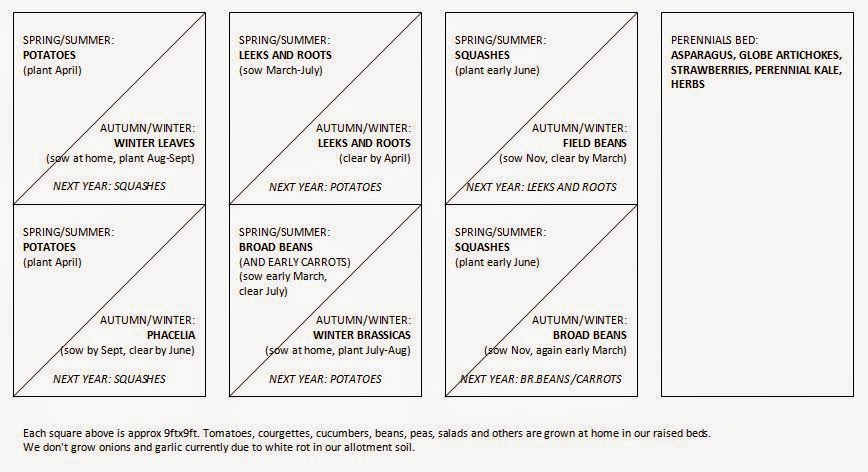
This rotation also allows for two squares to be sown with green manures over winter to add high-nitrogen organic matter to the compost heap, shelter wildlife and protect the soil. Phacelia and field beans are my two favoured green manures since field beans add vital nitrogen to the soil and can be sown as late as November, and phacelia attracts lots of insects and can be sown as late as September. Following squashes with winter-hardy beans means the timing for sowing is perfect; likewise with the winter leaves following the potatoes, and the winter brassicas following the broad beans. And even though we grow most of our beans at home, our allotment soil still gets a nitrogen injection thanks to the broad and field beans. Of course, this rotation doesn't include everything and I should do my best to efficiently rotate our crops at home too, but those on the allotment are the most important ones to rotate: beans for nitrogen, potatoes which are prone to damage from buildups of slugs and eelworms, and brassicas which are susceptible to clubroot, a very nasty fungal disease.
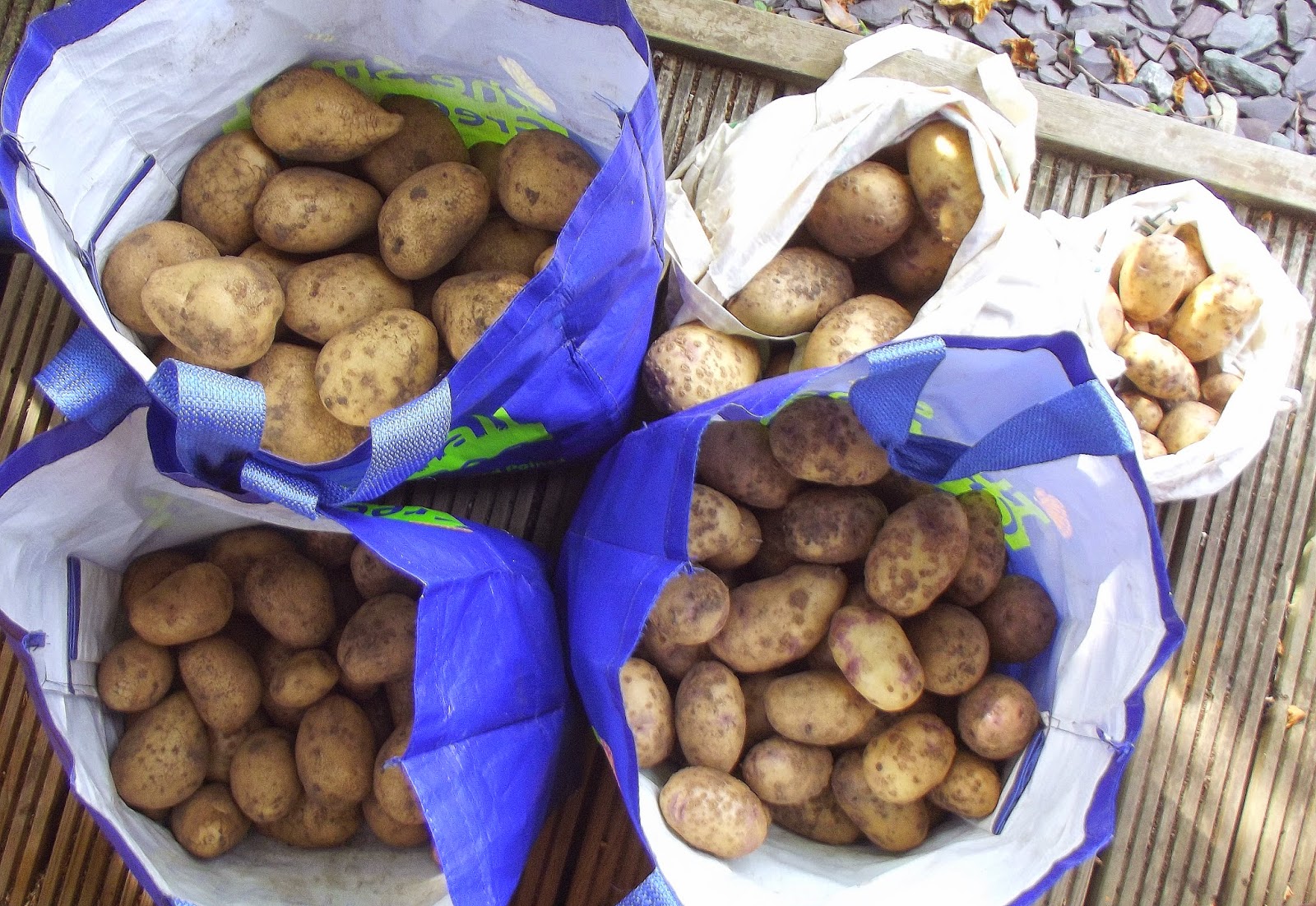
So far it's all going swimmingly. The potatoes are out (an awesome 28kg of Kestrel and 19kg Pentland Crown!) and the winter leaves are in; two rows of chard, two rows of winter spinach and a row of fennel (there's room for more, actually - I must do that). The squashes have finished a little earlier than usual, which means we have plenty of time to clear the soil for winter beans. The leeks, root veg, celery, spring cabbages, kohlrabi and pak choi are coming along nicely and we will slowly harvest them all winter long, making the most of all our space. Brilliant!
There is one complicating factor looming, in that we are planning to clear our old strawberry and asparagus beds (not shown in the plan above) over winter and put them to new use next spring. These two areas don't really fit into the plan so I'm a bit puzzled about what to do with them (and I rather wish we could move our pond and our apple tree into one, which would help us make better use of the other!). Should we grow runner beans or courgettes on the plot again after all? Shall I expand my collection of perennials? Is it time to give in and plant some fruit bushes? Good job I've got all winter to think about it...
Traditionally, the main groups in a crop rotation are potatoes and roots, brassicas, beans, and 'other veg'. The potatoes are manured to enrich and slightly acidify the soil (preventing scab), heavy-feeding beans follow in the nicely broken-up ground after the potatoes are dug, then (often after an application of lime,) leafy brassicas to make good use of the nitrogen the bean roots accumulate. Then, presumably, you throw sweetcorn, cucurbits, tomatoes, leafy greens and everything else in together after that. Sounds simple enough, but questions abound. Do you grow swedes with the root crops or the brassicas? Aren't tomatoes in the same family as potatoes? Cucurbits take up way more space than anything else! And aren't you supposed to avoid manuring carrots?
I don't know, maybe I overthink these things - maybe I'm just too keen to abide by all the rules and to do it "right". But I think, after eight years on our allotment, I've finally cracked it!
This is partly thanks to slimming down the number of crops we grow on the allotment anyway - we don't grow onions and garlic due to white rot spores in our soil, and we prefer to keep salad leaves and quick-ripening summer crops like French beans, courgettes and tomatoes at home so we can pick them more regularly. On the allotment we grow the lower-maintenance stuff: potatoes, squashes, root veg, broad beans, leeks, and a limited amount of winter brassicas and spinach-type leaves (plus some perennials in a permanent area). We've grouped broad beans, leeks and root veg roughly together: together they take up about the same amount of space we use for more space-hungry crops (potatoes and squashes), and it means we can follow our broad beans (which finish around midsummer) with winter brassicas, thus keeping our earlier-sown swedes in the same area as our other brassicas.
Ladies and gents, I give you our brand new crop rotation plan! (Click pic to enlarge.)
This rotation also allows for two squares to be sown with green manures over winter to add high-nitrogen organic matter to the compost heap, shelter wildlife and protect the soil. Phacelia and field beans are my two favoured green manures since field beans add vital nitrogen to the soil and can be sown as late as November, and phacelia attracts lots of insects and can be sown as late as September. Following squashes with winter-hardy beans means the timing for sowing is perfect; likewise with the winter leaves following the potatoes, and the winter brassicas following the broad beans. And even though we grow most of our beans at home, our allotment soil still gets a nitrogen injection thanks to the broad and field beans. Of course, this rotation doesn't include everything and I should do my best to efficiently rotate our crops at home too, but those on the allotment are the most important ones to rotate: beans for nitrogen, potatoes which are prone to damage from buildups of slugs and eelworms, and brassicas which are susceptible to clubroot, a very nasty fungal disease.
So far it's all going swimmingly. The potatoes are out (an awesome 28kg of Kestrel and 19kg Pentland Crown!) and the winter leaves are in; two rows of chard, two rows of winter spinach and a row of fennel (there's room for more, actually - I must do that). The squashes have finished a little earlier than usual, which means we have plenty of time to clear the soil for winter beans. The leeks, root veg, celery, spring cabbages, kohlrabi and pak choi are coming along nicely and we will slowly harvest them all winter long, making the most of all our space. Brilliant!
There is one complicating factor looming, in that we are planning to clear our old strawberry and asparagus beds (not shown in the plan above) over winter and put them to new use next spring. These two areas don't really fit into the plan so I'm a bit puzzled about what to do with them (and I rather wish we could move our pond and our apple tree into one, which would help us make better use of the other!). Should we grow runner beans or courgettes on the plot again after all? Shall I expand my collection of perennials? Is it time to give in and plant some fruit bushes? Good job I've got all winter to think about it...
Friday, 18 February 2011
Winter Veg
It's so satisfying, in the middle of winter, when we feel we've been neglecting the plot terribly, to go down there and see the rows of parnsips, swedes and leeks still standing faithfully waiting to be harvested! The past few weeks we've feasted on parsnip soup, parsnip bread, roasted root veg, creamed leeks - and we're still getting through the autumn's squash as well.
Parsnips seem to grow particularly well on our plot and with very little care. Here is just a fraction of our 'White Gem' crop.
Of course, they're not all perfect.
The swedes suffer quite a lot of slug damage, but there are still plenty for us too.
And I was worried about our leek crop back in the autumn as there seemed to be a lot of onion flies on them - not something we've suffered before - but the cold weather seemed to see them all off, and the leeks have made a terrific recovery with very few signs of damage. Looks like I forgot to take any pictures of them yet, but I can show you the delicious creamed leeks I served here with cheese and chive mash and a lovely piece of lemon-and-herb-crusted pollack.
I used roughly the recipe from Sarah Raven's Garden Cookbook, but it's a fairly standard recipe: just slice your leeks finely, fry gently in butter and olive oil for a few minutes until soft, then stir in double cream, a little mustard (I love wholegrain) and some salt and pepper. I do believe I sloshed in some white wine too, letting it reduce before I added the cream. Sarah's recipe calls for a sprinkle of chervil at the end, but sadly I didn't have any.
Parsnips seem to grow particularly well on our plot and with very little care. Here is just a fraction of our 'White Gem' crop.
Of course, they're not all perfect.
The swedes suffer quite a lot of slug damage, but there are still plenty for us too.
And I was worried about our leek crop back in the autumn as there seemed to be a lot of onion flies on them - not something we've suffered before - but the cold weather seemed to see them all off, and the leeks have made a terrific recovery with very few signs of damage. Looks like I forgot to take any pictures of them yet, but I can show you the delicious creamed leeks I served here with cheese and chive mash and a lovely piece of lemon-and-herb-crusted pollack.
I used roughly the recipe from Sarah Raven's Garden Cookbook, but it's a fairly standard recipe: just slice your leeks finely, fry gently in butter and olive oil for a few minutes until soft, then stir in double cream, a little mustard (I love wholegrain) and some salt and pepper. I do believe I sloshed in some white wine too, letting it reduce before I added the cream. Sarah's recipe calls for a sprinkle of chervil at the end, but sadly I didn't have any.
Wednesday, 30 June 2010
Summer Sights, and the River Ver
We rushed to the allotment early this morning to beat the heat, and got loads and loads of weeding done and the patch dug for the everlasting cauliflowers, which I will plant out at the next opportunity. When the weeds are clear the plot really looks pretty good - this is definitely our best year so far.
The asparagus ferns are looking really lush now, with the petunias flowering beneath. The ferns are covered in tiny flowers and it's pretty funny watching the huge bumblebees trying to get inside them!
The swedes look like they're doing well down there.
The runner bean flowers are opening.
The leeks are weed-free again and thriving.
We were surprised to find a few raspberries appearing on our new raspberry canes! I thought we wouldn't get any fruit until next year!
And we have our first sunflower, albeit a very small one.
I can't wait to try these summer crookneck squash. You eat them like courgettes, but they are supposed to have an even better flavour. Anyone else tried them?
As you can see, the plot is looking good - even... dare I say it... tidy and organised!
We took a slightly different route home today, just out of curiosity. The river Ver runs along one side of our allotment site, and we followed it. The path runs most of the way through town, along a strip of woodland between streets and back gardens, and it was rather pleasant. I can't believe I've lived here 30 years, had my allotment for four, and I've never been along here before!
The Ver is not a big or impressive river these days - it's only a few inches deep in many places - but it's our river and we like it. I guess it must have been much more significant once upon a time, when people first settled here and the Roman city was built and so on. It still makes itself known from time to time in no uncertain terms when it reverts to its original course and floods the allotments!
Not all of the river is hidden away - here it flows under a main road and we walk past this pretty scene all the time. At the moment there are mounds and mounds of water forget-me-nots on the bank.
And look what else was hiding in the reeds right by the edge of the road!
At this point we would have rejoined our usual route home, but we decided to keep walking along the river into the park. These are more familiar scenes; I love walking in the park and am so lucky to have it on my doorstep!
The lake was man-made in the early thirties, and the Ver carefully routed along one side of it (on the right of the picture).
There are dozens of varieties of ducks and geese here - and when we come here regularly enough it's lovely to see them raising their new families each year! Last spring and summer I made a point of walking through nearly every day, and became quite familiar with each little clan and where it lived and how it was doing.
On the way out of the park is this octagonal pub, reputed to be the oldest pub in Britain, although there are other contenders. We were going to stop for lunch but decided to save our money for this evening... That's a whole nother blog...
The wording on this sign outside always makes me giggle!
The asparagus ferns are looking really lush now, with the petunias flowering beneath. The ferns are covered in tiny flowers and it's pretty funny watching the huge bumblebees trying to get inside them!
The swedes look like they're doing well down there.
The runner bean flowers are opening.
The leeks are weed-free again and thriving.
We were surprised to find a few raspberries appearing on our new raspberry canes! I thought we wouldn't get any fruit until next year!
And we have our first sunflower, albeit a very small one.
I can't wait to try these summer crookneck squash. You eat them like courgettes, but they are supposed to have an even better flavour. Anyone else tried them?
As you can see, the plot is looking good - even... dare I say it... tidy and organised!
We took a slightly different route home today, just out of curiosity. The river Ver runs along one side of our allotment site, and we followed it. The path runs most of the way through town, along a strip of woodland between streets and back gardens, and it was rather pleasant. I can't believe I've lived here 30 years, had my allotment for four, and I've never been along here before!
The Ver is not a big or impressive river these days - it's only a few inches deep in many places - but it's our river and we like it. I guess it must have been much more significant once upon a time, when people first settled here and the Roman city was built and so on. It still makes itself known from time to time in no uncertain terms when it reverts to its original course and floods the allotments!
Not all of the river is hidden away - here it flows under a main road and we walk past this pretty scene all the time. At the moment there are mounds and mounds of water forget-me-nots on the bank.
And look what else was hiding in the reeds right by the edge of the road!
At this point we would have rejoined our usual route home, but we decided to keep walking along the river into the park. These are more familiar scenes; I love walking in the park and am so lucky to have it on my doorstep!
The lake was man-made in the early thirties, and the Ver carefully routed along one side of it (on the right of the picture).
There are dozens of varieties of ducks and geese here - and when we come here regularly enough it's lovely to see them raising their new families each year! Last spring and summer I made a point of walking through nearly every day, and became quite familiar with each little clan and where it lived and how it was doing.
On the way out of the park is this octagonal pub, reputed to be the oldest pub in Britain, although there are other contenders. We were going to stop for lunch but decided to save our money for this evening... That's a whole nother blog...
The wording on this sign outside always makes me giggle!
Thursday, 20 May 2010
Splosh!
I have taken the plunge. The courgettes - two Black Beauty and two Summer Crookneck Squash - are now planted out on the plot.
The other squashes will follow just as soon as we can get the last bed dug. They are covered in buds and raring to go!
Yesterday I also weeded the swedes, and constructed this rather nifty cage to keep the pigeons off. Sadly it won't keep the flea beetles off, and the poor things are looking rather nibbled.
We got the raspberries weeded too, with a little help from a friend. Nice to see they're putting on some good growth. Today I'm going to plant out the rest of the sunflowers between them, I think. I'll put some nasturtiums here too, as ground cover.
The pond is still looking a nasty shade of green, although the new plants are settling in nicely and the water violet is spreading already.
Next thing to try is reducing the amount of sunlight the pond gets - that should reduce the algae. When the herb plants around the pond get bigger they will cast their shadows on the water, but for now the whole thing is rather exposed. And the frogs prefer the shade too:
So for now I have erected this rather unattractive sunshade out of a sheet of black plastic, which will shade a large portion of the pond for a large portion of the day. I don't really know if it will be enough - I've heard of people covering their whole pond with a sheet to get rid of algae - but I don't want to shade the plants too much.
And finally, I see our mysterious digger has dug another mysterious hole.
There are three like this in the strawberry bed, right where it was dug last year when there were beans here! I can't imagine what he's digging for, nor why he always digs in the same places.
A little TLC for the strawberry bed is my next task, I think. It needs a good weeding before mulching with straw and netting it for the fruiting season...
The other squashes will follow just as soon as we can get the last bed dug. They are covered in buds and raring to go!
Yesterday I also weeded the swedes, and constructed this rather nifty cage to keep the pigeons off. Sadly it won't keep the flea beetles off, and the poor things are looking rather nibbled.
We got the raspberries weeded too, with a little help from a friend. Nice to see they're putting on some good growth. Today I'm going to plant out the rest of the sunflowers between them, I think. I'll put some nasturtiums here too, as ground cover.
The pond is still looking a nasty shade of green, although the new plants are settling in nicely and the water violet is spreading already.
Next thing to try is reducing the amount of sunlight the pond gets - that should reduce the algae. When the herb plants around the pond get bigger they will cast their shadows on the water, but for now the whole thing is rather exposed. And the frogs prefer the shade too:
So for now I have erected this rather unattractive sunshade out of a sheet of black plastic, which will shade a large portion of the pond for a large portion of the day. I don't really know if it will be enough - I've heard of people covering their whole pond with a sheet to get rid of algae - but I don't want to shade the plants too much.
And finally, I see our mysterious digger has dug another mysterious hole.
There are three like this in the strawberry bed, right where it was dug last year when there were beans here! I can't imagine what he's digging for, nor why he always digs in the same places.A little TLC for the strawberry bed is my next task, I think. It needs a good weeding before mulching with straw and netting it for the fruiting season...
Sunday, 25 April 2010
A Quiet Week...
Progress has been slow on the plot this week, and we haven't achieved much except for regular watering trips. I was beginning to think the warm sunny weather had spelled the end for my direct-sown seeds, and that the compost I sowed my salads in was perhaps too coarse despite all the sieving, and that maybe I'd have to sow everything again, and I was getting pretty depressed...
But today, in a general maintenance visit between rain showers, I was overjoyed to find a few radish seedlings and some tiny lettuce seedlings popping up! Hurrah! (They didn't photograph well, sadly, so you'll just have to believe me.) I also found a row of carrots coming up...
And some swede seedlings, under their little protective net tunnel...
The first strawberry flowers...
And the first potatoes appearing...
The onions are doing nicely, as are the shallots...
And the apple tree is about to burst into bloom. I didn't expect the buds to be this colour!
Hastings, our 'allotment cat', has been back for a couple of weeks after a long absence, and enjoyed lying about in the sun close to wherever I was watering and weeding.
And I picked these chives and asparagus spears for dinner.
I guess the plot has been busier than I have!
But today, in a general maintenance visit between rain showers, I was overjoyed to find a few radish seedlings and some tiny lettuce seedlings popping up! Hurrah! (They didn't photograph well, sadly, so you'll just have to believe me.) I also found a row of carrots coming up...
And some swede seedlings, under their little protective net tunnel...
The first strawberry flowers...
And the first potatoes appearing...
The onions are doing nicely, as are the shallots...
And the apple tree is about to burst into bloom. I didn't expect the buds to be this colour!
Hastings, our 'allotment cat', has been back for a couple of weeks after a long absence, and enjoyed lying about in the sun close to wherever I was watering and weeding.
And I picked these chives and asparagus spears for dinner.
I guess the plot has been busier than I have!
Tuesday, 6 May 2008
A Beautiful Bank Holiday
What a beautiful bank holiday!
We had a great day on the plot in the sun and got loads done. The herb garden is now clear and ready to plant. Already growing you can see three tiny minarette fruit trees (two apples, one pear), a horseradish plant and two lavender plants.

And we've planted the first of our yarrow paths. It's hard to believe these tiny spidery plants will spread enough to fill the path, but I'll watch and wait...

While digging round the horseradish I cut a few pieces of root to plant among the potatoes - it's supposed to repel eelworms and improve their health generally. I've noticed a gap where one potato hasn't come up yet (bottom middle of the picture, although you probably can't see the gap for the weeds) - I hope it's doing all right down there!
Tiny weeds like this are coming up everywhere now. I seem to spend ages picking them out of the salad rows but it's an endless task.
The salad bed is starting to look pretty good though:
Although the mustard is being attacked flea-beetles, and they're starting on the mizuna and rocket too.
I've never had to deal with flea-beetles before - what do you do? I hear they're making derris unavailable as of this year so I won't have to make that is-it-harmless-enough? decision. My first reaction when I go out later will be to put my mint pots next to the rows - apparently flea-beetles don't like the smell. I might plant a couple of the sage seedlings I grew for the brassica beds there too.
The broad beans are suffering from something as well:
Is this vine weevil? I think so. There are a few blackfly too. The broad beans have had so many problems now I almost feel like giving up on them!
It's not all bad news though. Look at the carrots!
It may not like like much, but they've never got this far for me before. I'm so proud!
And the swedes are coming up too:
And to top the day off, we watched this damselfly emerging from its larval skin. Magic!
We had a great day on the plot in the sun and got loads done. The herb garden is now clear and ready to plant. Already growing you can see three tiny minarette fruit trees (two apples, one pear), a horseradish plant and two lavender plants.

And we've planted the first of our yarrow paths. It's hard to believe these tiny spidery plants will spread enough to fill the path, but I'll watch and wait...

While digging round the horseradish I cut a few pieces of root to plant among the potatoes - it's supposed to repel eelworms and improve their health generally. I've noticed a gap where one potato hasn't come up yet (bottom middle of the picture, although you probably can't see the gap for the weeds) - I hope it's doing all right down there!
Tiny weeds like this are coming up everywhere now. I seem to spend ages picking them out of the salad rows but it's an endless task.The salad bed is starting to look pretty good though:
Although the mustard is being attacked flea-beetles, and they're starting on the mizuna and rocket too.
I've never had to deal with flea-beetles before - what do you do? I hear they're making derris unavailable as of this year so I won't have to make that is-it-harmless-enough? decision. My first reaction when I go out later will be to put my mint pots next to the rows - apparently flea-beetles don't like the smell. I might plant a couple of the sage seedlings I grew for the brassica beds there too.The broad beans are suffering from something as well:
Is this vine weevil? I think so. There are a few blackfly too. The broad beans have had so many problems now I almost feel like giving up on them!It's not all bad news though. Look at the carrots!
It may not like like much, but they've never got this far for me before. I'm so proud!And the swedes are coming up too:
And to top the day off, we watched this damselfly emerging from its larval skin. Magic!
Subscribe to:
Posts (Atom)


