Showing posts with label potatoes. Show all posts

Monday, 15 February 2016

And We're Off!

I don't feel quite right these days when I'm not actively growing things; in winter my green fingers begin to itch, and boredom and frustration creep in, and it's a huge relief when February arrives and I can justify getting a few early seeds started. I used to wait until mid-Feb - Charles Dowding recommends this as there are ten hours of daylight or more from this time and seedlings are less likely to get leggy - but I sometimes feel that my chillies and things are a bit behind, so this year I started sowing slightly earlier; at Imbolc, which marks the halfway point between the winter solstice and the spring equinox.

So here we are; my first (slightly leggy) seedlings are tucked up in the heated propagator, the seed potatoes are chitting, and I've even treated myself to a nice new cloche to get some things started early outside in the raised bed.


Last year I vowed not to bother with peppers and chillies this year and concentrate on plants that would actually crop for me instead; they're a lovely idea but without a polytunnel or greenhouse they just don't seem to be worth it here, and end up a waste of space. Of course, when I actually got round to sowing it was hard to stick to that decision  - I just wanted to sow as many things as I could get away with, and I had to remind myself of those past failures! But I did allow myself two varieties: 'Basket of Fire' chillies, which I'll grow under a bell cloche to see if that helps them along, and some 'Ancho' chillies which I did really well with a couple of years ago. I also started some 'Bonica F1' aubergines, and two each of three early tomato varieties; 'Latah', 'Stupice' and 'Jen's Tangerine'. I'll sow some more when I sow the other tomatoes in March, and see if the early start really made any difference... Germination has been excellent, except from the 'Ancho' chilli seeds which are a bit old. I'll set the seedlings deeper when I pot them up, to counter the legginess.


I've also started some 'Monarch' celeriac, and some 'Golden Spartan' celery - a variety we saw looking particularly impressive at Wisley last autumn. (It's no guarantee we'll be able to replicate the success of the Wisley gardeners, of course!) We've never succeeded with celeriac yet, so let's hope it's third time lucky... These seeds are in an unheated propagator indoors on a windowsill.


Potato varieties chosen this year include 'Pentland Crown' and 'King Edward' which both did well for us previously, plus 'Desiree' on the recommendation of several Twitter friends. I've always steered clear of red-skinned potatoes, mostly due to a memory of eating them weirdly soaked in vinegar at a French friend's house as a child... But they've gotta be worth a try, right? For earlies to grow at home, I really wanted 'Accent' - we grow them at FoodSmiles and they produce extremely well and taste delicious - but couldn't seem to find them except by mail order, with a £5 delivery fee of course! So I settled on 'Home Guard'. Then, at Seedy Sunday in Brighton last weekend, there they were; I picked up not only six 'Accent' but six 'Yukon Gold' to try too! We certainly won't be short of potatoes this summer...


My new cloche is from Harrod Horticultural; a rigid plastic thing that slots together in sections, so I can extend it in future if I want, and it seems very sturdy indeed. It has indentations in the roof to collect rainwater and let it drip through tiny holes to water the plants, so it shouldn't dry out beneath and is easy to water, and it's so much simpler to handle than faffing about with fleece, which I detest. As soon as I've cleared space (the right space) on the raised bed, I'll get it in place, let the soil warm for a week or so, and then start sowing early carrots, spinach, lettuce, radishes, rocket and spring onions under it.

So off we go! Another growing season begins. Isn't it funny how every one is just as exciting as the last? :-)

Sunday, 3 May 2015

Tater Time

We've had some early potatoes growing in sacks in the garden for a few weeks now - I've been gradually filling the sacks to cover the growing shoots and protect them from frost, and we should have our first new potatoes by the end of the month. I've made three successional sowings, three weeks apart, to spread the harvest out.


But we've only just planted our maincrop potatoes on the allotment. As with seed-sowing, when I was new to growing I used to be anxious to get this job done as soon as we hit March, but these days I take a more relaxed attitude; it takes about two weeks for potato shoots to appear so they'll be arriving in mid-May and I suspect they'll be safe from frost by then.


Our three chosen varieties - Pentland Crown, King Edward and Sante - have been chitting on the bathroom windowsill for a good long time now, and all have healthy chits which should get them off to a good start. They have a full bed to themselves in our crop rotation - space for about 60 plants - and had we to remove a few forgotten carrots and parsnips, as well as quite a lot of dead nettle and chickweed, to clear the area. Then we raked some home-made compost over the whole lot, divided the bed into three, laid out the seed spuds in two double rows, and used trowels to plant them all 4-5 inches deep.


I'll be sure to hoe this bed over the next couple of weeks to get rid of any new weeds, and then in a few weeks time when all the shoots are up we'll earth them up, but otherwise we'll just leave the spuds to do their thing now until they die off again in August or September. Easy-peasy - just the way I like it :-)

Friday, 27 March 2015

Sowathon!

March has been a busy month for many reasons, and I've been way behind with seed-sowing for the new season, but in the last week I've squeezed in a few hours in the garden and taken the opportunity to catch up!


This time last week was the spring equinox, when the days become longer than the nights again (hurrah!), and it seemed like a good time to sow my tomato seeds. I potted up all the pepper, chilli and aubergine plants from the propagator - they're looking big and healthy and have been spending daytimes out in the plastic greenhouse (pic above) - and I sowed five varieties of tomatoes in their place: Amish Paste (a good cooking tomato, but tasty sliced as well), Dr Carolyn (delicious heritage variety!), Angelle (my favourite, from seeds saved from supermarket toms), Skykomish (a blight-resistant variety) and Indigo Rose (the 'black tomato', super-high in antioxidants). They all popped up in just four days and are growing away on the windowsill now. The electric propagator is a real help in getting warmth-loving seeds to germinate!


They look a bit leggy - I guess we've had some gloomy days lately - but they'll catch up with themselves and I'll plant them deep when I pot them up.

We spent a couple of hours topping up the big raised bed in the garden, with the last half-bag of the compost we bought for the purpose last year, plus a layer of new multi-purpose compost. I treated the bed with sulphur before sowing to try to begin lowering its high pH (see previous post), but I decided it might be overcautious to limit what I sow in it this year - after all, growth did seem to improve quite a lot during the course of last season, and the layer of fresh compost should help a bit too - so I'm trying a bigger variety of veg in it than I originally planned. It won't take long to see whether they grow well or not, and I can always resow something else later... The bed already contains some parsley, chives, garlic and perpetual spinach from last year, and I filled up the rest of the space with rows of carrots, turnips, lettuce, spring onions, komatsuna, watercress, spinach, kohlrabi, radishes and mustard.


I also sowed some more celeriac seeds. I had been hardening off my young celeriac plants, but then I read somewhere that if celeriac gets too cold in its first spring it can think it's in its second year, and go to flower rather than producing a good root. Last year's celeriac didn't actually go to flower, but it was a terrible failure and I wondered if my early-hardening-off could possibly be why... So this new set of seedlings will be coddled indoors until the temperatures are higher out there, and we'll see if it makes a difference!


The corner garden bed needed a good clear-up - it had quite a few weeds, last year's bean poles and old bean and pea plants, and some honeysuckle and snowberry invading fast. Once tidied, I sowed some peas and mangetout against the fence, and scattered mint leaves and chopped up dry mint stems over them to keep the mice away - it works a treat!


Finally, I sowed some chard, leaf celery and flowers (cerinthe and achillea) in cells in the plastic greenhouse, and planted some early 'Accent' potatoes in sacks. The potato shoots could be harmed by frost after they appear, so I'll need to keep an eye on them and keep earthing them up or throw fleece over them on cold nights. I've got six of these bags so I'll sow two more in two weeks, and two more two weeks later, to spread out my harvest a bit.


I'm nearly caught-up but there's still plenty more to do, and it'll be April in just a few days... In fact, I'd better get back out there!

Friday, 20 February 2015

Chitting Potatoes

At the beginning of the month I bought my seed potatoes, and it's that time of year again when the pretty coloured bottles and candles on the bathroom windowsill get packed away...


...to make room to chit my potatoes!


Chitting potatoes makes them develop nice strong shoots so that they start growing faster when you stick them in the ground. Just lay them out in a bright place. Too dark and they'll grow long spindly shoots that break easily, but put them in direct sunlight and the delicate new shoots might shrivel. This north-east facing windowsill is perfect. They get damp whenever someone has a shower, but they dry out again and don't seem to mind. Here's what they look like after nearly three weeks. You can see tiny rolls of new green leaves starting to form, and the little-white-bump beginnings of new roots.


Some people like to debate whether chitting is a good thing to do or a waste of the potatoes' energy which creates a risk of shocking the spuds when you put them in the cold ground. Some major gardening organisations have run tests to see how much difference it made, and found it generally didn't. But I mainly do it because, well, they've gotta go somewhere, right? And I do like to buy them early, so I can get the varieties I want and I'm not left with the shrivelled up manky ones, and it does help to check that they're all healthy and find out which eyes are strongest (I'll plant those facing upwards), and it's good to feel like I'm making a start on the growing season nice and early, even if it is just putting potatoes on a windowsill... I've also read somewhere that chitting stimulates production of solanine in the spuds, which makes them less appealing to any hungry rodents that might eat them after planting, and stops them rotting in the soil. Some people like to sit their seed potatoes in the cups of egg boxes, or even buy special chitting trays, to keep them all neat and tidy with their best eyes standing straight up. I just cram them all together, eyes up-ish - they take up less room that way, they don't mind touching each other and the chits will always grow upwards...

We've grown Kestrel potatoes for a few years now - they seemed to do best on our plot and they taste delicious, especially as mash and roasties. But when we tried Pentland Crown on a quarter of our potato bed last year in the search for a better jacket potato, they did really well too, and suffered much less scab and took longer to soften and sprout in storage, so we decided it was time to branch out and see what we were missing with some more new varieties...


So our maincrop spuds this year are a third King Edward, a third Sante and a third Pentland Crown. We bought them from our local independent garden centre, Aylett Nurseries, where you can select individual tubers and fill a bag for a set price. We got 60 tubers for £3.95! Much better than buying online!

We did buy some seed spuds online too, though. At FoodSmiles last year I was really impressed by a particular first early potato called Accent, which gave huge yields and tasted lovely, so I sought it out and found it at Tuckers Seeds. They arrived last week too, and are chitting on another windowsill. They'll be grown at home, in sacks.


I've also found some leftover seed potatoes from last year which I left in the summer house when we didn't have room for them. I can't remember what they are and I'm not sure I'll grow them, but you can see, even a year after buying them, they're still raring to go, having been kept in the right bright but cool conditions!


Tuesday, 23 September 2014

Crop Rotation Confessions...

I have a confession to make. Crop rotation on a small plot has always rather baffled me. On a big plot it makes sense - on a big plot you can afford to leave a patch of ground empty in preparation for a later crop, or to sow a green manure in the middle of summer just for the heck of it - but on a small allotment where you want to make the most of every space all year round, it can be a real juggling act trying to get your potatoes out early enough for your purple-sprouting broccoli to go in, or clearing your onion patch in time to sow beans and corn, or figuring out what on earth to grow after you've harvested your squashes as late as October - and who uses exactly the same amount of space for every crop group anyway??

Traditionally, the main groups in a crop rotation are potatoes and roots, brassicas, beans, and 'other veg'. The potatoes are manured to enrich and slightly acidify the soil (preventing scab), heavy-feeding beans follow in the nicely broken-up ground after the potatoes are dug, then (often after an application of lime,) leafy brassicas to make good use of the nitrogen the bean roots accumulate. Then, presumably, you throw sweetcorn, cucurbits, tomatoes, leafy greens and everything else in together after that. Sounds simple enough, but questions abound. Do you grow swedes with the root crops or the brassicas? Aren't tomatoes in the same family as potatoes? Cucurbits take up way more space than anything else! And aren't you supposed to avoid manuring carrots?

I don't know, maybe I overthink these things - maybe I'm just too keen to abide by all the rules and to do it "right". But I think, after eight years on our allotment, I've finally cracked it!

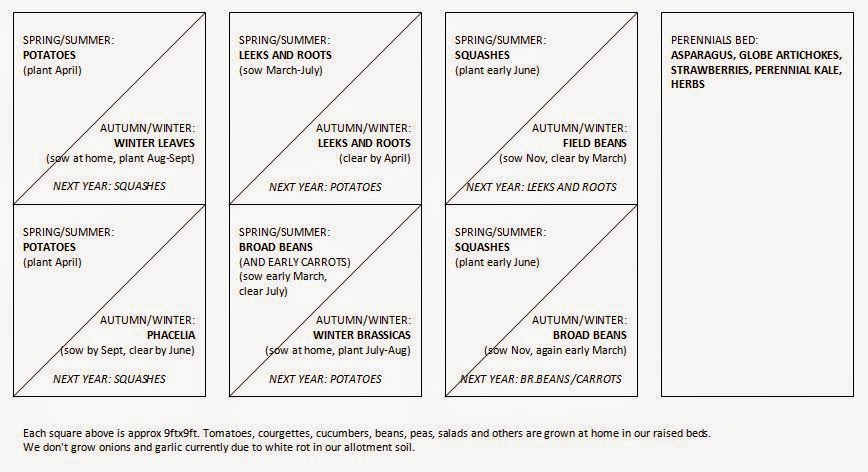
This is partly thanks to slimming down the number of crops we grow on the allotment anyway - we don't grow onions and garlic due to white rot spores in our soil, and we prefer to keep salad leaves and quick-ripening summer crops like French beans, courgettes and tomatoes at home so we can pick them more regularly. On the allotment we grow the lower-maintenance stuff: potatoes, squashes, root veg, broad beans, leeks, and a limited amount of winter brassicas and spinach-type leaves (plus some perennials in a permanent area). We've grouped broad beans, leeks and root veg roughly together: together they take up about the same amount of space we use for more space-hungry crops (potatoes and squashes), and it means we can follow our broad beans (which finish around midsummer) with winter brassicas, thus keeping our earlier-sown swedes in the same area as our other brassicas.

Ladies and gents, I give you our brand new crop rotation plan! (Click pic to enlarge.)


This rotation also allows for two squares to be sown with green manures over winter to add high-nitrogen organic matter to the compost heap, shelter wildlife and protect the soil. Phacelia and field beans are my two favoured green manures since field beans add vital nitrogen to the soil and can be sown as late as November, and phacelia attracts lots of insects and can be sown as late as September. Following squashes with winter-hardy beans means the timing for sowing is perfect; likewise with the winter leaves following the potatoes, and the winter brassicas following the broad beans. And even though we grow most of our beans at home, our allotment soil still gets a nitrogen injection thanks to the broad and field beans. Of course, this rotation doesn't include everything and I should do my best to efficiently rotate our crops at home too, but those on the allotment are the most important ones to rotate: beans for nitrogen, potatoes which are prone to damage from buildups of slugs and eelworms, and brassicas which are susceptible to clubroot, a very nasty fungal disease.

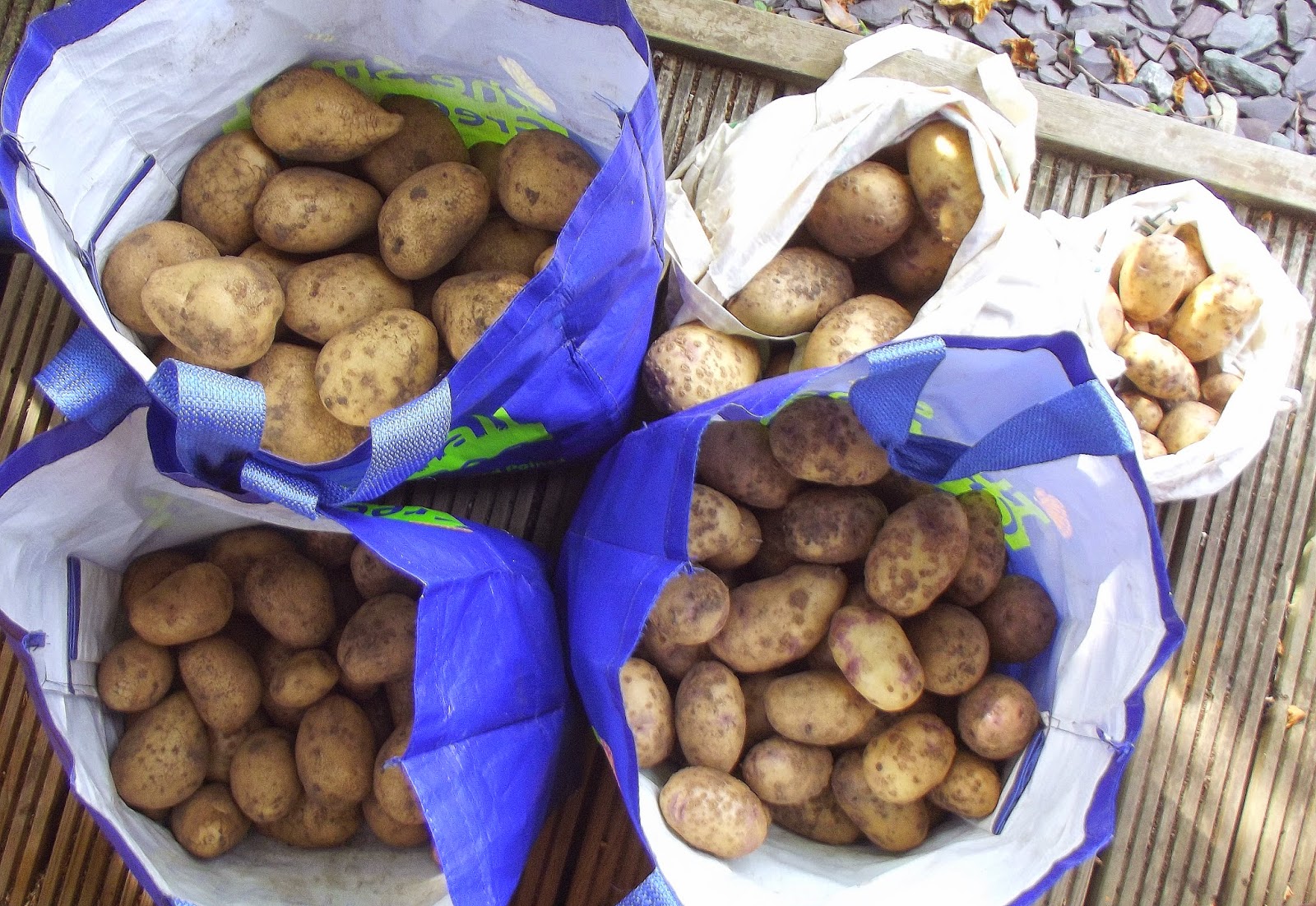
So far it's all going swimmingly. The potatoes are out (an awesome 28kg of Kestrel and 19kg Pentland Crown!) and the winter leaves are in; two rows of chard, two rows of winter spinach and a row of fennel (there's room for more, actually - I must do that). The squashes have finished a little earlier than usual, which means we have plenty of time to clear the soil for winter beans. The leeks, root veg, celery, spring cabbages, kohlrabi and pak choi are coming along nicely and we will slowly harvest them all winter long, making the most of all our space. Brilliant!


There is one complicating factor looming, in that we are planning to clear our old strawberry and asparagus beds (not shown in the plan above) over winter and put them to new use next spring. These two areas don't really fit into the plan so I'm a bit puzzled about what to do with them (and I rather wish we could move our pond and our apple tree into one, which would help us make better use of the other!). Should we grow runner beans or courgettes on the plot again after all? Shall I expand my collection of perennials? Is it time to give in and plant some fruit bushes? Good job I've got all winter to think about it...

Thursday, 21 February 2013

Winter catch-up!

By the end of October our garden beds were looking good, full of pak choi, turnips, kale, radishes, winter lettuces, perpetual spinach, kai lan, lamb's lettuce, purple sprouting broccoli and carrots, not to mention self-seeded claytonia everywhere.


The greenhouse was full of pots of rocket, mustard, pak choi, lettuce and spring cabbages.


The saffron came up but didn't flower, which was disappointing. I've been feeding it all winter to try to build it up for next year. I'm not sure whether it's supposed to be this floppy...


On the plot, we had a few leeks doing well, and our over-winter onions and garlic got off to a great start. We even managed to pick a couple of big bags of chickweed for the dinner table, and turned them into a creamy green sauce to serve with rostis and poached eggs with lots of parmesan.

In November, I was given a mushroom growing kit for my birthday, and proceeded to grow lots of lovely pearl oyster mushrooms. The kit, from Fungi Futures, is easy to grow indoors and produces three flushes of mushrooms over a couple of months.


Good, huh? Growing mushrooms like this is fun and a great experience, and it's amazing to watch how fast they grow! This kit makes a great gift, but it's a rather expensive way to get your mushrooms and there must be more cost-effective alternatives to grow them long term... I've always been a bit put-off by 'gourmet' mushrooms as I find some varieties rather rubbery and weird, but now I can safely say I like oyster mushrooms so maybe I'll see what I can do about growing some more...

In December I discovered this wonderful recipe for Seville orange cheesecake - the best orange cheesecake you're ever likely to taste and possibly the bestest ever cheesecake ever. And, being someone who doesn't like traditional fruity spicy Christmas desserts, I made this equally awesome choc-and-nut Christmas pudding for the big day. The recipe is adapted from a Delicious Magazine recipe, but after a trial run I decided there was plenty of room for improvement, so here's my version.


Choc-and-nut Christmas Pudding
  • Grease a 1.5 litre pudding basin and dust with cocoa powder to prevent sticking.
  • Beat together 175g unsalted butter (at room temp), 100g caster sugar and 60g soft brown sugar until light and fluffy.
  • Beat three medium eggs into the mix, a little at a time.
  • Stir in then sift in 100g plain flour, 45g cocoa powder, 2 tsp baking powder and 1/2 tsp bicarbonate of soda and fold in thoroughly.
  • Fold in 50g chopped hazelnuts and 50g ground almonds, 1 tsp vanilla extract, 2 tsp mixed spice, 75ml full-fat milk, the zest of one large orange, and 150g chopped dark chocolate (or dark chocolate chips).
  • Pour into the pudding basin and seal with greaseproof paper, foil and string - Lesley Waters shows how here. Then put the pudding basin in a large pan with a lid, add enough hot water to come halfway up the sides of the basin, cover, and simmer for two hours. Make sure the pan doesn't dry out.
  • For the sauce, place 125g dark chocolate (broken up) in a jug with 2 tbsp golden syrup and a good splash of brandy. Heat 250ml double cream and 150ml full-fat milk in a pan until almost boiling, then pour over the chocolate and stir until it makes a smooth, glossy sauce. (If it doesn't come together, transfer to a bain marie and keep stirring, or microwave it for a few seconds at a time, stirring in between, until it does.)
  • Unwrap the pudding, run a knife carefully round the edge, and turn it out onto a serving plate. Dust with icing sugar or add other decoration as desired, and serve hot with the chocolate sauce.
It's dense and crumbly and rich, just like a Christmas pud should be, and full of chocolatey goodness with lots of nutty crunch and just a touch of spice to keep things festive. It's best served hot, and don't forget the brandy and chocolate sauce!

In January, during a mild spell, we harvested our Jerusalem artichokes. The crop was smaller than I was expecting - I don't know if they didn't do very well (I didn't notice them flower) or if we just missed them in the heavy clay soil! I read somewhere that they were good for breaking up heavy soils but they were extremely hard to dig and even harder to find, caked in clay! I'll soon find out how many we missed when those we left behind start growing in spring...

I picked a few more bits and pieces from the garden, and was delighted to find I could put a whole meal together with homegrown ingredients - in January!


I slow-roasted some pork shoulder with herbs and red wine til it was fall-apart tender, and served it up with pureed Jerusalem artichokes, fresh patio-grown new potatoes, braised turnips and baby onions (stored from summer), and garlicky kale and chard. It was a fab meal and so satisfying to be able to do that in January, even if it was just the once! The Jerusalem artichokes were a new one on us and we were both very pleasantly surprised by their sweetness and flavour. I do hope we get more next year!


I've had three chilli plants overwintering on my windowsill, all full of fruit which I seem to use up terribly slowly (I'm too used to just chucking some powder in), so I picked them all, strung thread through their stalks and hung them up to dry.


We're in February now and the garden's looking a bit sorry for itself, having spent several weeks under snow recently. My remaining radishes are rotten, the pak choi is bolting (already??), and the outdoor winter lettuces have vanished. The carrots are doing about as well as they always do for me - I might as well give up sowing carrots altogether! The greenhouse lettuces are doing really well, but a late family of caterpillars ate most of the rocket and the rest has now bolted. The broccoli is not really big enough in its containers - I'm getting the feeling it really needs to go in open ground.


I've had quite a few pickings from my winter garden - kale has probably fed me most, and the Jerusalem artichokes and winter potatoes (fleeced on the patio) were definitely worthwhile. There are still quite a few turnips, winter lettuces, lamb's lettuce and pak choi to be eaten, claytonia as always, and some very small spring cabbages which I hope will reach a useful size as spring comes on. The perpetual spinach and chard are just starting to get going again and signs of new growth are everywhere. Hurrah!


And of course, the sowing has begun for the new season, with leeks in pots outside, and slow-growing chillies, peppers and aubergines on the windowsill. I started them early this month - later than last year, as they got a bit much to cope with before planting out, but still early enough, I hope, to give them a decent head start and an earlier crop.


Writing this, I've just remembered I started my first early potatoes about this time last year, and this year I haven't even bought my seed potatoes yet! I must get a move on! The plastic greenhouse is on its last legs, poor thing, and needs replacing, and I must find a pot for the plum tree I've ordered too. I haven't even thought about broad beans yet and I dread to think what the allotment is looking like right now! February 21st? It's practically March!

Saturday, 28 July 2012

New Potatoes

As well as my usual maincrop of Kestrel potatoes on the allotment, I'm growing spuds in sacks in the garden this year for the first time. I started the first ones - three 'Foremost' earlies - in late February, with a covering of fleece, against the wall of the house where it's a little warmer than in the open. They were growing by March 20th, when I sowed more 'Foremost' and some 'Charlotte' in two more sacks.


They all grew pretty well, and I earthed them up periodically until the sacks were full to the top. The foliage was so big and healthy I eventually had to stake it back to keep the walkway round the side of the house clear. But they took a long time to flower and I'm not even sure they all did - I blame the gloomy weather - and when I had a rummage around in the soil of my earliest-planted potatoes in late June I was dismayed that I couldn't find a single spud! Early potatoes are supposed to take 10-12 weeks from planting to harvesting - this was at around 17 weeks!

 
But I had broken quite a lot of the foliage off by accident when I was trying to keep the walkway clear, and realised that that first early planting wouldn't be able to grow much more anyway, so a couple of weeks later I gave in to curiosity and emptied the sack. I found the soil rather dry - apparently all the rain we've been having didn't reach them enough in the shelter of the house and didn't penetrate deep enough into the sack - but at the bottom of the bag I found several handfuls of beautiful firm white tubers. Phew! Some of them were tiny and I expect they still could have got bigger with more watering and more time (and without having their leaves broken off).


Fresh potatoes are so delicious, and we ate them up quickly in a Ligurian pasta dish with green beans and homemade pesto, and boiled and buttered with a pie. My faith is restored that something really is happening in the other sacks, and I quickly replanted the first with my last two 'Charlotte' seed spuds - I have ten 'Melody' spare too so I'll keep the cycle going when I harvest the others. Shrivelled-up seed potatoes that have been chitting since spring grow like the clappers - they were up in less than a week and growing at an incredible rate!

I'm a bit confused that all the potatoes harvested were right at the bottom of the sack - I thought the whole idea was that earthing up encouraged more tubers to form higher and higher up. I did find a tuber high up in another sack while rummaging, so this obviously can happen to some extent. But another piece of advice is to plant tubers in levels, so that you have more plants per sack, each producing tubers at different heights - I suspect this may be more productive and I think I'll try it next time...
Related Posts Plugin for WordPress, Blogger...