Showing posts with label greenhouse. Show all posts

Wednesday, 1 April 2015

Busy, busy!

Winter and early spring are great times for gardeners to do all sorts of non-growing jobs, like developing new areas and working on paths or buildings. I had a long list of these this year, and a long session on the allotment on Monday finally allowed us to finish up all but one of them. Just in time I'd say - 'early spring' is most definitely over now we've hit April!

We finally finished digging over what was previously our strawberry bed, which will be our flower patch this year and hopefully bring looooads more beneficial insects to the plot, as well as giving us flowers to cut and give away. I planted out the corncockle, calendula and clary sage I raised at home over winter, and I'll sow lots more here in a couple of weeks...


We've also planted up the herb patch round the pond and fruit trees. The focus here isn't on culinary herbs, as they're much more useful grown at home where you can grab them easily as you need them, but on flowering perennial herbs for insects and some herbs which I'd like to try drying for tea - lemon balm, camomile and peppermint. I've also popped a few perennial and self-sowing flowers in; some poached egg plant and primroses, an oriental poppy and an echinops. Maybe I should call it my 'companion plants patch' instead of my herb patch.


There's still a bit of work to do to get rid of the last of the grass in that corner by the pond... But it's so good to have this area looking nice again after it got swamped with grass and then we mulched it with manky cardboard over winter!


When we moved our compost bins last summer, there was a lot of good compost in the bottom that we just couldn't use at the time, so it's been heaped up in the place where the compost bins were ever since - we even grew our beans late last summer on the temporary raised bed it created...


...but now we've levelled the ground and moved the pile to this year's potato bed, where it will help build the soil. Our greenhouse will go in this spot this year. I hope the people on the next plot sort out their compost pile soon - it's a bit of a battle to stop it falling onto our plot, and there are brambles growing in it which keep finding their way into this bed.


While we were on the plot I also took the opportunity to sow some more seeds: I scattered some dill and parsley seeds in some carefully-chosen corners, and sowed beetroots, turnips and parsnips in rows in our roots bed, a foot apart, and covered with sieved compost.


Do you like my new plant labels? They look a bit industrial, but I was desperate to find something that would last for years, instead of perishing in the sun or rotting in the rain or just getting kicked about and lost in the dirt, and I hope these are the answer. They're from Amazon - I tried to find another supplier but couldn't - by a company called GardenMate. The permanent marker is supposed to last all season, and I'll be able to clean it off with a solvent cleaner to reuse them. That's the theory, anyway...

I'm happy that we have some broad beans on the plot at last, after a bit of a battle against mice eating the seeds! These were actually sown at home in a big seed tray at the beginning of March, and planted out this week. There are a few more sown direct here too, and covered with the same mesh to try to keep the rodents off this time. I have half a feeling I'm going to go down there and find little holes chewed right through the netting one of these days!


At home, I've sown lots more seeds, including celery, basil, dill, perpetual spinach, pea shoots and some more flowers; sunflowers, achillea and cerinthe. After a manic March, I think I've just about caught up with myself. The only things remaining are to clear and dig over the old asparagus bed, which is small and shouldn't take too long, and plant out my poor sweet peas which are getting desperate for some space and some support! Poor things!


I'm glad it's April now and the weather must warm up a bit more soon. I feel like I've got a bit of a holiday coming up over the long Easter weekend, and I'll probably get stuck into some more sowing: courgettes, squashes, brassicas and beans are next, as well as the bulk of the flower patch, getting the greenhouse sorted - and it'll be time to plant potatoes before we know it!

Friday, 27 March 2015

Sowathon!

March has been a busy month for many reasons, and I've been way behind with seed-sowing for the new season, but in the last week I've squeezed in a few hours in the garden and taken the opportunity to catch up!


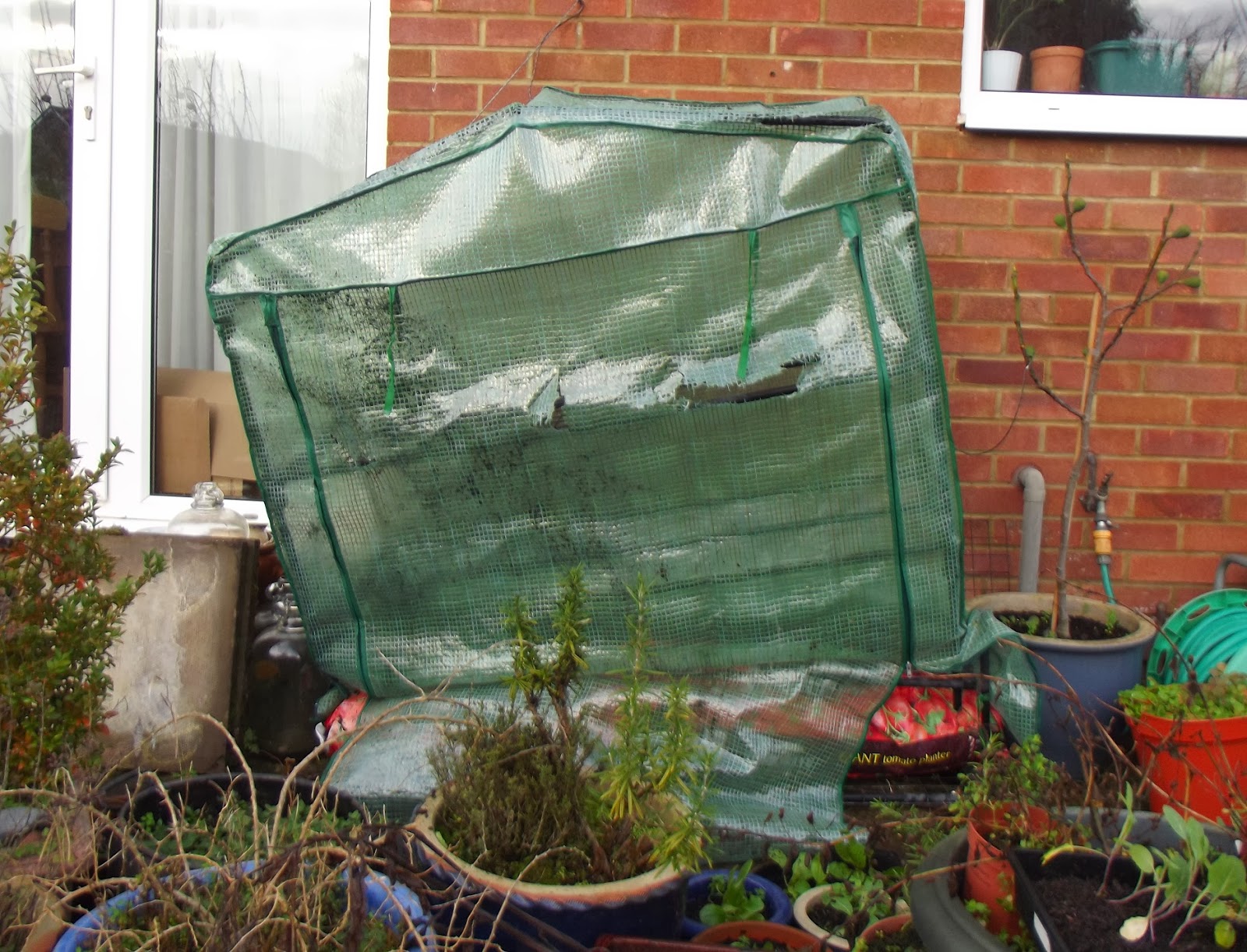
This time last week was the spring equinox, when the days become longer than the nights again (hurrah!), and it seemed like a good time to sow my tomato seeds. I potted up all the pepper, chilli and aubergine plants from the propagator - they're looking big and healthy and have been spending daytimes out in the plastic greenhouse (pic above) - and I sowed five varieties of tomatoes in their place: Amish Paste (a good cooking tomato, but tasty sliced as well), Dr Carolyn (delicious heritage variety!), Angelle (my favourite, from seeds saved from supermarket toms), Skykomish (a blight-resistant variety) and Indigo Rose (the 'black tomato', super-high in antioxidants). They all popped up in just four days and are growing away on the windowsill now. The electric propagator is a real help in getting warmth-loving seeds to germinate!


They look a bit leggy - I guess we've had some gloomy days lately - but they'll catch up with themselves and I'll plant them deep when I pot them up.

We spent a couple of hours topping up the big raised bed in the garden, with the last half-bag of the compost we bought for the purpose last year, plus a layer of new multi-purpose compost. I treated the bed with sulphur before sowing to try to begin lowering its high pH (see previous post), but I decided it might be overcautious to limit what I sow in it this year - after all, growth did seem to improve quite a lot during the course of last season, and the layer of fresh compost should help a bit too - so I'm trying a bigger variety of veg in it than I originally planned. It won't take long to see whether they grow well or not, and I can always resow something else later... The bed already contains some parsley, chives, garlic and perpetual spinach from last year, and I filled up the rest of the space with rows of carrots, turnips, lettuce, spring onions, komatsuna, watercress, spinach, kohlrabi, radishes and mustard.


I also sowed some more celeriac seeds. I had been hardening off my young celeriac plants, but then I read somewhere that if celeriac gets too cold in its first spring it can think it's in its second year, and go to flower rather than producing a good root. Last year's celeriac didn't actually go to flower, but it was a terrible failure and I wondered if my early-hardening-off could possibly be why... So this new set of seedlings will be coddled indoors until the temperatures are higher out there, and we'll see if it makes a difference!


The corner garden bed needed a good clear-up - it had quite a few weeds, last year's bean poles and old bean and pea plants, and some honeysuckle and snowberry invading fast. Once tidied, I sowed some peas and mangetout against the fence, and scattered mint leaves and chopped up dry mint stems over them to keep the mice away - it works a treat!


Finally, I sowed some chard, leaf celery and flowers (cerinthe and achillea) in cells in the plastic greenhouse, and planted some early 'Accent' potatoes in sacks. The potato shoots could be harmed by frost after they appear, so I'll need to keep an eye on them and keep earthing them up or throw fleece over them on cold nights. I've got six of these bags so I'll sow two more in two weeks, and two more two weeks later, to spread out my harvest a bit.


I'm nearly caught-up but there's still plenty more to do, and it'll be April in just a few days... In fact, I'd better get back out there!

Friday, 6 February 2015

An Exception

I've always tried to avoid growing F1 hybrids - well, mostly. If I'm sent free seeds with an order or magazine it seems rather churlish to reject them, and a few others have slipped through the net over the years for one reason or another. It's not that there's anything 'wrong' with hybrids, but you have to support the things that you want to thrive. It's a bit like buying British or local. I want to see biodiversity and food security thriving, and hybrids undermine these by drastically reducing demand for traditional open-pollinated varieties, and because they're not genetically stable and can't reproduce to create another generation the same. I also like to think I can save the seeds of all my crops, although my seed-saving operation has a long way to go yet... And F1 seeds can be pretty expensive too!

But this year I'm making one deliberate exception, and it's this:


Aubergines are a luxury vegetable for us - something that we could easily do without, but something I'd love to eat more. I rarely buy them, simply because I'm buying less and less veg anyway - my priority is to eat what I grow and I'm far too busy eating all the courgettes and French beans and tomatoes and peppers and leafy greens coming out of the garden when they're in season. So the only way I'm gonna get to eat them is if I grow them myself!

But aubergines, lets face it, are just not really suited to the British climate - they need lots and lots of warmth and sunshine - yet I know many gardeners have moderate success with them, especially under cover. Not me; I've managed to grow just two small aubergines in five or six years of trying, and one of them went bad on the plant. There are only really two open-pollinated varieties of aubergines widely available (not counting fancy-coloured ones or mini ones, which I'm less interested in for now) and I've tried them both, without success. So when I read a recommendation for this variety, Bonica F1, on Nicky Kyle's great blog I thought well, why not have one last bash? Better to grow an F1 hybrid than not to grow them at all! Hybridisation brings the best traits together from other varieties to create new varieties that are (generally) more productive or earlier, more consistent and more reliable - the easier (though pricier) choice for any gardener, and in theory they will crop more readily where traditional varieties have failed. The plastic greenhouse we're putting on the allotment this year means we'll be able to provide them with a bit more protection than at home, too, so I'm crossing my fingers and looking forward to a bountiful aubergine harvest for once!

Sunday, 4 January 2015

2014

It's easy to think that winter is a quiet time for gardeners, but there's plenty to be done. Between harvesting winter crops, checking fleeces and stakes, winter digging, construction projects and maintenance, nurturing overwintering plants and looking after little seedlings in the greenhouse, there's also plenty of planning to be done, and it inevitably involves a good look back over the past growing season to see what worked and what didn't.

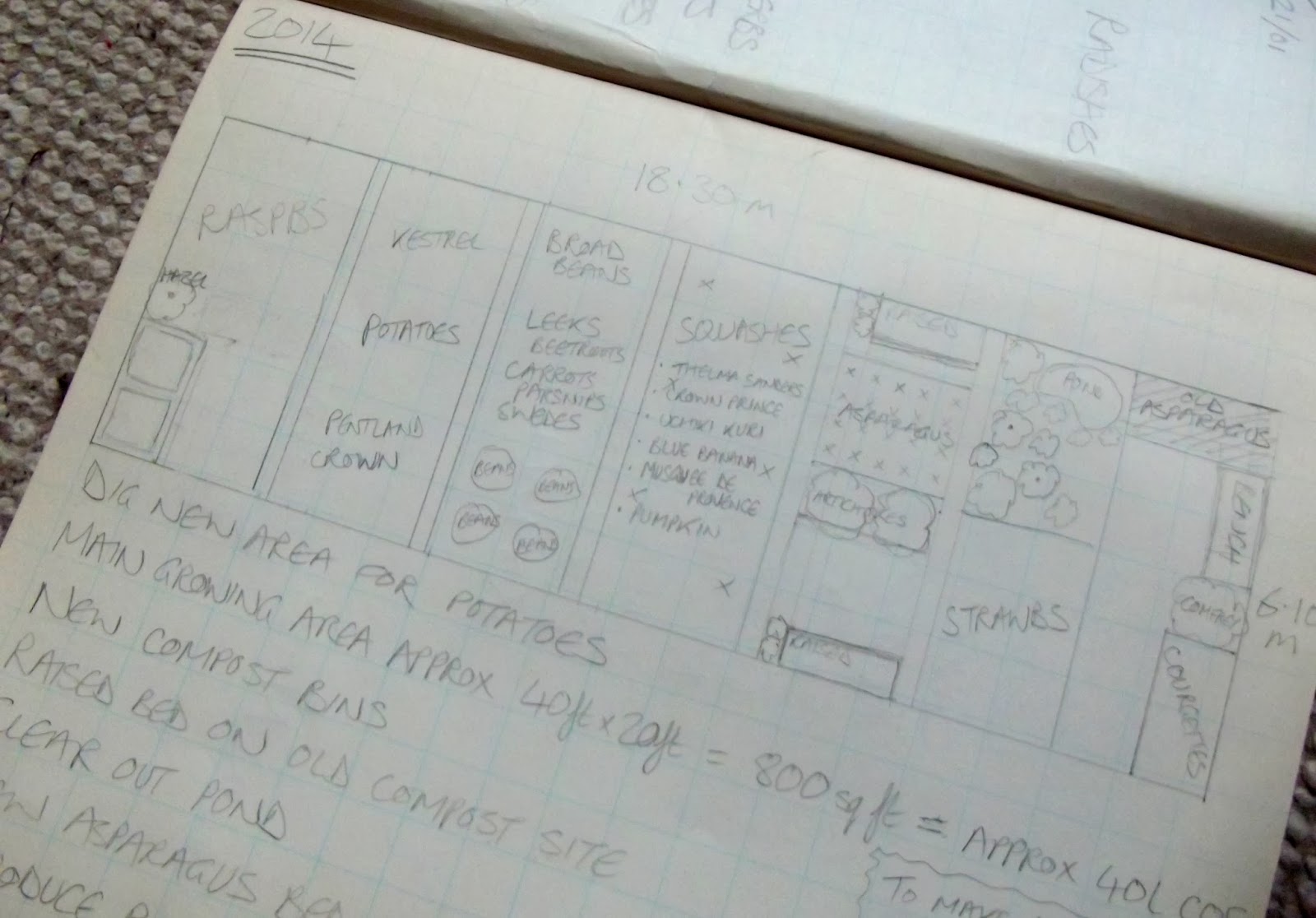
2014 was a pretty bumper year for us, but there are always lessons to be learned. Our plot was under a couple of feet of floodwater for a week early on in the year, but thankfully it didn't do any real damage or set us back - we just had some extra clearing up to do, and to be patient in waiting for the soil to dry out again. We've settled on a new 'structure' for our plot, with three main beds in a rotation plus a number of perennial areas, and we made several new paths. We failed to cultivate the difficult far corner of the plot or our old strawberry bed, but we did clear them and cover them up to stifle the weeds and make the job easier later. We planted a new perennials bed with asparagus, artichokes, strawberries and herbs - hopefully some perennial kale will go in here too. We built new compost bins in a new area, and grew beans on the super-fertile patch where the old bins were. We also upped our growing game in the garden at home, converting a shrub bed to grow vegetables and adding three raised beds - more on all that in another post.

2013, compost bins. 2014, French beans. 2015 greenhouse!
We tried a new way of adding fertility to our plot; the 'Complete Organic Fertiliser' recommended by Steve Solomon for rebalancing soil nutrients for maximum plant health and nutrition. Though I can't quantify the results or compare to a 'control' area, I have to say everything on the plot just grew better than ever with virtually no problems, and I am quite sure the COF helped that happen. I will be going one step further this year: sending some soil samples off for laboratory analysis and creating a custom mix to balance it even better.

Another thing we trialled was 'Rootgrow' or mycorrhizal fungi, endorsed by the RHS; a mix of natural fungi that forms symbioses with plant roots and gives plants access to more nutrients and water. It's primary recommended use is in planting trees and shrubs, to help them establish quicker and more easily, but it is supposed to help any plant so I used it under every single crop to see what happened. In theory it should drought-proof plants and help fruits and roots to swell more steadily and evenly. In practice, though we had great growth almost everywhere and the new asparagus and artichokes established without a hitch, my container potatoes gave identical yields whether I used the Rootgrow or not, the newly-planted strawberries didn't establish well for some reason, squashes and swedes came in a huge mix of sizes, and my celeriac completely failed to swell, so I'm not entirely convinced...

Potatoes did wonderfully - we managed to grow a kilo for every week of the year. (If only I had somewhere better to store them - they are now sprouting and turning soft). Scab was very bad on our old favourite Kestrel, but we also tried Pentland Crown this year, which makes a much better baked jacket spud, seems to store slightly better, and doesn't suffer as much scab, so we will be growing more of these in 2015! On reflection I wondered if I should have left the lime out of the COF applied to this area, as it probably made it worse.


Carrots were our best ever, even though we couldn't find our enviromesh in time to protect our first sowing so we lost some to carrot fly - our later sowings did brilliantly and they even won a first placing in the allotment association show! We have only succeeded with carrots since we added lime to our soil - perhaps they need the extra calcium.


Pumpkins and squashes did brilliantly too; we brought home 18 lovely fruits and many are still sitting around happily on windowsills and doormats waiting to be eaten. Arguably we might have expected even more squashes from our eight plants - some plants only gave us one or two fruits - but they suffered from quite a lot of weed competition... Turns out it wasn't such a good idea to undersow them with clover; clover actually gets quite big and unruly when it wants to!


Leeks, parsnips, swedes, broad beans and beetroots all got along just fine. Beetroots really are just THE easiest vegetable to grow - nothing seems to stop them. I only wish Eddie liked them better as I'm eating them mostly by myself. The leeks are suffering from some allium leaf miner and I think we should cover them with mesh next year. We only grew one variety of French beans - a local heritage variety called Ryder's Blue Coco - and I sowed them rather late due to a lack of space earlier on. They were delightful - really tender - and we were eating them long after our neighbours' beans had finished, but we couldn't save any seeds from them because they didn't have time to mature before the first frost, which was a great shame. I do have just a few seeds left so I MUST do better at this next year!


Our chard and winter spinach, planted out in late summer, suffered a bit of neglect due to an extremely busy autumn, but though we lost a few to slugs and snails, they grew superbly and we really should have harvested more from them before the winter. We will still be able to pick from them when growth starts again in early spring though. Our first attempt at fennel suffered the same neglect but also grew very well indeed, and again we failed to harvest it in good time. It's certainly one to try again this year though. We also have a few spring cabbages nearly ready which have done really well - a nice compact variety called Pixie which, assuming it tastes good come spring, I will certainly grow again.

2014 was our first year growing both celery and celeriac. The celery did okay, though it was a bit thin and stringy (I don't usually eat it raw much anyway - just use it for soups, stocks and stews - so that doesn't really matter). The celeriac was a huge disappointment; no root to speak of at all, and I'm not sure why or what to do differently next year...


The importance of beneficial insects really, properly hit home to me last spring when scores of ladybirds descended on our blackfly-infested broad beans and cleared the whole lot up for us. I'm pretty sure there were more ladybirds around than before because I'd grown phacelia in the next bed over winter - ladybirds seem to be attracted by lacy foliage and as we cleared it up in the spring there were loads of them among it. I always grow a few flowers here and there, but now I will grow more!


In the home garden, our courgettes and tomatoes were just fabulous and kept me busy finding new ways to use them! The tomatoes succumbed to blight in the late summer, as they always do. We tried a local heritage variety of tomato - 'Ryder's Midday Sun' - but sadly didn't find them up to a good standard; the plants grew slowly, the tomatoes were watery and lacked flavour, and they were first to succumb to blight! Maybe they'd do better in a greenhouse... But while I'm very glad to have had the opportunity to try them, I'm not sure I have the space to persist with them. Cucumbers and salad greens in our new raised beds did not do well at all and I'm sure there was a problem with the soil - more on that in another post... Peppers did okay but gosh, they take so long to ripen! We were disappointed in a new variety we tried - 'Hebar' - which had very thin flesh and not much flavour at all. The seller described it as "particularly sweet and tasty" so I'd love to know what anyone else thinks of them! We have bought a plastic greenhouse to put on the allotment this summer, which should be just big enough to grow a few tomatoes, cucumbers and peppers in. This way we hope to have blight free tomatoes and earlier peppers! We'll still grow some at home too though...

Kaibi Round, Ancho Grande, Hebar, Lipstick
The enviromesh over the kale bed got torn in high winds early in the year, and by late summer caterpillars had stripped the plants as I was too lazy to do anything about it... Thankfully some of the plants made a surprisingly good comeback though! Another mistake I will not repeat next year is planting French beans behind courgette plants. After the courgettes had been growing a month I couldn't reach the beans at all, and had to leave them all to pick for drying instead! The mangetout was great - we could hardly keep up with it - and we were really impressed by variety 'Carouby de Maussane' with giant pods! I have never grown ordinary peas, as frozen British peas are extremely good and convenient, and all the podding seemed like too much of a faff, but last year we did grow a multipurpose mangetout/podding pea - 'Ezeta's Krombek Blauwschokker' - and when they got too big to eat as mangetout I was forced to pod a few... They were so lovely that I might just add a few real podding peas to my garden this year...

Carouby de Maussane mangetout - still gorgeously sweet and tender at this size!
The 'perennial salad mix' from Suffolk Herbs turned out to be a mix of chicories and radicchios, which have grown well but... I just don't really like the taste. Admittedly I should have read the back of the pack more carefully, but this picture is a bit misleading I think!


All in all, we will do much the same this year as last, but here are the things we plan to do differently:
  • Grow more flowers - to include a cutting-flower patch!
  • Do even more to balance our soil nutrition according to Steve Solomon's great book 'The Intelligent Gardener'
  • Add a plastic greenhouse to the allotment to grow a few summer veg under cover.
  • Don't plant anything behind courgettes!
  • Improve raised bed soil.
  • Buy more enviromesh, to replace torn piece and cover leeks too.
  • Keep squash bed weed-free - perhaps mulch beneath plants - and grow fewer plants so they don't get so tangled.
  • Grow some proper peas, perhaps.
  • Try harder with celeriac.
  • Grow more Pentland Crown potatoes and less Kestrel - and try another new variety too.
  • There are always new varieties to try; this year new ones for us include oyster leaf, beefsteak plant, pink banana squash, skykomish tomatoes (supposed to have some blight resistance), marconi rosso peppers, and we're going to attempt to grow cauliflowers for the first time, since we buy them quite a lot...
  • We also plan to plant a new fruit patch on the long-neglected and difficult far corner of the allotment, and clear and replant our overgrown herb bed.
Frosty radicchio

Wednesday, 29 January 2014

New Beginnings

Well hello. It's been a long time, but I finally got round to realising that the only reason I wasn't posting anymore was simply for that reason; because it had been such a long time. Sometimes the hardest part is just showing up, isn't it?

So I'm not going to do a big long catch-up about everything I've done in the last year - partly because it's too much work and partly because it'd probably bore you all in one go anyway (and because the last time I did that was only three posts ago, which is a bit embarrassing). Instead, I'll just let you know that last year was pretty good and plans are afoot for an even better year ahead.


We seem to have finally beaten the grass in the middle section of our plot, allowing us to convert to no-dig growing for the most part, and this year we plan to work hard on the even grassier area down the bottom, and beat that too. This will involve some serious weeding and mulching of the raspberry bed, moving our compost bin to smother some of the troublesome grass, and digging over a tough area to plant our potatoes. Meanwhile, growing beans, roots and squashes on the middle part should be easy-peasy (though we've given up on onions and garlic thanks to the pernicious white rot in our soil), and we're going to commit one weed-free strip to perennial vegetables, including a brand new asparagus bed, some globe artichokes, and space for a new strawberry patch which we hope to plant next winter from this summer's runners. We've got some exciting new varieties to try, such as sweet-leafed stevia and Suffolk Herbs' "perennial salad mix", and we're also going to be trying out a new system for fertilising and remineralising the soil, from a fascinating book by Steve Solomon called The Intelligent Gardener: Growing Nutrient-Dense Food. More on all that to come!

For now, I'm sitting on my hands trying to resist sowing seeds, and wondering if this is it for winter or if it's finally going to kick in next week... or maybe in March or April just to wind us all up... I will permit myself to sow peppers from 1st February but, well, this happened...


...so before that, my first priority needs to be somewhere new to put this year's tender seedlings!

Thursday, 21 February 2013

Winter catch-up!

By the end of October our garden beds were looking good, full of pak choi, turnips, kale, radishes, winter lettuces, perpetual spinach, kai lan, lamb's lettuce, purple sprouting broccoli and carrots, not to mention self-seeded claytonia everywhere.


The greenhouse was full of pots of rocket, mustard, pak choi, lettuce and spring cabbages.


The saffron came up but didn't flower, which was disappointing. I've been feeding it all winter to try to build it up for next year. I'm not sure whether it's supposed to be this floppy...


On the plot, we had a few leeks doing well, and our over-winter onions and garlic got off to a great start. We even managed to pick a couple of big bags of chickweed for the dinner table, and turned them into a creamy green sauce to serve with rostis and poached eggs with lots of parmesan.

In November, I was given a mushroom growing kit for my birthday, and proceeded to grow lots of lovely pearl oyster mushrooms. The kit, from Fungi Futures, is easy to grow indoors and produces three flushes of mushrooms over a couple of months.


Good, huh? Growing mushrooms like this is fun and a great experience, and it's amazing to watch how fast they grow! This kit makes a great gift, but it's a rather expensive way to get your mushrooms and there must be more cost-effective alternatives to grow them long term... I've always been a bit put-off by 'gourmet' mushrooms as I find some varieties rather rubbery and weird, but now I can safely say I like oyster mushrooms so maybe I'll see what I can do about growing some more...

In December I discovered this wonderful recipe for Seville orange cheesecake - the best orange cheesecake you're ever likely to taste and possibly the bestest ever cheesecake ever. And, being someone who doesn't like traditional fruity spicy Christmas desserts, I made this equally awesome choc-and-nut Christmas pudding for the big day. The recipe is adapted from a Delicious Magazine recipe, but after a trial run I decided there was plenty of room for improvement, so here's my version.


Choc-and-nut Christmas Pudding
  • Grease a 1.5 litre pudding basin and dust with cocoa powder to prevent sticking.
  • Beat together 175g unsalted butter (at room temp), 100g caster sugar and 60g soft brown sugar until light and fluffy.
  • Beat three medium eggs into the mix, a little at a time.
  • Stir in then sift in 100g plain flour, 45g cocoa powder, 2 tsp baking powder and 1/2 tsp bicarbonate of soda and fold in thoroughly.
  • Fold in 50g chopped hazelnuts and 50g ground almonds, 1 tsp vanilla extract, 2 tsp mixed spice, 75ml full-fat milk, the zest of one large orange, and 150g chopped dark chocolate (or dark chocolate chips).
  • Pour into the pudding basin and seal with greaseproof paper, foil and string - Lesley Waters shows how here. Then put the pudding basin in a large pan with a lid, add enough hot water to come halfway up the sides of the basin, cover, and simmer for two hours. Make sure the pan doesn't dry out.
  • For the sauce, place 125g dark chocolate (broken up) in a jug with 2 tbsp golden syrup and a good splash of brandy. Heat 250ml double cream and 150ml full-fat milk in a pan until almost boiling, then pour over the chocolate and stir until it makes a smooth, glossy sauce. (If it doesn't come together, transfer to a bain marie and keep stirring, or microwave it for a few seconds at a time, stirring in between, until it does.)
  • Unwrap the pudding, run a knife carefully round the edge, and turn it out onto a serving plate. Dust with icing sugar or add other decoration as desired, and serve hot with the chocolate sauce.
It's dense and crumbly and rich, just like a Christmas pud should be, and full of chocolatey goodness with lots of nutty crunch and just a touch of spice to keep things festive. It's best served hot, and don't forget the brandy and chocolate sauce!

In January, during a mild spell, we harvested our Jerusalem artichokes. The crop was smaller than I was expecting - I don't know if they didn't do very well (I didn't notice them flower) or if we just missed them in the heavy clay soil! I read somewhere that they were good for breaking up heavy soils but they were extremely hard to dig and even harder to find, caked in clay! I'll soon find out how many we missed when those we left behind start growing in spring...

I picked a few more bits and pieces from the garden, and was delighted to find I could put a whole meal together with homegrown ingredients - in January!


I slow-roasted some pork shoulder with herbs and red wine til it was fall-apart tender, and served it up with pureed Jerusalem artichokes, fresh patio-grown new potatoes, braised turnips and baby onions (stored from summer), and garlicky kale and chard. It was a fab meal and so satisfying to be able to do that in January, even if it was just the once! The Jerusalem artichokes were a new one on us and we were both very pleasantly surprised by their sweetness and flavour. I do hope we get more next year!


I've had three chilli plants overwintering on my windowsill, all full of fruit which I seem to use up terribly slowly (I'm too used to just chucking some powder in), so I picked them all, strung thread through their stalks and hung them up to dry.


We're in February now and the garden's looking a bit sorry for itself, having spent several weeks under snow recently. My remaining radishes are rotten, the pak choi is bolting (already??), and the outdoor winter lettuces have vanished. The carrots are doing about as well as they always do for me - I might as well give up sowing carrots altogether! The greenhouse lettuces are doing really well, but a late family of caterpillars ate most of the rocket and the rest has now bolted. The broccoli is not really big enough in its containers - I'm getting the feeling it really needs to go in open ground.


I've had quite a few pickings from my winter garden - kale has probably fed me most, and the Jerusalem artichokes and winter potatoes (fleeced on the patio) were definitely worthwhile. There are still quite a few turnips, winter lettuces, lamb's lettuce and pak choi to be eaten, claytonia as always, and some very small spring cabbages which I hope will reach a useful size as spring comes on. The perpetual spinach and chard are just starting to get going again and signs of new growth are everywhere. Hurrah!


And of course, the sowing has begun for the new season, with leeks in pots outside, and slow-growing chillies, peppers and aubergines on the windowsill. I started them early this month - later than last year, as they got a bit much to cope with before planting out, but still early enough, I hope, to give them a decent head start and an earlier crop.


Writing this, I've just remembered I started my first early potatoes about this time last year, and this year I haven't even bought my seed potatoes yet! I must get a move on! The plastic greenhouse is on its last legs, poor thing, and needs replacing, and I must find a pot for the plum tree I've ordered too. I haven't even thought about broad beans yet and I dread to think what the allotment is looking like right now! February 21st? It's practically March!

Thursday, 12 July 2012

Six Strategies to Cope With Persistent Rainfall

At the beginning of the season I wrote about strategies for coping with drought and hosepipe bans. Hmm. Now, after two record-breakingly wet months, and amidst what is likely to become a third, I think it's time to start calling summer in Britain 'the wet season' and adjusting our practices to match, don't you? I've already talked about flooding, here, but what else can we do in future to improve the health of our plants when the sun don't shine?


1 - Look after your soil
Organic matter is a must for healthy soil; not only does it retain moisture to protect plants from drought, but it improves drainage too, by providing a more open soil structure. Dig it in early in the season, or spread it on top and let the worms do the work. Organic matter is even more important in heavy clay soils, which waterlog easily. To improve drainage even more, create a lighter soil by adding sand.

2 - Plan for good drainage
Raised beds are the ultimate in improved drainage for veg crops - assuming of course they are filled with good, well-draining soil. It can also be useful to plant on mounds or ridges. Aerate soil by spiking it to help drainage and drying. There is debate about whether crocks or stones in the bottoms of pots actually help or hinder drainage - scientists say they hinder it - but one thing we must certainly do is make sure there are enough drainage holes in our pots and make sure they stay clear. Raising containers off the ground on bricks or stones will also help. If you have a serious problem, consider a drainage trench or soakaway, filled with rubble or gravel, to carry water away. You can leave it open or top it with plastic sheeting and cover with soil.

3 - Restore nutrients
Excessive watering can leach nutrients out of the soil and leave plants hungry, so be sure to feed them regularly. Liquid feed, though, may do more harm than good in a very wet container! Blood, fish and bone is a great all-round dry feed which you can just sprinkle on the soil and allow the rain to water in gently, or work into the top few inches of damp soil. Rock dust is a highly recommended soil 'remineraliser', which I've just begun experimenting with this year - they say it improves plant health and yields dramatically... Seaweed is another good all-round plant-booster, that stimulates and strengthens plants against all problems. It can be watered in or used as a foliar feed on dry days.

4 - Protect your plants
I know I'm always whinging about not having a greenhouse, but this year it would have been more useful than ever. Cucumbers and gherkins dropped dead in the gloom and even cool-weather peas and asparagus grew painfully slowly. A little cover to intensify what few UV rays we've had would probably have been a great benefit. If this wet-summer trend continues, I think growing under glass or plastic will become more and more important, and I will certainly try to grow my cucumbers under cover after this year. Others that would benefit from it are tomatoes of course, French beans, peppers and chillies, strawberries and asparagus. Rosemary hates being wet, and I have moved mine into the mini-greenhouse where my aubergines and West Indian gherkins are already thriving. Oh, how I dream of my very own polytunnel... On another note, just like mulch can help in drought conditions by preventing evaporation, it can help in wet weather by absorbing some of the water before it reaches the soil. Use an impenetrable mulch such as plastic over the roots of waterlogged plants, or something absorbent such as straw or newspaper as a general cover, and pull it back on sunny days to let things dry out!

5 - Defend against pests and diseases
Keep on top of pruning, staking and mulching to keep plants off wet soil and improve ventilation - this will lessen the risk of fungal diseases. And be prepared for slugs and snails, which thrive in wet conditions. Hand-picking, beer traps, barriers of copper/tinfoil/eggshell/ash/sand, decoy plants (French marigolds are good), wheat bran, nematodes and organic pellets are all methods worth considering, and a combination of several of these is best! Encourage natural predators such as ground beetles, amphibians, hedgehogs and ground-feeding birds (thrushes, robins, blackbirds, starlings) by providing food and undisturbed habitats for them. Perhaps there is an opportunity to alter your landscaping to draw excess water to a pond or bog garden, and make the most of the excess water to encourage wildlife! Slugs also struggle to feed on high-up plants, so climbing plants are less at risk, as are those on roofs and windowsills.


6 - Pollinate
Rain keeps pollinating insects at home indoors, and pollination of my tomatoes in particular has been very poor so far this year. Tomatoes and peppers are self pollinating and only require a shake or a flick on the back of the flower to pollinate them. Others can be carefully hand-pollinated using a soft paintbrush.

What about you? How do you plan to improve things for your crops if next season is as wet and gloomy as this one?
Related Posts Plugin for WordPress, Blogger...