We finally made it to the allotment this week, after having not managed to go at all during December, and did some much-needed catching up.
Here it is:
Of course, it doesn't look like much at the moment, but there's plenty going on, and considering what a battle we've always had with couchgrass and other perennial weeds we're pretty pleased with it. But it's been a long time since I took or shared any pictures of it, so let me give you the tour...
It's split roughly into seven sections, more by accident than design, with woodchip paths in between them, lined with bricks and some cheap weedproof fabric that isn't quite doing the job any more.
Section one, above, is where our compost bins are. We built them last spring to replace our old ones, in another spot, which were falling apart, and we relocated them here because it's under the shade of an elder tree and the soil is full of roots - everything we've grown here in the past has struggled a bit, so it's a good spot to use for something other than plants! The area covered in weedproof fabric over there has also been problematic, but we're determined to get it under control this year and plant a new fruit patch here, mulching heavily between the plants to try to beat the couchgrass!
Section two is the first of our three rotation beds. Last year we grew potatoes here - now the near half is covered in a phacelia green manure (and quite a few annual weeds) and the far half has rows of spinach and chard (again with the weeds...) There's also a row of scabiosa I planted out too late to flower, but it seems to be coming through the winter a treat! After we clear this patch in late spring we'll grow squashes and pumpkins here.
Section three (our second rotation bed) is where our root crops were grown, though it's beginning to look a little sparse now. The spring cabbages in the foreground are at a variety of stages - we picked our first this week but others are not ready yet, and one has rotted! :-( Beyond that is a small row of calabrese which should produce in the spring, some carrots, parsnips, swedes, celery and leeks. We've just finished the beetroots. When this patch is clear in early to mid spring, we'll plant our potatoes here.
Section four (our third rotation bed) was pumpkins and squashes last year, but now it's bare, which is pretty disappointing because I sowed most of it with field beans (a green manure) and broad beans in November. (The cardboard is there to protect a patch I left unsown, intending to make a second sowing in March.) I guess I left it just a little too late; they say early November is the latest you should sow but we did it near the end of the month. Still, never mind, there's plenty of time to sow more broad beans, and our root veg and leeks will go here from March onwards.
Section five is what we call our perennials bed, though it's not the only one! We planted it last year with asparagus (along the left hand side) strawberries (in the raised beds) and globe artichokes (far end, under little mounds of woodchip mulch and black plastic to protect the crowns from frost), as well as some parsley, sage, lavender and lemon balm. It's done okay so far but the plants are still getting established - hopefully they will be even better this year. I'd also like to plant some perennial kale among the sage - supposedly sage keeps cabbage white butterflies away, but we will see!
Section six is home to our pond (far end), two columnar 'spur' fruit trees, and our old strawberry patch (this end) which is now under a mulch of thick cardboard until we can dig it over. There used to be a really nice herb garden planted around the pond and the trees, but over the years it's become swamped with couchgrass and very few plants are left, so this area is up for redevelopment this year... We will replant the herb garden - perhaps through a membrane to keep the grass down - and the old strawberry bed will become a flower patch! We'll also be giving away the pear tree - we don't like the fruit! - and we need to right the very wonky apple tree before it goes over! We'll have to do this soon while the trees are still dormant - they won't like having their roots messed with.
Finally, section seven is where we keep our tools in our storage bench, and it's where our old compost bins were (on the right). That spot is now a lovely fertile patch where we'll put a plastic greenhouse this year for a few tomatoes, peppers and cucumbers. We've also got a little comfrey patch here which we use to feed the compost and make plant feed, and at the far end is a little bed which used to grow asparagus, though it's almost all been choked out by grass - another redevelopment project for this year. I think it's just big enough for a couple of bean teepees... or I might decide to grow the beans at home and grow sweet peas here instead, or some more fruit! I'd also like to narrow this path a bit to maximise the growing space in section six on the left.
You'll notice there's not much space here for summer fruiting crops like French beans, courgettes and tomatoes, nor salads or brassicas. A few years ago we decided we were better off only growing reasonably low-maintenance veg at the allotment, since we struggle to get here enough to look after them. It's working out really well, and we can still grow those things at home where we can keep an eye on them and pick them regularly! We don't grow many brassicas simply because we find them so problematic (what with flea beetles, whitefly, rootfly, slugs, three kinds of caterpillars and pigeons all wanting a share!) but we are adding them to our repertoire gradually. And we don't grow onions or shallots because we have dreadful white rot in the soil which destroys the crop, but we manage a bit of garlic and plenty of spring onions at home, and I'm sure we'll return to onion-growing at some point...
During our trip on Monday we pruned the apple and pear trees and made a good job of weeding and tidying the perennials bed, cutting down last year's asparagus ferns, herb flower spikes and sunflower stems. Here's a 'before' picture!
There's much more weeding to be done before things start growing again in spring, and we need to make a start on that digging very soon too. We're all crossing our fingers for no flooding this year, so we can keep at it!
Showing posts with label brassicas. Show all posts
Saturday, 10 January 2015
Tuesday, 23 September 2014
Crop Rotation Confessions...
I have a confession to make. Crop rotation on a small plot has always rather baffled me. On a big plot it makes sense - on a big plot you can afford to leave a patch of ground empty in preparation for a later crop, or to sow a green manure in the middle of summer just for the heck of it - but on a small allotment where you want to make the most of every space all year round, it can be a real juggling act trying to get your potatoes out early enough for your purple-sprouting broccoli to go in, or clearing your onion patch in time to sow beans and corn, or figuring out what on earth to grow after you've harvested your squashes as late as October - and who uses exactly the same amount of space for every crop group anyway??
Traditionally, the main groups in a crop rotation are potatoes and roots, brassicas, beans, and 'other veg'. The potatoes are manured to enrich and slightly acidify the soil (preventing scab), heavy-feeding beans follow in the nicely broken-up ground after the potatoes are dug, then (often after an application of lime,) leafy brassicas to make good use of the nitrogen the bean roots accumulate. Then, presumably, you throw sweetcorn, cucurbits, tomatoes, leafy greens and everything else in together after that. Sounds simple enough, but questions abound. Do you grow swedes with the root crops or the brassicas? Aren't tomatoes in the same family as potatoes? Cucurbits take up way more space than anything else! And aren't you supposed to avoid manuring carrots?
I don't know, maybe I overthink these things - maybe I'm just too keen to abide by all the rules and to do it "right". But I think, after eight years on our allotment, I've finally cracked it!
This is partly thanks to slimming down the number of crops we grow on the allotment anyway - we don't grow onions and garlic due to white rot spores in our soil, and we prefer to keep salad leaves and quick-ripening summer crops like French beans, courgettes and tomatoes at home so we can pick them more regularly. On the allotment we grow the lower-maintenance stuff: potatoes, squashes, root veg, broad beans, leeks, and a limited amount of winter brassicas and spinach-type leaves (plus some perennials in a permanent area). We've grouped broad beans, leeks and root veg roughly together: together they take up about the same amount of space we use for more space-hungry crops (potatoes and squashes), and it means we can follow our broad beans (which finish around midsummer) with winter brassicas, thus keeping our earlier-sown swedes in the same area as our other brassicas.
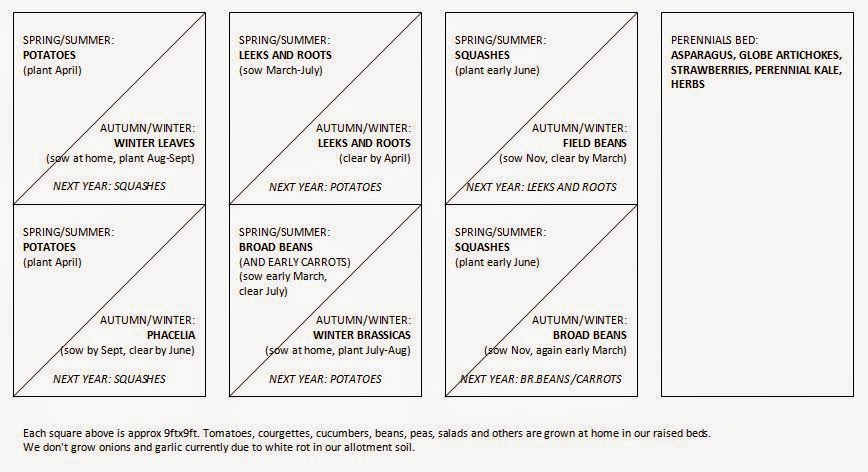
Ladies and gents, I give you our brand new crop rotation plan! (Click pic to enlarge.)
This rotation also allows for two squares to be sown with green manures over winter to add high-nitrogen organic matter to the compost heap, shelter wildlife and protect the soil. Phacelia and field beans are my two favoured green manures since field beans add vital nitrogen to the soil and can be sown as late as November, and phacelia attracts lots of insects and can be sown as late as September. Following squashes with winter-hardy beans means the timing for sowing is perfect; likewise with the winter leaves following the potatoes, and the winter brassicas following the broad beans. And even though we grow most of our beans at home, our allotment soil still gets a nitrogen injection thanks to the broad and field beans. Of course, this rotation doesn't include everything and I should do my best to efficiently rotate our crops at home too, but those on the allotment are the most important ones to rotate: beans for nitrogen, potatoes which are prone to damage from buildups of slugs and eelworms, and brassicas which are susceptible to clubroot, a very nasty fungal disease.
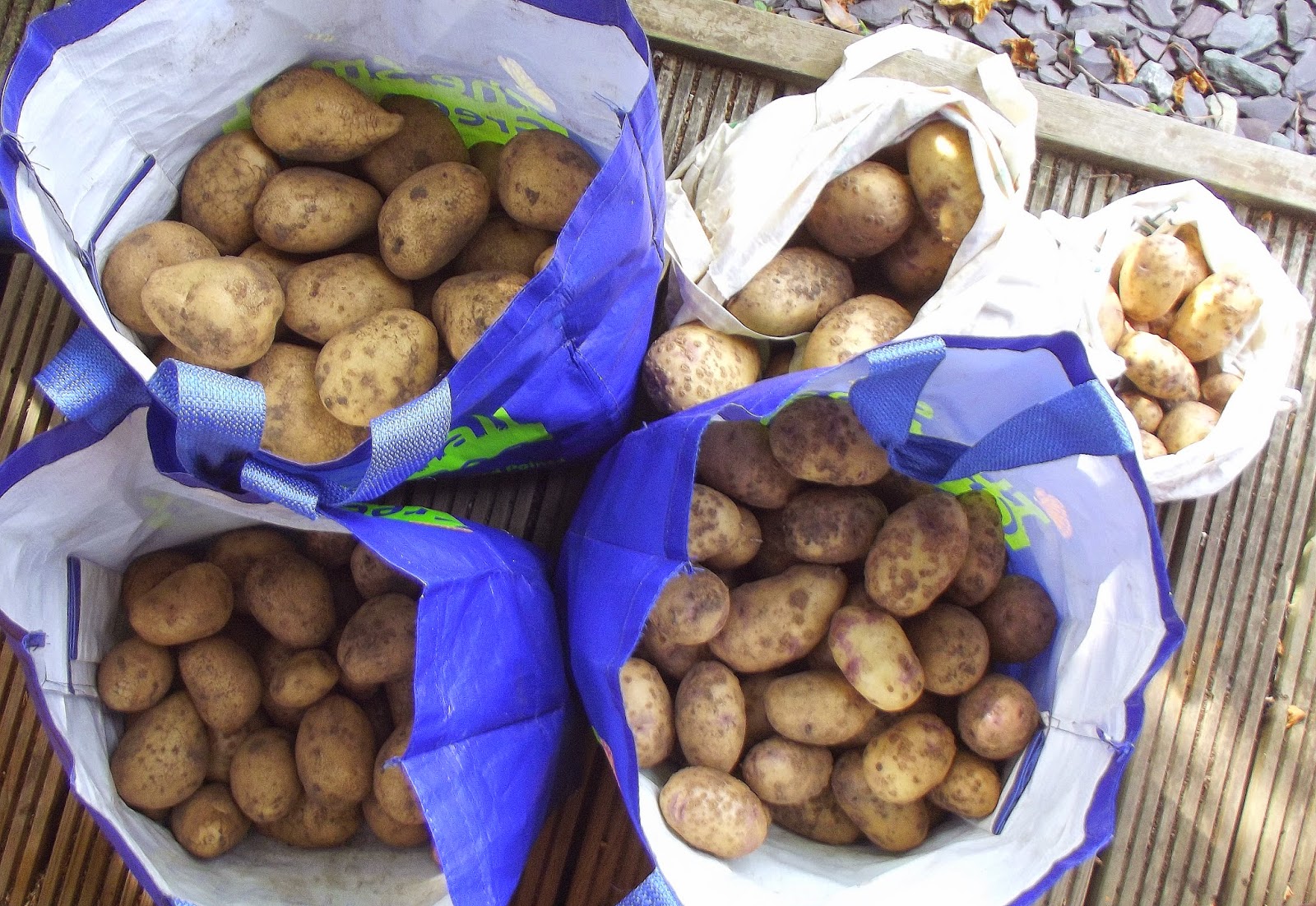
So far it's all going swimmingly. The potatoes are out (an awesome 28kg of Kestrel and 19kg Pentland Crown!) and the winter leaves are in; two rows of chard, two rows of winter spinach and a row of fennel (there's room for more, actually - I must do that). The squashes have finished a little earlier than usual, which means we have plenty of time to clear the soil for winter beans. The leeks, root veg, celery, spring cabbages, kohlrabi and pak choi are coming along nicely and we will slowly harvest them all winter long, making the most of all our space. Brilliant!
There is one complicating factor looming, in that we are planning to clear our old strawberry and asparagus beds (not shown in the plan above) over winter and put them to new use next spring. These two areas don't really fit into the plan so I'm a bit puzzled about what to do with them (and I rather wish we could move our pond and our apple tree into one, which would help us make better use of the other!). Should we grow runner beans or courgettes on the plot again after all? Shall I expand my collection of perennials? Is it time to give in and plant some fruit bushes? Good job I've got all winter to think about it...
Traditionally, the main groups in a crop rotation are potatoes and roots, brassicas, beans, and 'other veg'. The potatoes are manured to enrich and slightly acidify the soil (preventing scab), heavy-feeding beans follow in the nicely broken-up ground after the potatoes are dug, then (often after an application of lime,) leafy brassicas to make good use of the nitrogen the bean roots accumulate. Then, presumably, you throw sweetcorn, cucurbits, tomatoes, leafy greens and everything else in together after that. Sounds simple enough, but questions abound. Do you grow swedes with the root crops or the brassicas? Aren't tomatoes in the same family as potatoes? Cucurbits take up way more space than anything else! And aren't you supposed to avoid manuring carrots?
I don't know, maybe I overthink these things - maybe I'm just too keen to abide by all the rules and to do it "right". But I think, after eight years on our allotment, I've finally cracked it!
This is partly thanks to slimming down the number of crops we grow on the allotment anyway - we don't grow onions and garlic due to white rot spores in our soil, and we prefer to keep salad leaves and quick-ripening summer crops like French beans, courgettes and tomatoes at home so we can pick them more regularly. On the allotment we grow the lower-maintenance stuff: potatoes, squashes, root veg, broad beans, leeks, and a limited amount of winter brassicas and spinach-type leaves (plus some perennials in a permanent area). We've grouped broad beans, leeks and root veg roughly together: together they take up about the same amount of space we use for more space-hungry crops (potatoes and squashes), and it means we can follow our broad beans (which finish around midsummer) with winter brassicas, thus keeping our earlier-sown swedes in the same area as our other brassicas.
Ladies and gents, I give you our brand new crop rotation plan! (Click pic to enlarge.)
This rotation also allows for two squares to be sown with green manures over winter to add high-nitrogen organic matter to the compost heap, shelter wildlife and protect the soil. Phacelia and field beans are my two favoured green manures since field beans add vital nitrogen to the soil and can be sown as late as November, and phacelia attracts lots of insects and can be sown as late as September. Following squashes with winter-hardy beans means the timing for sowing is perfect; likewise with the winter leaves following the potatoes, and the winter brassicas following the broad beans. And even though we grow most of our beans at home, our allotment soil still gets a nitrogen injection thanks to the broad and field beans. Of course, this rotation doesn't include everything and I should do my best to efficiently rotate our crops at home too, but those on the allotment are the most important ones to rotate: beans for nitrogen, potatoes which are prone to damage from buildups of slugs and eelworms, and brassicas which are susceptible to clubroot, a very nasty fungal disease.
So far it's all going swimmingly. The potatoes are out (an awesome 28kg of Kestrel and 19kg Pentland Crown!) and the winter leaves are in; two rows of chard, two rows of winter spinach and a row of fennel (there's room for more, actually - I must do that). The squashes have finished a little earlier than usual, which means we have plenty of time to clear the soil for winter beans. The leeks, root veg, celery, spring cabbages, kohlrabi and pak choi are coming along nicely and we will slowly harvest them all winter long, making the most of all our space. Brilliant!
There is one complicating factor looming, in that we are planning to clear our old strawberry and asparagus beds (not shown in the plan above) over winter and put them to new use next spring. These two areas don't really fit into the plan so I'm a bit puzzled about what to do with them (and I rather wish we could move our pond and our apple tree into one, which would help us make better use of the other!). Should we grow runner beans or courgettes on the plot again after all? Shall I expand my collection of perennials? Is it time to give in and plant some fruit bushes? Good job I've got all winter to think about it...
Thursday, 21 February 2013
Winter catch-up!
By the end of October our garden beds were looking good, full of pak choi, turnips, kale, radishes, winter lettuces, perpetual spinach, kai lan, lamb's lettuce, purple sprouting broccoli and carrots, not to mention self-seeded claytonia everywhere.
The greenhouse was full of pots of rocket, mustard, pak choi, lettuce and spring cabbages.
The saffron came up but didn't flower, which was disappointing. I've been feeding it all winter to try to build it up for next year. I'm not sure whether it's supposed to be this floppy...
On the plot, we had a few leeks doing well, and our over-winter onions and garlic got off to a great start. We even managed to pick a couple of big bags of chickweed for the dinner table, and turned them into a creamy green sauce to serve with rostis and poached eggs with lots of parmesan.
In November, I was given a mushroom growing kit for my birthday, and proceeded to grow lots of lovely pearl oyster mushrooms. The kit, from Fungi Futures, is easy to grow indoors and produces three flushes of mushrooms over a couple of months.
Good, huh? Growing mushrooms like this is fun and a great experience, and it's amazing to watch how fast they grow! This kit makes a great gift, but it's a rather expensive way to get your mushrooms and there must be more cost-effective alternatives to grow them long term... I've always been a bit put-off by 'gourmet' mushrooms as I find some varieties rather rubbery and weird, but now I can safely say I like oyster mushrooms so maybe I'll see what I can do about growing some more...
In December I discovered this wonderful recipe for Seville orange cheesecake - the best orange cheesecake you're ever likely to taste and possibly the bestest ever cheesecake ever. And, being someone who doesn't like traditional fruity spicy Christmas desserts, I made this equally awesome choc-and-nut Christmas pudding for the big day. The recipe is adapted from a Delicious Magazine recipe, but after a trial run I decided there was plenty of room for improvement, so here's my version.
Choc-and-nut Christmas Pudding
In January, during a mild spell, we harvested our Jerusalem artichokes. The crop was smaller than I was expecting - I don't know if they didn't do very well (I didn't notice them flower) or if we just missed them in the heavy clay soil! I read somewhere that they were good for breaking up heavy soils but they were extremely hard to dig and even harder to find, caked in clay! I'll soon find out how many we missed when those we left behind start growing in spring...
I picked a few more bits and pieces from the garden, and was delighted to find I could put a whole meal together with homegrown ingredients - in January!
I slow-roasted some pork shoulder with herbs and red wine til it was fall-apart tender, and served it up with pureed Jerusalem artichokes, fresh patio-grown new potatoes, braised turnips and baby onions (stored from summer), and garlicky kale and chard. It was a fab meal and so satisfying to be able to do that in January, even if it was just the once! The Jerusalem artichokes were a new one on us and we were both very pleasantly surprised by their sweetness and flavour. I do hope we get more next year!
I've had three chilli plants overwintering on my windowsill, all full of fruit which I seem to use up terribly slowly (I'm too used to just chucking some powder in), so I picked them all, strung thread through their stalks and hung them up to dry.
We're in February now and the garden's looking a bit sorry for itself, having spent several weeks under snow recently. My remaining radishes are rotten, the pak choi is bolting (already??), and the outdoor winter lettuces have vanished. The carrots are doing about as well as they always do for me - I might as well give up sowing carrots altogether! The greenhouse lettuces are doing really well, but a late family of caterpillars ate most of the rocket and the rest has now bolted. The broccoli is not really big enough in its containers - I'm getting the feeling it really needs to go in open ground.
I've had quite a few pickings from my winter garden - kale has probably fed me most, and the Jerusalem artichokes and winter potatoes (fleeced on the patio) were definitely worthwhile. There are still quite a few turnips, winter lettuces, lamb's lettuce and pak choi to be eaten, claytonia as always, and some very small spring cabbages which I hope will reach a useful size as spring comes on. The perpetual spinach and chard are just starting to get going again and signs of new growth are everywhere. Hurrah!
And of course, the sowing has begun for the new season, with leeks in pots outside, and slow-growing chillies, peppers and aubergines on the windowsill. I started them early this month - later than last year, as they got a bit much to cope with before planting out, but still early enough, I hope, to give them a decent head start and an earlier crop.
Writing this, I've just remembered I started my first early potatoes about this time last year, and this year I haven't even bought my seed potatoes yet! I must get a move on! The plastic greenhouse is on its last legs, poor thing, and needs replacing, and I must find a pot for the plum tree I've ordered too. I haven't even thought about broad beans yet and I dread to think what the allotment is looking like right now! February 21st? It's practically March!
The greenhouse was full of pots of rocket, mustard, pak choi, lettuce and spring cabbages.
The saffron came up but didn't flower, which was disappointing. I've been feeding it all winter to try to build it up for next year. I'm not sure whether it's supposed to be this floppy...
On the plot, we had a few leeks doing well, and our over-winter onions and garlic got off to a great start. We even managed to pick a couple of big bags of chickweed for the dinner table, and turned them into a creamy green sauce to serve with rostis and poached eggs with lots of parmesan.
In November, I was given a mushroom growing kit for my birthday, and proceeded to grow lots of lovely pearl oyster mushrooms. The kit, from Fungi Futures, is easy to grow indoors and produces three flushes of mushrooms over a couple of months.
Good, huh? Growing mushrooms like this is fun and a great experience, and it's amazing to watch how fast they grow! This kit makes a great gift, but it's a rather expensive way to get your mushrooms and there must be more cost-effective alternatives to grow them long term... I've always been a bit put-off by 'gourmet' mushrooms as I find some varieties rather rubbery and weird, but now I can safely say I like oyster mushrooms so maybe I'll see what I can do about growing some more...
In December I discovered this wonderful recipe for Seville orange cheesecake - the best orange cheesecake you're ever likely to taste and possibly the bestest ever cheesecake ever. And, being someone who doesn't like traditional fruity spicy Christmas desserts, I made this equally awesome choc-and-nut Christmas pudding for the big day. The recipe is adapted from a Delicious Magazine recipe, but after a trial run I decided there was plenty of room for improvement, so here's my version.
Choc-and-nut Christmas Pudding
- Grease a 1.5 litre pudding basin and dust with cocoa powder to prevent sticking.
- Beat together 175g unsalted butter (at room temp), 100g caster sugar and 60g soft brown sugar until light and fluffy.
- Beat three medium eggs into the mix, a little at a time.
- Stir in then sift in 100g plain flour, 45g cocoa powder, 2 tsp baking powder and 1/2 tsp bicarbonate of soda and fold in thoroughly.
- Fold in 50g chopped hazelnuts and 50g ground almonds, 1 tsp vanilla extract, 2 tsp mixed spice, 75ml full-fat milk, the zest of one large orange, and 150g chopped dark chocolate (or dark chocolate chips).
- Pour into the pudding basin and seal with greaseproof paper, foil and string - Lesley Waters shows how here. Then put the pudding basin in a large pan with a lid, add enough hot water to come halfway up the sides of the basin, cover, and simmer for two hours. Make sure the pan doesn't dry out.
- For the sauce, place 125g dark chocolate (broken up) in a jug with 2 tbsp golden syrup and a good splash of brandy. Heat 250ml double cream and 150ml full-fat milk in a pan until almost boiling, then pour over the chocolate and stir until it makes a smooth, glossy sauce. (If it doesn't come together, transfer to a bain marie and keep stirring, or microwave it for a few seconds at a time, stirring in between, until it does.)
- Unwrap the pudding, run a knife carefully round the edge, and turn it out onto a serving plate. Dust with icing sugar or add other decoration as desired, and serve hot with the chocolate sauce.
In January, during a mild spell, we harvested our Jerusalem artichokes. The crop was smaller than I was expecting - I don't know if they didn't do very well (I didn't notice them flower) or if we just missed them in the heavy clay soil! I read somewhere that they were good for breaking up heavy soils but they were extremely hard to dig and even harder to find, caked in clay! I'll soon find out how many we missed when those we left behind start growing in spring...
I picked a few more bits and pieces from the garden, and was delighted to find I could put a whole meal together with homegrown ingredients - in January!
I slow-roasted some pork shoulder with herbs and red wine til it was fall-apart tender, and served it up with pureed Jerusalem artichokes, fresh patio-grown new potatoes, braised turnips and baby onions (stored from summer), and garlicky kale and chard. It was a fab meal and so satisfying to be able to do that in January, even if it was just the once! The Jerusalem artichokes were a new one on us and we were both very pleasantly surprised by their sweetness and flavour. I do hope we get more next year!
I've had three chilli plants overwintering on my windowsill, all full of fruit which I seem to use up terribly slowly (I'm too used to just chucking some powder in), so I picked them all, strung thread through their stalks and hung them up to dry.
We're in February now and the garden's looking a bit sorry for itself, having spent several weeks under snow recently. My remaining radishes are rotten, the pak choi is bolting (already??), and the outdoor winter lettuces have vanished. The carrots are doing about as well as they always do for me - I might as well give up sowing carrots altogether! The greenhouse lettuces are doing really well, but a late family of caterpillars ate most of the rocket and the rest has now bolted. The broccoli is not really big enough in its containers - I'm getting the feeling it really needs to go in open ground.
I've had quite a few pickings from my winter garden - kale has probably fed me most, and the Jerusalem artichokes and winter potatoes (fleeced on the patio) were definitely worthwhile. There are still quite a few turnips, winter lettuces, lamb's lettuce and pak choi to be eaten, claytonia as always, and some very small spring cabbages which I hope will reach a useful size as spring comes on. The perpetual spinach and chard are just starting to get going again and signs of new growth are everywhere. Hurrah!
And of course, the sowing has begun for the new season, with leeks in pots outside, and slow-growing chillies, peppers and aubergines on the windowsill. I started them early this month - later than last year, as they got a bit much to cope with before planting out, but still early enough, I hope, to give them a decent head start and an earlier crop.
Writing this, I've just remembered I started my first early potatoes about this time last year, and this year I haven't even bought my seed potatoes yet! I must get a move on! The plastic greenhouse is on its last legs, poor thing, and needs replacing, and I must find a pot for the plum tree I've ordered too. I haven't even thought about broad beans yet and I dread to think what the allotment is looking like right now! February 21st? It's practically March!
Monday, 2 July 2012
Allotment update. Gah!
I'm finally starting to face up to the fact this is a bad, bad year for growing. Between torrential rain and scorching sun, and thanks to weeds thriving through the mild winter, we still haven't cleared enough earth to plant out our sweetcorn, beans, sunflowers and squashes, and they're languishing and potbound at home. Grass is taking over everything and slugs are eating everything else. We've had the worst asparagus crop ever, and the spring hail that blasted blossoms off fruit trees and bushes is going to mean a pretty poor fruit crop too. All my cucumbers and gherkins (at home) yellowed and died for reasons unknown - I suspect they just couldn't take the prolonged cold, wet, dull weather - cutworms (or something) mowed down 90% of my broad beans, and my shallots have inexplicably gone straight to flower without swelling to any kind of decent size.
At least the potatoes are doing okay.
The garlic is looking good and the onions are doing all right, albeit with rather liberal applications of (organic) slug pellets to try to keep it that way.
And despite a lot of slug damage and a few weeds as always, we're picking plenty of strawberries, which are always a joy.
We've achieved one of our allotment goals at least - we've finally planted up the corner patch we hardly ever use (hard, root-filled soil) with some artichokes, perennial cauliflowers and heritage kales - all planted through weedproof fabric to try to keep things under control...
I'm gradually covering it with stones to protect the fabric (it's gonna take a while!), and plan to plant some sage between the brassicas to try to keep caterpillars at bay - apparently cabbage whites hate the smell. I'll believe it when I see it...
At home, our tomatoes, peppers, courgettes, herbs, mangetout, chard and French beans are doing all right, I've resown a couple of cucumbers, and I might actually manage to grow some aubergines this year - they're loving the extra warmth of the plastic greenhouse - so all is not lost.
But I'm gonna have to accept we're just not going to get everything done on the plot this year. Sigh.
Thursday, 12 April 2012
Nome's First Purple Sprouting Broccoli
Yes, I finally managed to produce some psb this year!
My homegrown seedlings last summer, if you remember, died of... ahem... drought, and I bought some new ones from Homebase later in the year and planted them in big pots in early October. Well, I guess early October was too late, as the plants didn't really get that big. But a couple of them finally produced their first spears a few weeks ago.
I cut them as soon as they got to a decent size, to encourage more shoots. They were delish, even if they didn't add much to a meal!
And the side shoots grew and grew... They were pretty thin, but I thought they might get fatter with time. They didn't.
This morning I went out and cut most of them for breakfast - like asparagus, psb is lovely with eggs.
What a disappointment! Even though the first spears were good, these were bitter and the stems were really stringy and tough! Ugh!
So where did I go wrong? I can't find an answer on the internet. Someone hinted that a mild winter may lead to bitter broccoli, but I haven't heard any other home-growers complaining about theirs. Other than that, I can only think that it might be down to planting out so late, or letting the spears get so tall. Anyone know better?
Luckily I have discovered broccoli leaves are surprisingly good eating (unless they have now gone bitter too) so I'll use the rest of the plants up pronto.
I am determined to do better this year and plant healthy home-grown seedlings out at the proper time!
My homegrown seedlings last summer, if you remember, died of... ahem... drought, and I bought some new ones from Homebase later in the year and planted them in big pots in early October. Well, I guess early October was too late, as the plants didn't really get that big. But a couple of them finally produced their first spears a few weeks ago.
I cut them as soon as they got to a decent size, to encourage more shoots. They were delish, even if they didn't add much to a meal!
And the side shoots grew and grew... They were pretty thin, but I thought they might get fatter with time. They didn't.
This morning I went out and cut most of them for breakfast - like asparagus, psb is lovely with eggs.
What a disappointment! Even though the first spears were good, these were bitter and the stems were really stringy and tough! Ugh!
So where did I go wrong? I can't find an answer on the internet. Someone hinted that a mild winter may lead to bitter broccoli, but I haven't heard any other home-growers complaining about theirs. Other than that, I can only think that it might be down to planting out so late, or letting the spears get so tall. Anyone know better?
Luckily I have discovered broccoli leaves are surprisingly good eating (unless they have now gone bitter too) so I'll use the rest of the plants up pronto.
I am determined to do better this year and plant healthy home-grown seedlings out at the proper time!
Saturday, 25 February 2012
Spring is in the air...
There's no doubt about it - spring is definitely in the air. The birds are singing, the sun is shining, flowers are popping up all over the place and everything is starting to grow again.
It's nice to see the sorrel and chives sprouting fresh new growth.
I know some people are harvesting purple sprouting broccoli by now, but mine still isn't showing any signs. Maybe it didn't get big enough before the winter. I wait with bated breath...
The lamb's lettuce is big enough to eat now, at last. This definitely needs an earlier start next year - and more of it too!
The radishes in the greenhouse haven't done anything worthwhile and are starting to look a bit sickly, but the spring onions have put on excellent growth over winter and are about ready to eat.
The claytonia has been going steady all winter long - I've picked handfuls from time to time, but I could (should) have eaten much more of it! In fact, I think I'd better thin this lot before the kale gets swamped!
The perpetual spinach, too, has kept producing slowly all winter, and I've picked the odd handful to add to veg dishes. The normal spinach did not do so well - something killed all but two of the plants! Next winter I'll make sure I have lots more perpetual spinach and chard going, since they stand so well through cold weather.
Like most gardeners, I'm chomping at the bit to start sowing again. I've already started a few potatoes - three 'Foremost' earlies - in a planter in the shelter of the house. I wouldn't plant them in open soil this early, but in dry fresh compost in a well-drained portable container it's another matter. The right temperature for planting spuds is about 8C, and most of our nights are 7 or higher at the moment, so as long as I protect them if we have another cold snap I reckon we're in with a good chance of a few super-earlies!
I bought six of these huge fold-away planters to use this year, thinking it'd be tidier than hoardes and hoardes of pots, the soil would be deeper, and I could plant lots of things closer together, rather than all in individual containers. The huge bags don't half hold a lot of soil! I don't know how I'm going to fill them all! In the first one I have planted my nine (one went mouldy in the greenhouse during the snow) everbearing 'Albion' strawberries, plus three which were too cramped in a pot in the garden. There's another planter ready and waiting in the background for some early carrots, lettuce, radishes and things, which I'll sow soon under a protective layer or two of fleece...
Oh, and my leek seedlings are doing well. They looked a bit frazzled today because I accidentally left them out in the cold last night, which must have come as a bit of a shock, but they'll recover, and I'm glad they got this head-start.
Can't wait to get stuck into some more sowing...
It's nice to see the sorrel and chives sprouting fresh new growth.
I know some people are harvesting purple sprouting broccoli by now, but mine still isn't showing any signs. Maybe it didn't get big enough before the winter. I wait with bated breath...
The lamb's lettuce is big enough to eat now, at last. This definitely needs an earlier start next year - and more of it too!
The radishes in the greenhouse haven't done anything worthwhile and are starting to look a bit sickly, but the spring onions have put on excellent growth over winter and are about ready to eat.
The claytonia has been going steady all winter long - I've picked handfuls from time to time, but I could (should) have eaten much more of it! In fact, I think I'd better thin this lot before the kale gets swamped!
The perpetual spinach, too, has kept producing slowly all winter, and I've picked the odd handful to add to veg dishes. The normal spinach did not do so well - something killed all but two of the plants! Next winter I'll make sure I have lots more perpetual spinach and chard going, since they stand so well through cold weather.
Like most gardeners, I'm chomping at the bit to start sowing again. I've already started a few potatoes - three 'Foremost' earlies - in a planter in the shelter of the house. I wouldn't plant them in open soil this early, but in dry fresh compost in a well-drained portable container it's another matter. The right temperature for planting spuds is about 8C, and most of our nights are 7 or higher at the moment, so as long as I protect them if we have another cold snap I reckon we're in with a good chance of a few super-earlies!
I bought six of these huge fold-away planters to use this year, thinking it'd be tidier than hoardes and hoardes of pots, the soil would be deeper, and I could plant lots of things closer together, rather than all in individual containers. The huge bags don't half hold a lot of soil! I don't know how I'm going to fill them all! In the first one I have planted my nine (one went mouldy in the greenhouse during the snow) everbearing 'Albion' strawberries, plus three which were too cramped in a pot in the garden. There's another planter ready and waiting in the background for some early carrots, lettuce, radishes and things, which I'll sow soon under a protective layer or two of fleece...
Oh, and my leek seedlings are doing well. They looked a bit frazzled today because I accidentally left them out in the cold last night, which must have come as a bit of a shock, but they'll recover, and I'm glad they got this head-start.
Can't wait to get stuck into some more sowing...
Subscribe to:
Posts (Atom)