Tuesday, 22 March 2011

Sausage and Pumpkin Casserole

I LOVE winter squashes (in case my 'Pumpkin Party' post wasn't evidence enough). They last for ages, and you can do so much with them. They store for so long that, despite a not-that-great harvest, we still have one left! And I thought it was about time we shared this year's favourite pumpkin/squash recipe. The spicy squash stew of last year hasn't had much of a look in this winter, to be honest. It's been all about this:


Sausage and Pumpkin Casserole
(Serves 4. Originally from Matt Tebbutt here, but this is how I make it:)
  • Fry eight sausages in a knob of butter until golden brown all over (5-8 minutes).
  • Add a chopped onion, two or three cloves of garlic (chopped), a big pinch of dried sage, and another knob of butter. Stir and cook 3-5 minutes.
  • Add diced pumpkin/winter squash (something close to 400g). Stir in. 
  • Turn up the heat and add 1 tbsp white wine vinegar. Stir and allow to evaporate for a few minutes.
  • Add 1 tsp sugar, a can chopped tomatoes, a can of cannellini beans (drained and rinsed), another pinch of sage, and enough chicken or veg stock to nearly cover. Season (you probably don't need salt, but be generous with the black pepper).
  • Bring to the boil, then place in a preheated oven at 180C for about an hour. (Keep covered for half an hour, then take the lid off.)

I like to serve this with baked potatoes (just chuck 'em in when the casserole's in the oven) and peas or broccoli.

Oooooh, it's soooo good.

Saturday, 19 March 2011

First Sowings

I know, I know, I'm way behind. The good news is MOST of the things I'm about to tell you about were actually sown a few weeks ago - I just haven't had the time to tell you about it yet.

First, leeks. The past few years I've bought leek seedlings, because of some early catastrophic failures, but this year I decided to grow them from seed again and I'm pleased to report that so far, it's going well.
I've got three varieties on the go for maximum chances of success; Autumn Giant 3, Malabar, and Musselburgh. In the background above you may also be able to make out some very tiny Winter Gem lettuces.

This year I'm growing mostly Angelle tomatoes from the seeds I saved from a supermarket tomato last year. The plants are really compact (straight up, few leaves, not much support needed) so I figured I could grow a lot in a small space. However, they've been rather sickly from the word go and a lot have 'damped off', so now I only have half as many! I'm planning another sowing tomorrow...
I've sown a couple of Hundreds and Thousands (from saved seeds) and Sub Arctic Plenty too, and they're doing fine...

As always, I'm having terrible trouble geting any peppers to germinate - I just don't know what I'm doing wrong! The Jalapenos are okay...
...but my King of the North green peppers, Dedo de Mocha Sweet Aji peepers (smoky flavoured but heat-free, the packet says!), Kaibi no 2 sweet red peppers and Doux Tres Long Des Landes long sweet peppers are showing few signs of life (twenty seeds, one shoot so far...). Perhaps I'll have to invest in one of those heated propogator things after all... Anyone recommend one?

We've been busy sowing on the plot as well, with four rows of broad beans (Bunyards Exhibition and Aquadulce) just about ready to pop up I reckon. In our two raised beds, I've sown a mass of salady veg. In one, French Breakfast radishes, Giant Radishes, Boltardy beetroots, and assorted carrot seeds. (Am I the only one that accumulates bazillions of half-packets of carrot seeds, then still buys new ones each year just in case the old ones don't work? Well this year all the old ones have gone in, all mixed up, and even if half of them don't work I'll still have PLENTY of carrots.) In the other, three varieties of spinach, Bull's Blood beetroot (for leaves), land cress and some Little Gems. These are the beds the foxes like to dig in for some unknown reason, so we finished the job by covering one bed with a spare piece of plastic mesh, and the other one (rather hopefully) with zigzags of string. Fingers crossed...

Wednesday, 16 March 2011

Survivors

It was a particularly harsh winter for most of us, and sadly some plants on the plot that should have overwintered seem to have bitten the dust.

We have just one Purple Sprouting Broccoli plant left, and not looking particularly enthusiastic about it:
And one of the 'Everlasting' cauliflowers is gone, while the growing tip of the other seems to have rotten away to leave a dead crater at the top of the stem. Not sure what this means... Luckily we have a couple of these plants spare, safe but pot-bound at home, so I have replaced the dead one and we'll wait and see what the other does.
It's not all bad though - we were surprised to find some leftover beetroots that withstood the winter in perfect condition! Time to make more chutney! And our parsnips and leeks (which we're still harvesting!) have done stupendously well, and continue to be reliable crops on our plot. I should have photographed the leeks before we ate all the biggest ones! But these are still very reasonably sized, healthy and delicious.
I was pleased to find one of my primroses popping up in a corner. I planted a few but last year they seemed to be losing the battle against the grass. There's no sign of the others.
I thought my perennial sweet peas had lost against either weeds or slugs too, but here they are, struggling away. They were sown last year and never got very big. As soon as I can I will set up some decent support for them and hopefully it won't be too long before we have gorgeous flowers climbing up our compost heap! They don't look like much at the moment though...

Finally, here's our chard making a valiant comeback - hopefully I'll get a few more handfuls of leaves before it goes to flower.
But that's enough about last year's plants... Next, this year's new sowings!

Tuesday, 22 February 2011

Armillatox

Last summer a friendly fellow blogger suggested using Armillatox to combat white rot in my onions. I’d never heard of the stuff before, so off to Google I went to look it up.

Armillatox is sold in the UK and Europe as an all natural, totally biodegradable, non polluting ‘soap-based outdoor cleaner’, intended for use on greenhouses, paths and patios. However, in America and elsewhere exactly the same formulation is popular as a herbicide, pesticide and fungicide, solving problems from black spot to vine weevil to club root and indeed white rot. So why is it not sold as such in the EU? Apparently in 2003, the EU ruled that any garden chemical registered for use before 1993 had to be re-tested, and safety data brought up to date. The cost of such testing was around £3 million – completely prohibitive to many small companies, and as a result more than 80 brands were taken off the shelves purely for economic reasons. (See this Telegraph article for more.)

I hate to use chemicals on my plot, and keep things as natural as I can, but the white rot was only getting worse and I do love my shallots and leeks, and they do say this stuff is completely natural and environmentally friendly. A bit more Googling showed that many UK gardeners still use Armillatox to treat their soil against all kinds of things, and they love it. So out I went and bought a bottle...
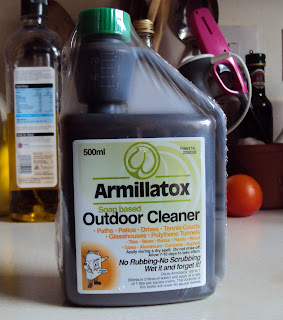

Okay, now for the embarrassing bit. To treat soil for white rot, the (US) product’s website recommends using a dilution of 1:100, and applying 5 litres per square metre. An easy enough calculation, you might think. Well, don’t ask me what was going on in my addled brain yesterday when it came to applying the stuff, but I got it wrong. Waaaaay wrong… I think I put 6 or 7 times too much of the stuff on. I was mortified when I realised and spent the rest of the evening in a state of misery, combing the internet for signs of hope. Was my soil ruined? Would I have to wait 7 times as long before I plant my onions? (The recommended period is three weeks after application.)

Some people said as long as we got a few heavy rain showers it’d be fine. Some said my onions might taste of the stuff. Some pointed out that using anything not licensed as a pesticide/fungicide as such was illegal (a fair point, actually, but it’s exactly as illegal as making your own soap-spray or garlic infusion to ward off greenfly, and show me a gardener who’s never done that). A certain major UK gardening forum promptly told me off and locked my thread to prevent further discussion; a rather unfriendly overreaction considering I was just asking for advice. And some told me they most certainly wouldn’t eat vegetables grown on soil contaminated with carcinogenic coal tar, thank you very much.

Well, that was a new one. Off I went to Google again. But there’s even more confusion on that matter…

Coal tar, traditionally used in soap and in treating nasty skin conditions, especially psoriasis, and also commonly used in food additives, cosmetics and for coating playgrounds and car parks, was withdrawn from many products (information is painfully vague) in the EU in 2006.

Cancer scientists say that preparations with more than 5% crude coal tar are carcinogenic. (Remember Armillatox’s recommended dilution is 1:100, and it can’t all be crude coal tar. With the amount of water applied too, not even my accidental overdose would have come close to 5%. Oh, and I'm putting it on my soil, not my skin.) But evidence is apparently sketchy, with results of animal tests completely unsupported by evidence in humans, and controversy everywhere. Psoriasis sufferers are certainly keen to insist it is not harmful.

Environmentalists say that coal tar releases harmful PAHs (polycyclic aromatic hydrocarbons) into the environment. But PAHs are everywhere in our environment anyway; they’re released by any combustion of carbon-based fuels. Wood, coal, diesel, cigarettes, incense… oh, and by grilling, frying or smoking food. Studies on places where coal tar was used industrially but then banned show no reduction in PAH levels even five years later. PAHs also occur in space, and some scientists believe they may have more than a little to do with how we all got here in the first place. Seems a little like banning beaches to protect us from sun exposure to me.

Then I received a pleasant and reassuring message from the makers of Armillatox:

“Don't worry, it will not have contaminated your soil - Armillatox is totally biodegradable. …Leave 21 days before planting your onions and you should have no adverse effects.”

Well, now. They didn’t reprimand me for unlicensed use and are quite happy for me to plant in the treated soil. But then, perhaps they thought I was American; my email address doesn't really give anything away...

Confused? So am I.

But if anyone has any wisdom to share, please do, because I’ve got 100 Stuttgarter Giant onions, a load of Picasso shallots and French Cledor garlic and three varieties of Leek seedlings (Malabar, Musselburgh, Autumn Giant 3) preparing to go into that plot and I'm still kinda worried…


Update: Since this is one of my most-viewed blog posts, I thought I should update it with the results of this little accidental experiment! I'm pleased to say that my onions etc. had no funny taste and didn't seem to be at all affected by the armillatox. However, it didn't stop my white rot problem either!

Friday, 18 February 2011

Winter Veg

It's so satisfying, in the middle of winter, when we feel we've been neglecting the plot terribly, to go down there and see the rows of parnsips, swedes and leeks still standing faithfully waiting to be harvested! The past few weeks we've feasted on parsnip soup, parsnip bread, roasted root veg, creamed leeks - and we're still getting through the autumn's squash as well.

Parsnips seem to grow particularly well on our plot and with very little care. Here is just a fraction of our 'White Gem' crop.
 Of course, they're not all perfect.

The swedes suffer quite a lot of slug damage, but there are still plenty for us too.

And I was worried about our leek crop back in the autumn as there seemed to be a lot of onion flies on them - not something we've suffered before - but the cold weather seemed to see them all off, and the leeks have made a terrific recovery with very few signs of damage. Looks like I forgot to take any pictures of them yet, but I can show you the delicious creamed leeks I served here with cheese and chive mash and a lovely piece of lemon-and-herb-crusted pollack.
I used roughly the recipe from Sarah Raven's Garden Cookbook, but it's a fairly standard recipe: just slice your leeks finely, fry gently in butter and olive oil for a few minutes until soft, then stir in double cream, a little mustard (I love wholegrain) and some salt and pepper. I do believe I sloshed in some white wine too, letting it reduce before I added the cream. Sarah's recipe calls for a sprinkle of chervil at the end, but sadly I didn't have any.
Related Posts Plugin for WordPress, Blogger...